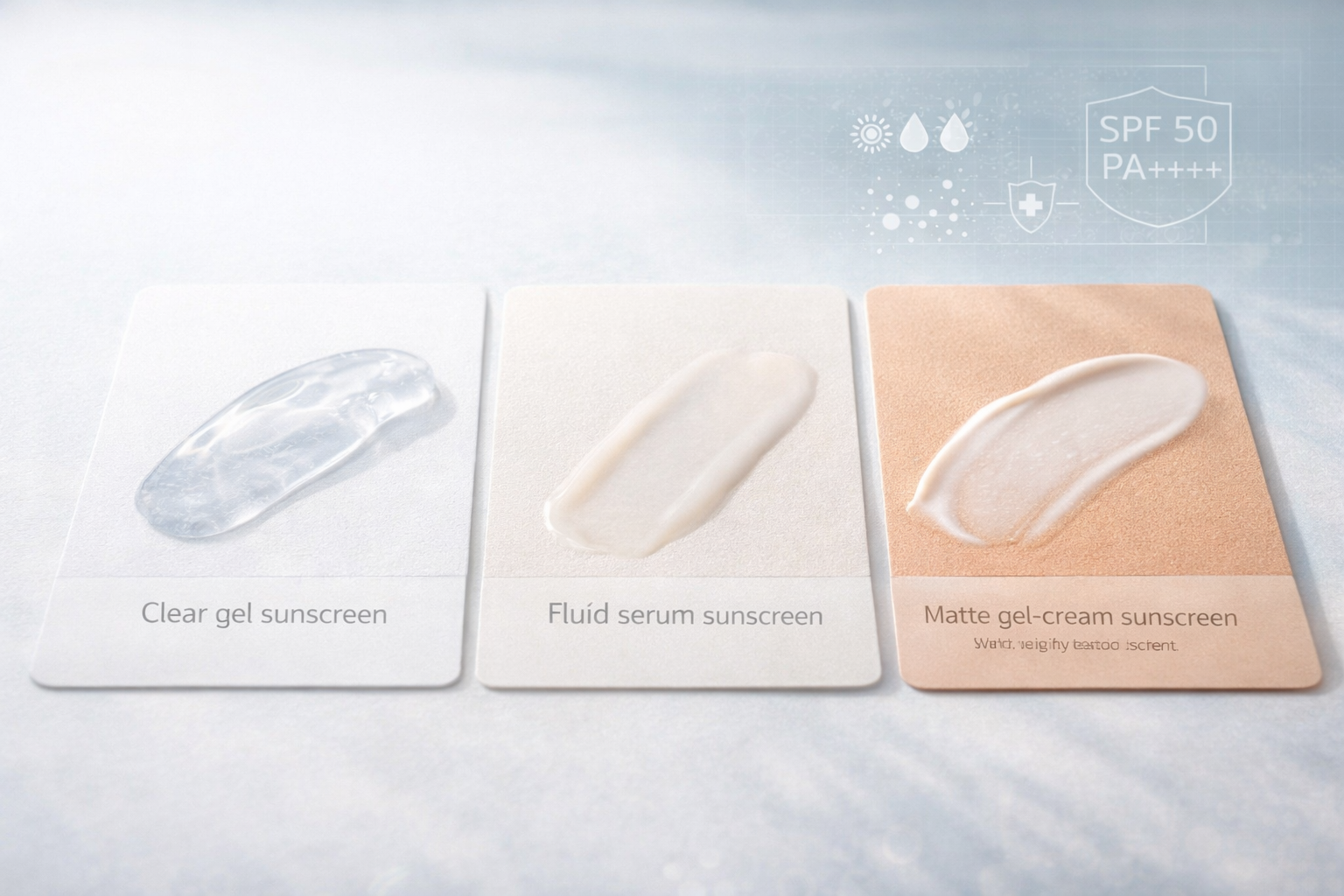
SECTION 1 — Why Oily Skin Needs Different Sunscreen in Thailand
Oily skin in a temperate climate (like New York or London) behaves completely differently than oily skin in Thailand’s tropical zone. The difference is thermal-induced hyper-seborrhea.
- The +10% Rule: Clinical research shows that for every 1°C rise in skin temperature, the sebum excretion rate increases by 10%. In Bangkok (35°C avg), your skin produces 30-40% more oil than it does in a 20°C office.
- Sebum Liquefaction: Heat lowers the viscosity of your natural oils (sebum). Instead of sitting in the pore, the oil flows rapidly onto the skin surface, mixing with sweat.
- The “Comedogenic Soup”: In high humidity, sweat cannot evaporate. It mixes with this liquid sebum and your sunscreen’s emulsifiers. This mixture creates an occlusive, stagnant pool that swells the keratinocytes around the pore (poral occlusion), leading to “tropical acne” or Acne Aestivalis.
The takeaway: You don’t just need “oil-free”; you need a sunscreen engineered to handle high-volume liquid flow without clogging or sliding off.
SECTION 2 — How Standard Sunscreen Can Worsen Oily Skin
Most Western sunscreens fail on oily skin in Thailand because of Occlusion.
- Film Formers: To make sunscreens water-resistant, brands often use heavy polymers (acrylates) that form a plastic-like wrap on the skin. On oily skin, this traps the increased sebum production inside the pore.
- Emollients: Ingredients like Isopropyl Myristate or Cocoa Butter are used to make sunscreens spreadable. In heat, these feel suffocating and greasy.
- The “Shine Amplifier”: Chemical filters (like Avobenzone) are naturally oily. When mixed with your own sebum, they create a reflective surface that makes the face look wet, not just dewy.
SECTION 3 — What Makes Thai Sunscreens Ideal for Oily Skin
Thai formulators have developed specific technologies to combat the “Tropical Melt”:
- Water-Break Matrix: Instead of a cream, Thai sunscreens use a “Water Serum” structure. The oil-soluble UV filters are encapsulated in a water-based gel. Upon contact with the skin, the gel breaks, releasing water that evaporates (cooling the skin) while leaving a micro-thin layer of filters.
- Micronized Oil Sponges: Thai formulas for oily skin (like Srichand) often contain Kaolin, Silica, or Polymethylsilsesquioxane. These are microscopic porous spheres that sit on the skin surface and physically absorb sebum as it exits the pore, maintaining a matte finish for hours.
- Fast Volatility: They use high-volatility solvents (safe alcohols) that flash off instantly, preventing the “sticky” phase that traps dust and pollution.
SECTION 4 — Best Sunscreen Textures for Oily Skin
| Texture | Viscosity | Oil Control | Tropical Feel | Verdict |
|---|---|---|---|---|
| Water Serum | Low (Water-like) | Moderate | Excellent | Best for daily wear; breathable. |
| Bi-Phase Milk | Very Low (Runny) | High | Good | Best for extreme humidity/sports. Contains powders. |
| Gel-Cream | Medium | Low-Mod | Good | Good for dehydrated-oily skin (AC environments). |
| Essence | Low-Med | Low | Moderate | Can be sticky in 90% humidity. Avoid if very oily. |
| Stick | Solid | High | Poor | Waxy texture can clog pores if used as primary layer. |
SECTION 5 — SPF & PA for Oily Skin in Tropics
For oily skin, PA++++ (UVA Protection) is critical for acne prevention, not just anti-aging.
- Sebum Oxidation: UV rays (specifically UVA) oxidize Squalene (a lipid in your sebum) into Squalene Peroxide.
- The Acne Trigger: Squalene Peroxide is highly comedogenic and inflammatory. It signals the pore to hyper-keratinize (clog).
- The Solution: You need high antioxidant protection + high PA++++ to stop this oxidation chain reaction. Low UVA protection = More blackheads.
SECTION 6 — Sunscreen Ingredients for Oily & Acne Skin
Look for these “Hero Ingredients” in Thai INCI lists:
- Zinc PCA: Used in Srichand Green. It inhibits 5-alpha reductase (the enzyme that triggers oil production) and kills C. acnes bacteria.
- Niacinamide (Vit B3): Regulates sebum and reduces the redness of existing pimples. Found in Her Hyness and Clear Nose.
- Silica / Kaolin: Physical oil absorbers.
- Salicylic Acid (BHA): Keeps pores clear while you wear the sunscreen.
- Tea Tree / Centella: Anti-inflammatory agents to cool “heated” skin.
SECTION 7 — Best Thai Sunscreens for Oily Skin (By Need)
1. The “Matte King” (Best Oil Control)
Product: Srichand Sunlution Acne Care Sunscreen (Green Tube)
- Why: It is basically a seboregulating treatment disguised as sunscreen.
- Tech: Contains Salicylic Acid (BHA) and Gluconolactone (PHA) to exfoliate dead skin cells that trap oil.
- Finish: Natural Matte. Zero stickiness.
- Best For: Active acne, teenage skin, extremely oily T-zones.
2. The “Invisible Shield” (Best Lightweight)
Product: MizuMi UV Water Serum (Blue Bottle)
- Why: It has the texture of water. No silicone heaviness.
- Tech: 100% Non-Chemical filters (Zinc Oxide/Titanium Dioxide) in a water base.
- Finish: Semi-Matte (Skin-like).
- Best For: Sensitive oily skin that reacts to chemical filters.
3. The “Budget Performer” (Best Value)
Product: Mistine Aqua Base Ultra Protection Matte & Light
- Why: Uses “Aqua Base” technology to feel weightless. Very affordable.
- Tech: High silica content for slip and oil absorption.
- Finish: Dry Touch.
- Best For: Daily commuting, body application.
4. The “Acne Eraser” (Best for Scars)
Product: Clear Nose UV Sun Serum
- Why: Formulated specifically for “acne-prone” skin, with a focus on fading dark spots (PIH).
- Tech: 7-Free gentle formula (no alcohol/steroids) + 15x Amino acid booster.
- Finish: Light Gel.
- Best For: Adult acne, post-acne marks.
5. The “Reef Safe” Choice
Product: Her Hyness Royal Hya Water Sunscreen
- Why: Clean beauty standard. No clogging silicones.
- Tech: Encapsulated UV filters that don’t irritate pores.
- Finish: Glow (but non-greasy).
- Best For: Dehydrated oily skin (oily surface, dry underneath).
SECTION 8 — Thai vs. Western Oily-Skin Sunscreens
| Feature | Thai (e.g., Srichand) | Western (e.g., La Roche Posay) |
|---|---|---|
| Texture | Water-Serum / Milk | Dry-Touch Cream / Gel-Cream |
| Alcohol | Often used for “flash dry” (safe types) | Used heavily or avoided (heavy feel) |
| Mattifying Agent | Silica / Kaolin / Zinc | Perlite / Airlicium |
| White Cast | Minimal (Tone-up options available) | None (Chemical) or High (Mineral) |
| Humidity Wear | Excellent (Breathable) | Good, but can feel “sweaty” underneath |
| Price | $10 – $15 | $30+ |
SECTION 9 — How to Apply Sunscreen on Oily Skin in Humidity
- Skip the Moisturizer: In Thailand, high-humidity air provides hydration. A “Water Serum” sunscreen is moisturizing enough. Applying a separate cream moisturizer under sunscreen is the #1 cause of greasiness and pilling for oily skin.
- The “Blot then Reapply” Method:
- Do not layer sunscreen over a greasy face. It will slide off.
- Step 1: Use an oil blotting sheet (or tissue) to remove excess sebum.
- Step 2: Apply the fresh layer of sunscreen.
- Step 3: (Optional) Dust with Srichand Translucent Powder to reset the matte finish.
- Double Cleanse at Night: Even “lightweight” sunscreens contain polymers that cling to the skin. You must use an oil cleanser or micellar water before your foam cleanser to prevent clogged pores.
SECTION 10 — Common Mistakes (Oily Skin in Thailand)
- Using “Cream” Textures: Avoiding alcohol is generally good, but in Thailand, alcohol-free creams often rely on heavy oils to dissolve filters. A little alcohol in a gel formula helps it dry before it mixes with sebum.
- Trusting “Dewy” Labels: “Dewy” in Korea = “Oil Slick” in Thailand. Avoid anything labeled “Glow,” “Rich,” or “Moist” if you have oily skin.
- Not Washing Off Body Sunscreen: Using heavy body sunscreens (like Banana Boat) on the face is a guarantee for a breakout. Keep body and face products separate.
FAQ
Q: Is Thai sunscreen good for oily skin?
A: Yes, possibly the best in the world. They are formulated for a population that deals with extreme heat and humidity daily, prioritizing lightweight, non-sticky textures.
Q: Does SPF 50 worsen acne?
A: Not if you choose the right formula. In fact, UV protection prevents acne scars from turning dark (PIH) and reduces inflammation. Ingredients like Salicylic Acid in Srichand actually treat acne while protecting.
Q: Can I use Gel sunscreen if I have sensitive oily skin?
A: Yes. Look for MizuMi Blue. It is a gel-serum texture but uses physical filters (Zinc), making it non-irritating and non-clogging.
Q: What is the best matte sunscreen in Thailand?
A: Srichand Sunlution Acne Care (Green) offers the most “dry” matte finish. Mistine Aqua Base is a close second.
Q: Will these leave a white cast on tan skin?
A: Clear Nose, Srichand, and Her Hyness are chemical/hybrid formulas and leave zero white cast. MizuMi (Physical) has a slight initial cast that fades, but it is much better than Western mineral sunscreens.
Q: Is sweat-proof sunscreen bad for pores?
A: Water-resistant formulas (“Milks”) are harder to wash off and can clog pores if not removed properly. Use them only for beach/sports. For daily city use, a “Water Serum” is safer for acne-prone skin.
Q: Can I use makeup over Thai sunscreens?
A: Yes. “Water Serums” act as excellent primers. They smooth the skin surface without the slippery silicone feel of Western primers.
Citations:
Clinical data on sebum excretion rate increasing 10% per 1°C rise in temperature.
Sebum oxidation mechanism: UV rays oxidize squalene into comedogenic squalene peroxide.
Srichand Sunlution Acne Care ingredients: Zinc PCA, Salicylic Acid, Gluconolactone for oil control.
Mistine Aqua Base ingredients: Silica function as mattifying agent.
MizuMi UV Water Serum formulation: Non-chemical filters in water-break matrix.
Clear Nose UV Sun Serum: 7-Free formula and acne-specific claims.