SECTION 1 — Why Sunscreen in Thailand Is Different
Thailand is a “Tropical Crucible” for skincare. The challenge here is not just UV intensity, but the combination of Extreme UV + High Humidity + Heat.
- The UV Index: Thailand averages a UV Index of 11-12 (Extreme) year-round. In contrast, a “high” UV day in London or Seattle might reach 6 or 7. This means burn time (erythema dose) is less than 15 minutes for unprotected skin.
- The “Double Exposure” Effect: In coastal areas (Phuket, Krabi), UV rays are not just coming from the sky. Sand reflects up to 25% of UV radiation, and sea foam reflects about 25%. You are being hit from above and below.
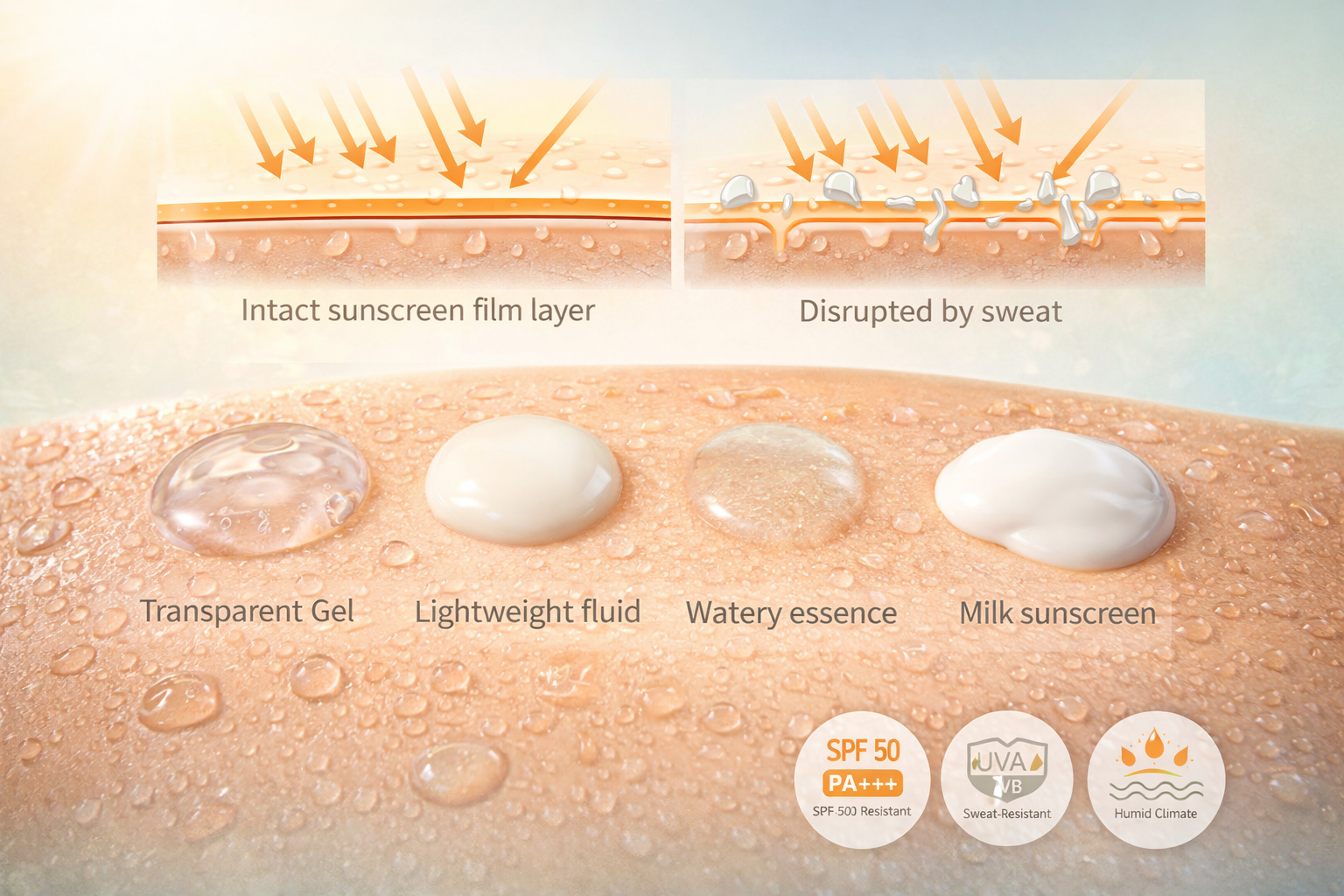
- Hyper-Hidrosis (Excessive Sweating): In 90% humidity, sweat does not evaporate; it accumulates. This creates a “wash-off” effect that is chemically different from swimming. It is a constant, low-level solvent erosion of your sunscreen film.
The Result: A sunscreen that protects you perfectly in Paris or New York may fail in Bangkok within 45 minutes because the vehicle (the cream base) collapses under thermal stress, even if the filters are strong.
SECTION 2 — How Heat & Humidity Change Sunscreen Performance
Understanding why sunscreens fail in Thailand requires looking at Film Formation Dynamics.
- Sweat Dilution & Re-Emulsification: Most Western sunscreens are Oil-in-Water (O/W) emulsions. When you sweat, the water from your pores pushes against the sunscreen film. In high humidity, traditional emulsifiers can “re-activate,” grabbing the sweat and mixing it into the sunscreen layer, turning your protective film into a milky, patchy soup.
- Sebum Liquefaction: At 35°C (Thailand’s average high), human sebum becomes less viscous (more liquid). This liquefied oil acts as a solvent, dissolving oil-soluble chemical filters (like Avobenzone) and causing them to migrate into “clumps,” leaving microscopic gaps on your skin exposed to UV.
- SPF Decay: Heat increases the kinetic energy of molecules. Some chemical filters (especially older ones like Avobenzone without stabilizers) degrade faster in high heat, losing their ability to absorb UV photons more quickly than in cooler climates.
Expert Insight: “In Thailand, Film Durability > SPF Value. An SPF 30 that stays on your face in 90% humidity is infinitely better than an SPF 100 that slides off into your collar.”
SECTION 3 — What Makes Thai Sunscreens Unique
Thai formulators have engineered solutions specifically for this climate, often borrowing “Water Serum” technology from Japan but adapting it for extreme heat.
- Water-Break Technology: These formulas look like creams but “break” into water droplets upon application. This uses volatile silicones and water-soluble polymers to create a cooling effect (evaporative cooling) that lowers skin temperature, reducing immediate sweating.
- Micronized Oil-Absorbers: Thai sunscreens often contain high loads of Silica or Polymethylsilsesquioxane powders. These don’t just mattify; they physically absorb the sebum that would otherwise dissolve the sunscreen film.
- Hybrid Filter Architecture: They rarely rely on just one type of filter. They mix Tinosorb S/M (highly stable oil-soluble) with Phenylbenzimidazole Sulfonic Acid (water-soluble). By putting filters in both the oil and water phases of the cream, they ensure protection remains even if one phase is compromised by sweat.
SECTION 4 — SPF & PA++++ in Tropical UV
In the US and Europe, we focus on SPF (UVB/Burning). In Asia, the PA system (UVA/Aging) is king.
- UVA is the “Silent Killer” in the Tropics: UVB (Burning) intensity drops when it’s cloudy. UVA (Aging/Cancer) penetrates clouds and glass with consistent intensity year-round in Thailand.
- The “+” System:
- PA+: PPD 2-4 (Minimal)
- PA++: PPD 4-8 (Moderate)
- PA+++: PPD 8-16 (Good)
- PA++++: PPD 16+ (Superior)
- The Rule: In Thailand, never buy anything less than PA++++. The UVA flux is simply too high. A PA+++ sunscreen allows too much aging radiation to pass through during a full day of island hopping.
SECTION 5 — Best Sunscreen Textures for Thailand Climate
| Texture | Climate Performance | Best For… |
|---|---|---|
| Water Serum / Gel | Excellent. Evaporates fast, leaves breathable film. Best for humidity. | City walking, daily wear, oily skin. |
| Milk (Shake-type) | Good. High content of powders and silicones makes them very water-resistant. | Beach, outdoor sports, heavy sweating. |
| Essence | Moderate. Often too moisturizing for Bangkok heat. Can feel sticky. | Dry skin, air-conditioned offices. |
| Cream | Poor. Traps heat, induces sweating, feels “suffocating” (occlusive). | Only for dry skin or night use (not applicable). |
| Stick | Good for Touch-ups. Waxy barrier resists sweat but can feel heavy if used as a primary layer. | Reapplication over makeup. |
SECTION 6 — Sunscreen for Oily Skin in Humidity
If you have oily skin, Thailand’s humidity is your enemy.
- The Physiology: Heat enlarges pores and increases oil flow.
- The Solution: Look for “Soft Matte” finishes (e.g., Mistine, Srichand).
- Avoid: “Dewy” or “Glow” finishes popular in Korea. In Thailand, “Dewy” looks like “Greasy” within 20 minutes.
- Ingredient Tip: Look for Niacinamide in your sunscreen. It helps regulate sebum production while you wear it.
SECTION 7 — Thai Sunscreen Ingredients & Filters
Thai sunscreens utilize next-generation filters often unavailable in the USA.
| Filter | INCI Name | Why it’s superior in Thailand |
|---|---|---|
| Tinosorb S | Bis-Ethylhexyloxyphenol Methoxyphenyl Triazine | Photostable oil-soluble filter. Does not degrade in heat. Covers UVA & UVB. |
| Uvinul A Plus | Diethylamino Hydroxybenzoyl Hexyl Benzoate | Superior UVA protection. Replaces Avobenzone (which stings eyes) in many Thai formulas. |
| Titanium Dioxide | Titanium Dioxide (Nano/Micronized) | Used in “Tone-Up” sunscreens. Reflects UV and absorbs oil. |
| Zinc Oxide | Zinc Oxide | The primary filter for “Sensitive” and “Reef Safe” formulas (MizuMi). |
SECTION 8 — Best Thai Sunscreens by Climate Use
- Best for City/Daily (Bangkok Heat):
- Her Hyness Royal Hya Water Sunscreen: Zero grease, disappears instantly.
- MizuMi UV Water Serum (Blue): 100% physical, zero white cast, great for sensitive skin.
- Best for Beach/Water (Phuket/Krabi):
- MizuMi UV Water Active Sport (Orange): Very water-resistant, adheres to wet skin.
- Mistine Aqua Base Ultra Protection: Cheap, durable, body-friendly.
- Best for Acne-Prone Skin:
- Srichand Sunlution Acne Care (Green): Contains Salicylic acid to prevent clogging.
SECTION 9 — How to Apply Sunscreen in Tropical Climate
The “2-Finger Rule” is Mandatory.
Because “Water Serums” are so light, it is easy to under-apply. You need two full finger lengths of product for your face and neck.
The “Layering” Technique for Humidity:
- Don’t rub vigorously. Spread it evenly and let it set. Rubbing can break the forming film.
- Wait 10 minutes before going out. In high humidity, volatiles (alcohol/water) take longer to evaporate. If you sweat before the film sets, you ruin the protection.
- Set with Powder. Use a translucent powder (like Srichand) to “lock” the sunscreen. This absorbs the first wave of sweat and keeps the film intact.
SECTION 10 — Thai vs. Western Sunscreens in Heat
| Feature | Thai Sunscreen | Western (US/EU) Sunscreen |
|---|---|---|
| Texture | Watery, vanishing, cooling. | Thick, creamy, often greasy. |
| Film Feel | Breathable (Non-occlusive). | Heavy (Occlusive). |
| White Cast | Minimal (even with minerals). | High (minerals) or none (chemical). |
| Eye Sting | Low (Newer filters). | High (Avobenzone). |
| Durability | Optimized for Sweat/Humidity. | Optimized for Water Immersion (Pools). |
Winner for Thailand: Thai Sunscreens. Western ones often cause “Prickly Heat” (heat rash) because they trap sweat under a heavy occlusive layer.
SECTION 11 — Travel Sunscreen Guide: Thailand
- What to Pack: Bring one bottle of your trusted “heavy duty” waterproof sunscreen for the first beach day.
- What to Buy: Buy your daily facial sunscreen in Thailand (7-Eleven, Watsons). It will be cheaper and better suited for the climate.
- Storage: NEVER leave sunscreen in a parked motorbike or car. The internal temperature can reach 60°C, effectively cooking the emulsion and separating the filters. Keep it in your hotel room.
SECTION 12 — Reef-Safe Sunscreen in Thailand (Legal Warning)
Strict Regulations:
Since August 2021, the Thai Department of National Parks has banned sunscreens containing:
- Oxybenzone (Benzophenone-3)
- Octinoxate (Ethylhexyl methoxycinnamate)
- 4-Methylbenzylid Camphor (4MBC)
- Butylparaben
Fine: Up to 100,000 THB ($2,800 USD).
Safe Options:
- MizuMi (Blue/Orange) is fully compliant.
- Look for “Mineral” or “Physical” sunscreens (Zinc/Titanium).
- Avoid: Standard Nivea/Banana Boat bottles brought from home unless they explicitly state “Reef Safe” and exclude the above ingredients.
SECTION 13 — Common Sunscreen Mistakes in Thailand
- “I applied it in the morning.” -> In Thailand, sweat breaks the film by 11:00 AM. You must reapply or use a spray/powder SPF at lunch.
- “It’s cloudy.” -> UV Index is still 10+. You will burn.
- Using Body Sunscreen on Face. -> Body sunscreens in Thailand are often thicker and fragranced. They will cause acne in the humidity.
- Missing the “Sears.” -> The back of the neck and tops of feet are the #1 burn spots for tourists.
FAQ
Q: Is SPF 50 enough for Thailand?
A: Yes. SPF 50 blocks 98% of UVB. The difference between SPF 50 and SPF 100 is marginal (1%). The texture matters more: if SPF 100 is sticky, you won’t apply enough. Stick to SPF 50 PA++++.
Q: Can I use Thai sunscreen on kids?
A: Yes. Look for MizuMi Kids or Dermapon. They are gentle and widely available.
Q: How do I remove water-resistant sunscreen?
A: You need a Double Cleanse. Use a Micellar Water or Oil Cleanser first, then a foam cleanser. Water alone will not remove polymer-based Thai sunscreens.
Q: What if I get sunburned?
A: Go to a pharmacy and buy Aloe Vera Gel (usually 99% pure, clear green or white tub). Keep it in the fridge. Do not use oils (coconut oil) on fresh burns; it traps heat.
Q: Are “Whitening” sunscreens safe?
A: Yes. They usually just contain Niacinamide or Gluta to prevent tanning. They won’t bleach your skin.
Q: What is the best sunscreen for tattoos?
A: Use a Stick Sunscreen (balm type) on tattoos. The wax base protects the ink better than lotions.
Q: Can I carry sunscreen in carry-on?
A: Only if under 100ml. Thai airport security is strict. Most Thai sunscreens are sold in 30-40ml sizes, perfect for travel.
Q: Is mineral or chemical better for Thailand?
A: Hybrid is best. Pure mineral can be heavy and sweat off white streaks. Pure chemical can sting eyes. Thai Hybrids (like Her Hyness) offer the best of both worlds.
Citations:
Thai National Parks Sunscreen Ban (Oxybenzone, Octinoxate, 4MBC, Butylparaben).
Thailand UV Index data (11-12 average) and seasonal variation.
Scientific mechanisms of sunscreen film failure in high humidity (sweat dilution, re-emulsification).
Sebum liquefaction and “pilling” mechanism in tropical climates.
MizuMi and Her Hyness formulation technology (Water Serum, Non-Chemical).
Formulation strategies for tropical climates (Water-break technology).