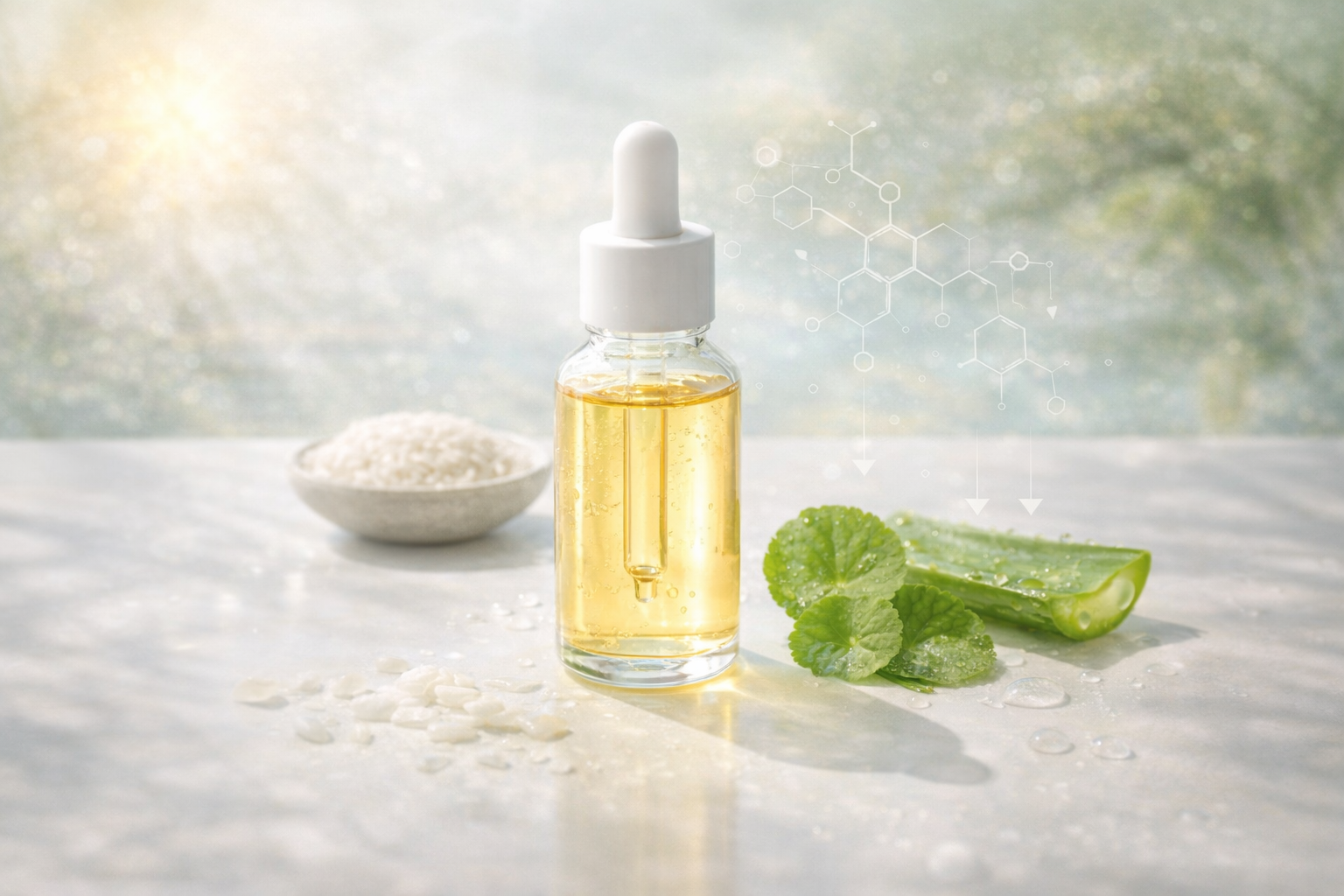
SECTION 1 — Why Vitamin C Is Essential in Thailand’s Climate
In a temperate climate, Vitamin C is a “nice-to-have” anti-aging ingredient. In Thailand’s UV Index 11+ environment, it is a daily survival essential.
- The “Double-Oxidation” Threat: Your skin faces two oxidation fronts in the tropics:
- External UV Flux: High UVB intensity generates direct free radicals (Reactive Oxygen Species) on the skin surface.
- Internal Heat Stress: High ambient temperature (35°C+) increases metabolic activity in the skin, producing internal free radicals that degrade collagen faster than in cooler climates.
- Melanin Hyper-Activation: Heat alone stimulates melanocytes. Without an antioxidant shield (Vitamin C), the combination of heat + UV creates stubborn “Tropical Melasma” that sunscreen alone cannot fully prevent.
SECTION 2 — How Vitamin C Works in Skin
- Tyrosinase Inhibition: Vitamin C binds to the active site of Tyrosinase (the enzyme that makes pigment), preventing it from converting Tyrosine into Melanin. This stops dark spots before they form.
- Photoprotection Synergy: Vitamin C is not a sunscreen, but it neutralizes the free radicals that sunscreen filters miss. Applying Vitamin C under SPF boosts your UV protection factor by neutralizing oxidative stress.
- Collagen Banking: It is a cofactor for the enzymes Prolyl Hydroxylase and Lysyl Hydroxylase, which are required to cross-link collagen fibers. Without C, new collagen is weak and degrades rapidly in the sun.
SECTION 3 — Vitamin C Forms in Thai Serums
Thai formulators have largely abandoned pure L-Ascorbic Acid (L-AA) because it rots in the heat. Instead, they use Heat-Stable Derivatives.
| Vitamin C Form | INCI Name | Stability in Heat | Potency | Irritation | Best For |
|---|---|---|---|---|---|
| Ethyl Ascorbic Acid (EAA) | 3-O-Ethyl Ascorbic Acid | Excellent (Stable up to 45°C) | High (Metabolizes fast) | Low | The “Gold Standard” for Thai serums. |
| Ascorbyl Glucoside | Ascorbyl Glucoside | Very Good | Medium (Needs conversion) | Very Low | Sensitive skin & daily use. |
| L-Ascorbic Acid (L-AA) | Ascorbic Acid | Poor (Oxidizes in days in humidity) | Very High | High | Only if stored in a fridge (rare in Thai beauty). |
| Niosome C | Encapsulated Ascorbic Acid | Good | High | Low | New tech used by brands like MizuMi. |
| Triple C | EAA + Glucoside + Caprylyl | Excellent | High (Multi-pathway) | Low | Maximum brightening (e.g., Gravich). |
SECTION 4 — Vitamin C Stability in Humid & Hot Climate
The biggest enemy of Vitamin C is Hydrolysis (breakdown by water).
- The Humidity Problem: In 90% humidity, every time you open a dropper bottle of L-Ascorbic Acid, moisture enters. This water accelerates oxidation, turning the serum brown (ineffective) within 2 weeks.
- The Thai Solution: Thai brands use Ethyl Ascorbic Acid because it is lipophilic (oil-loving) and water-stable. It does not hydrolyze easily, meaning a bottle kept in a warm Bangkok bathroom stays clear and active for months.
SECTION 5 — Thai Vitamin C Serum Textures
Texture dictates compliance. If it’s sticky, you won’t wear it in the heat.
- Water Serum (The Winner): Brands like Gravich and Srichand use ultra-light, alcohol-free water bases that evaporate instantly, leaving the Vitamin C behind without a sticky residue.
- Ampoule: Concentrated “shots” (like Srichand Super C) designed for night use. Slightly tackier but higher potency.
- Avoid: Heavy “Dry Oils” or silicone-based Vitamin C suspensions. In humidity, these trap heat and cause “Vitamin C Acne.”
SECTION 6 — Best Thai Vitamin C Serums (The Authority List)
1. The Stability King (Best Overall)
Product: Gravich Triple Vitamin C Booster Serum
- Chemist’s Verdict: A masterclass in stability. It combines 3 derivatives: 3-O-Ethyl Ascorbic Acid, Ascorbyl Glucoside, and Caprylyl 2-Glyceryl Ascorbate.
- Why: It hits pigmentation from three angles without oxidizing.
- Texture: Water-light, zero sticky residue.
2. The Potency Powerhouse (Best for Dark Spots)
Product: MizuMi Advance Niosome C
- Chemist’s Verdict: Uses Niosome Technology to encapsulate 3% Vitamin C. This allows it to penetrate deeper than standard serums (3-10x better absorption) without irritation.
- Why: It is clinically proven to reduce spots in 14 days due to enhanced delivery.
- Texture: Milky white serum.
3. The Budget Hero (Best Daily Use)
Product: Srichand Super C Brightening Intense Serum
- Chemist’s Verdict: Pairs Vitamin C with Sea Buckthorn (a natural source of C and E).
- Why: It includes Niacinamide to buffer the potential irritation of Vitamin C, making it safe for daily morning use.
- Texture: Gel-fluid.
4. The Sensitive Skin Choice
Product: Ingu 4D-Brightening Booster Serum
- Chemist’s Verdict: Formulated by a researcher who understands irritation. It uses gentler derivatives plus 4% Niacinamide and Coffee Bean Extract.
- Why: Focuses on reducing inflammation (redness) which often precedes pigmentation.
- Texture: Hydrating milk.
5. The Clinical Classic
Product: Yanhee Vitamin C Serum
- Chemist’s Verdict: From the famous Yanhee Hospital. A simple, no-nonsense formula using Ascorbyl Glucoside and Aloe Vera.
- Why: Extremely safe. It won’t give you “glass skin” overnight, but it slowly brightens without breaking you out.
- Texture: Clear gel.
SECTION 7 — Thai Ingredients Combined with Vitamin C
Thai serums rarely use Vitamin C alone. They use Synergistic Boosters.
- Vitamin C + Centella (Cica): The “Cool & Bright” combo. Cica reduces the heat/inflammation, allowing Vitamin C to work on pigment without triggering redness.
- Vitamin C + Rice Milk: Rice provides ceramides to buffer the skin barrier, preventing the “drying” effect some Vitamin C forms have.
- Vitamin C + Alpha-Arbutin: The ultimate “Whitening” duo. Arbutin stops the enzyme; Vitamin C cleans up the mess. Found in Srichand.
SECTION 8 — Thai Vitamin C vs. Western vs. Korean
| Feature | Thai (e.g., Gravich) | Western (e.g., Skinceuticals) | Korean (e.g., Klairs) |
|---|---|---|---|
| Main Form | Ethyl Ascorbic Acid | L-Ascorbic Acid | Ascorbic Acid (Low %) |
| Stability | High (Heat Resistant) | Low (Oxidizes fast) | Low-Medium |
| Texture | Water-Break (Non-sticky) | Oily/Tacky | Dewy/Glossy |
| pH Level | pH 4.5–5.5 (Gentle) | pH 2.5–3.5 (Stinging) | pH 3.5–5.0 |
| Packaging | Droppers/Pumps | Dark Glass | Clear/Dark Bottles |
Verdict: For tropical living, Thai serums are superior because they don’t spoil in your bathroom cabinet.
SECTION 9 — How to Use Thai Vitamin C in Tropical Routine
The “Antioxidant Sandwich” Method:
- Cleanse: Use a gentle gel cleanser.
- Vitamin C Serum: Apply to dry skin. Wait 2 minutes for it to absorb.
- Hydrator: (Optional) If you have dry skin, add a Hyaluronic Acid serum. Oily skin can skip this.
- Sunscreen (Critical): Seal it with an SPF 50. The Vitamin C makes the SPF work harder; the SPF stops the Vitamin C from oxidizing on your face.
Storage Tip: Even though Thai serums (EAA) are stable, storing them in the fridge extends their life and provides a cooling application that shrinks pores in the morning.
SECTION 10 — Common Vitamin C Mistakes in Hot Climate
- Buying “Fresh” L-Ascorbic Acid: Unless you can guarantee it was refrigerated during shipping and will be kept in your fridge, avoid pure L-AA in Thailand. It likely arrived partially oxidized.
- Applying to Wet Skin: Vitamin C penetrates best at a specific pH. Water on the face dilutes the acid and raises the pH, reducing efficacy.
- Mixing with Benzoyl Peroxide: If you treat acne, use Benzoyl Peroxide at night and Vitamin C in the morning. Mixing them neutralizes the antioxidant power.
FAQ
Q: Does Thai Vitamin C whiten skin?
A: It “brightens” by fading tan and spots, returning you to your natural baseline tone. It does not bleach skin beyond your genetic limit.
Q: Can I use it if I have acne?
A: Yes. Sodium Ascorbyl Phosphate (SAP) is a form used in some Thai serums that is antimicrobial and fights acne bacteria. Gravich is acne-safe.
Q: Why is my serum turning yellow?
A: If it’s L-Ascorbic Acid, throw it away; it’s oxidized. If it’s Ethyl Ascorbic Acid (like Gravich), a slight yellow shift is normal and safe, but dark brown means it’s expired.
Q: Is 20% better than 10%?
A: Not in the tropics. High percentages can cause irritation, which leads to inflammation and more pigment (PIH). 10-15% of a stable derivative is the sweet spot.
Q: Can I use Niacinamide with Thai Vitamin C?
A: Yes. Modern Thai formulas (like Ingu and Srichand) actually combine them in the same bottle. The myth that they “cancel each other out” is outdated science based on pure L-AA at high heat.
Citations:
Stability comparison: Ethyl Ascorbic Acid vs. L-Ascorbic Acid in high heat/humidity conditions.
Gravich Triple Vitamin C formulation analysis (3-derivative blend for stability).
MizuMi Niosome technology and efficacy of encapsulated Vitamin C.
Ingu serum formulation (Niacinamide synergy and low-irritation profile).
Srichand Super C ingredients (Sea Buckthorn, Niacinamide, Alpha-Arbutin synergy).
Yanhee Vitamin C Serum formulation (Ascorbyl Glucoside safety).