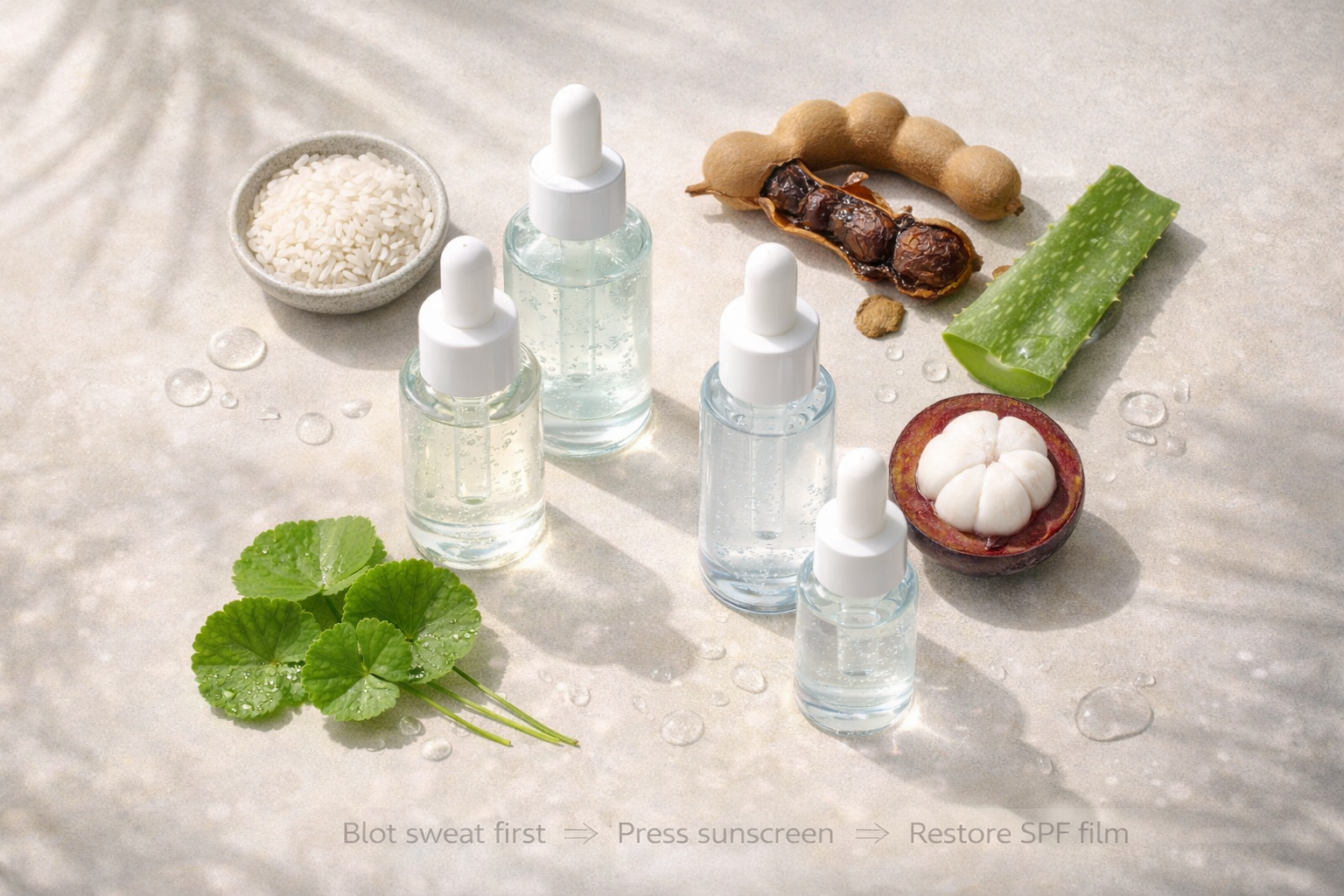
SECTION 1 — What Defines Thai Serums
A serum in Paris is designed to combat cold winds and dry heating. A serum in Bangkok is designed for a completely different enemy: The Tropical Crucible.
Thai serums are unique because they must deliver high-potency actives (like 15% Niacinamide or pure Alpha-Mangostin) without creating a “sweat barrier.” In 90% humidity, standard glycerin-heavy Western serums feel sticky and suffocate the pores (occlusion).
- The “Flash-Break” Texture: Thai serums use Polymeric Emulsifiers that break into water immediately upon contact with the skin. This lowers skin temperature and allows actives to penetrate before sweat washes them away.
- The Brightening Obsession: Due to intense UV indices (11+), Thai serums are aggressively focused on Tyrosinase Inhibition (stopping pigment). They don’t just “glow”; they target the biological pathway of melanin production triggered by heat.
SECTION 2 — Types of Thai Serums
- Brightening / Whitening: The most popular category. Focuses on fading sun spots, acne scars (PIH), and reversing “dullness” caused by sebum oxidation.
- Hydrating (Water-Based): Designed to replace water lost through sweating. Unlike Western serums that use heavy oils to seal moisture, these use Humectants (Hyaluronic Acid, Snow Mushroom) that bind water without grease.
- Acne & Oil Control: Formulated for “Tropical Acne”—breakouts caused by the mix of heat, sweat, and pollution.
- Barrier Repair: A newer category (led by brands like Ingu and Her Hyness) that focuses on repairing the stratum corneum damaged by UV and over-exfoliation.
SECTION 3 — Thai Brightening Serum Science
In Thailand, “Brightening” is not a marketing term; it is a chemical necessity. High heat stimulates melanocytes even without UV exposure.
- Mechanism: Thai serums often use a “Multi-Pathway” approach.
- Pathway 1: Stop Melanin Production (Alpha-Arbutin, Turmeric).
- Pathway 2: Stop Melanin Transfer (Niacinamide).
- Pathway 3: Exfoliate Surface Pigment (Tamarind/AHA).
- Radiance vs. Whitening: Modern Thai serums (post-2020) focus on Radiance (even tone) rather than bleaching skin shades lighter, moving away from dangerous mercury-laden street creams of the past.
SECTION 4 — Thai Hydrating Serum Technology
How do you hydrate skin that is already sweating?
- The “Humectant Web”: Thai serums use multi-molecular weight Hyaluronic Acid. The small molecules penetrate deep to hydrate, while the large molecules form a breathable net on top that doesn’t trap heat.
- Bio-Ferments: Ingredients like Galactomyces are popular because they hydrate like an oil but feel like water.
- Sweat Compatibility: Formulas are pH-balanced to remain stable even when mixed with slightly acidic sweat (pH 4.5–5.5).
SECTION 5 — Thai Treatment Serums
- Acne (Mangosteen): Thai chemists have unlocked the power of Garcinia Mangostana. The peel contains Alpha-Mangostin, a xanthone that kills C. acnes bacteria and reduces inflammation faster than Tea Tree Oil, without the burning sensation.
- Pore Tightening: In heat, pores dilate. Serums use Witch Hazel and Fomes Officinalis (Mushroom) extract to physically tighten the pore lining, reducing oil flow.
SECTION 6 — Traditional & Herbal Thai Serum Ingredients
These are not just “folk remedies”; they are clinically validated phytochemicals.
| Ingredient | Source | Bioactive Compound | Skin Benefit |
|---|---|---|---|
| Tamarind | Tamarindus indica | Tartaric Acid (AHA) | Gentle exfoliation, breaks down dead skin cells for glow. |
| Turmeric | Curcuma longa | Tetrahydrocurcumin | Potent antioxidant, inhibits tyrosinase (pigment), reduces acne redness. |
| Mangosteen | Garcinia mangostana | Xanthones | “The Queen of Fruits” for acne. Anti-bacterial and anti-inflammatory. |
| Rice | Oryza sativa | Gamma-Oryzanol | Ceramide-rich, strengthens skin barrier, softens texture. |
| Butterfly Pea | Clitoria ternatea | Anthocyanins | High antioxidant protection against UV damage. |
SECTION 7 — Modern Actives in Thai Serums
Thai brands effectively blend tradition with clinical actives.
- Niacinamide (Vitamin B3): The “Holy Grail” of Thai skincare. It controls oil, brightens skin, and strengthens the barrier—solving the three biggest tropical skin problems at once.
- Hyaluronic Acid (8-Molecule): Brands like Her Hyness use complex HA blends to provide “injectable-like” hydration topically.
- Succinic Acid: A rising star for acne that is gentler than Salicylic Acid, perfect for sensitive skin in heat.
SECTION 8 — Thai Serum Textures for Tropical Climate
| Texture | Viscosity | Skin Feel | Best For… |
|---|---|---|---|
| Water Serum | Very Low | Disappears instantly. | Oily skin, Morning routine. |
| Ampoule | Medium | Potent, slight tackiness. | Night routine, Spot treatment. |
| Emulsion | Low-Med | Milky, moisturizing. | Dry skin, replaces moisturizer. |
| Essence | Low | Watery, refreshing. | Layering first step. |
Verdict: For humidity, Water Serums are superior. They allow your sweat glands to function normally while delivering actives.
SECTION 9 — How to Choose Thai Serum by Skin Type
- Oily / Acne: Look for Mangosteen or Zinc PCA serums. Texture should be “Watery.” (e.g., Oxecure, MizuMi).
- Dry / Dehydrated: Look for Rice Milk or Hyaluronic Acid. Texture can be “Milky.” (e.g., Her Hyness).
- Sensitive: Look for Centella (Cica) or Aloe. Avoid high % AHAs. (e.g., Ingu, MizuMi).
- Pigmentation: Look for Tamarind and Alpha-Arbutin. (e.g., Gravich, Srichand).
SECTION 10 — Thai Serums in Skincare Routine
Morning (The “Shield” Routine):
- Cleanser
- Thai Vitamin C / Brightening Serum (Antioxidant protection)
- Sunscreen (No moisturizer needed if serum is hydrating).
Evening (The “Repair” Routine):
- Double Cleanse
- Thai Exfoliating Serum (Tamarind) OR Barrier Serum
- Light Gel Moisturizer.
SECTION 11 — Thai Serum Brands Guide
1. MizuMi (The Clinical Choice)
- Hero: Advance Niacinamide 15 Concentrate Serum.
- Focus: High % actives without irritation. 5-Free safety standard.
2. Her Hyness (The Clean Luxury)
- Hero: Bio-Peptide Advanced Youth Plus Glow Serum.
- Focus: Royal Jelly + Peptides. Botox-like effects without needles. “Clean Beauty” standard.
3. Ingu (The Science Disrupter)
- Hero: 4D-Acne Clearing Toner/Serum.
- Focus: Barrier health. Uses Encapsulated Salicylic Acid and Thai Green Tea.
4. Gravich (The Ingredient Specialist)
- Hero: Triple Vitamin C Booster.
- Focus: Single-ingredient focuses (like The Ordinary) but formulated for Thai skin. Affordable and effective.
5. Srichand (The Oil Control Expert)
- Hero: Skin Moisture Burst Serum.
- Focus: Hydration for oily skin that doesn’t cause clogging.
SECTION 12 — Thai vs. Korean vs. Western Serums
| Feature | Thai Serum | Korean Serum | Western Serum |
|---|---|---|---|
| Texture | Ultra-light / Water-break | Dewy / Gel-like | Silicone / Oil-based |
| Finish | Matte / Satin | Glass Skin (Shiny) | Silky / Tacky |
| Key Active | Whitening (Arbutin/Tamarind) | Barrier (Snail/Cica) | Anti-Aging (Retinol/Vit C) |
| Climate | Tropical (Humid) | Temperate (Dry Winter) | Varied |
Verdict: If you live in a hot, humid place, Thai serums will feel better and perform better than sticky Korean “glass skin” serums.
SECTION 13 — Common Myths About Thai Serums
- Myth: “Thai serums contain bleach.”
- Fact: Legitimate brands (sold in Watsons/Boots) use safe, FDA-approved brighteners like Niacinamide and Arbutin. Only illegal street market creams contain mercury.
- Myth: “Herbal serums are weak.”
- Fact: Thai herbal serums often use concentrated extracts (e.g., 99% pure Centella). They are pharmaceutical grade, not just “tea water.”
- Myth: “They are sticky.”
- Fact: Only cheap supermarket sachets might be sticky. Pharmacy brands (MizuMi, Ingu) are engineered to be non-sticky in 90% humidity.
FAQ
Q: Can I use Thai serums with Retinol?
A: Yes. Many Thai serums (like Her Hyness) are designed to be hydrating buffers used before or after your Retinol to prevent irritation.
Q: What is the best Thai serum for dark spots?
A: Look for serums containing Tamarind (natural AHA) combined with Alpha-Arbutin. Gravich and MizuMi make excellent spot-correcting serums.
Q: Are Thai serums vegan?
A: Many are (like Ingu and MizuMi). However, brands using Royal Jelly (Her Hyness) or Snail Mucin (Snail White) are not vegan. Check the label.
Q: Where can I buy authentic Thai serums?
A: Buy from official stores on Shopee/Lazada (if in SE Asia) or YesStyle/Stylevana for global shipping. Avoid random eBay sellers to prevent fakes.
Citations:
Efficacy of Turmeric and Tamarind in tyrosinase inhibition and skin brightening.
Clinical studies on Mangosteen Peel extract (Alpha-Mangostin) for acne treatment.
Comparative analysis of Thai vs. Western/Korean textures for humid climates.
Ingredient breakdown of Ingu vs. MizuMi vs. Her Hyness serums.
Bioactivity of Thai herbal ingredients (Tamarind AHAs, Rice Gamma-Oryzanol).