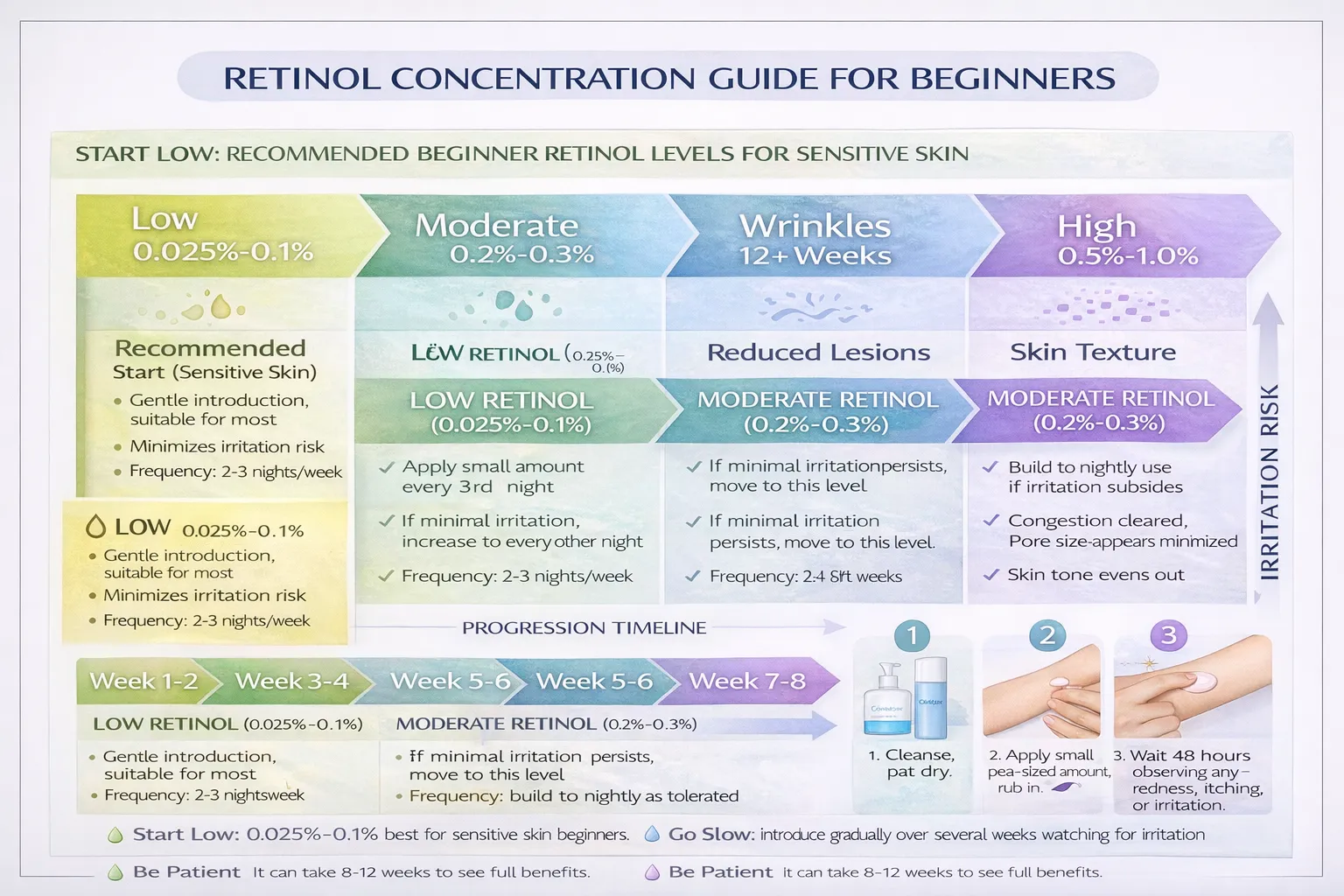
The promise of retinol is undeniable-smoother texture, fewer wrinkles, clearer skin, and a more youthful glow. Yet if you have sensitive skin, rosacea, eczema, or a history of irritation, the prospect of using retinol feels terrifying. You’ve read the horror stories: severe redness, peeling so intense you can’t leave the house, burning sensations that last for weeks.
Here’s the truth that dermatologists rarely emphasize enough: retinol is not off-limits for sensitive skin. It’s a matter of how you introduce it.
This guide addresses the exact fears that keep people with sensitive skin away from retinol. We’ll show you not just whether it’s safe (it is), but how to use it without triggering a reactive nightmare. You’ll learn the safety protocols that dermatologists recommend, the specific techniques that minimize irritation, and a realistic timeline for results. By the end, you’ll understand your skin’s relationship with retinol better than 95% of users.
Understanding Retinol & Sensitive Skin
What Is Retinol?
Retinol is a form of vitamin A-specifically, a fat-soluble compound that exists naturally in animal-based foods like liver and eggs. In skincare, retinol appears in cosmetic products as a stable, relatively gentle derivative of vitamin A. Think of it as a precursor: your skin must convert retinol through two enzymatic steps before it becomes the active form, retinoic acid, which is what actually triggers cellular changes.
This conversion process is important. The multi-step pathway means retinol acts slower than prescription retinoids but with significantly less irritation potential, making it the entry point for most people with sensitive skin.
How Retinol Works
Retinol’s mechanism of action centers on cellular turnover and collagen production. When retinol reaches the epidermis and dermis, it binds to retinoic acid receptors, triggering a cascade of effects:
- Increases cell turnover: Retinol accelerates the shedding of dead skin cells and encourages the formation of new, healthier cells. Clinical studies show this happens within days of application, though visible results take weeks.
- Stimulates collagen synthesis: Retinol activates fibroblasts (collagen-producing cells) to increase collagen I and III production, reversing the collagen breakdown caused by sun damage and aging.
- Regulates sebum production: For acne-prone skin, retinol reduces excess oil and unclogs pores by normalizing skin cell differentiation.
- Improves barrier function: Paradoxically, while retinol can initially dry skin, long-term use strengthens the skin barrier by promoting the production of ceramides and other lipids.
- Fades hyperpigmentation: Retinol inhibits melanin production and accelerates the removal of melanin-containing dead skin cells, gradually lightening dark spots and evening skin tone.
These effects don’t happen overnight. The timeline is gradual-measured in weeks and months, not days. This gradual process is actually advantageous for sensitive skin because it allows your skin to adapt.
Why Does Sensitive Skin React to Retinol?
Sensitive skin reacts to retinol for three primary reasons:
- Increased cell turnover: Retinol accelerates the shedding of skin cells. For a compromised or inflamed barrier, this rapid turnover can feel overwhelming, triggering temporary redness, dryness, and peeling as dead cells accumulate on the surface.
- Barrier disruption: Retinol increases transepidermal water loss (TEWL)-the amount of water that escapes through the skin barrier. For sensitive skin with an already weakened barrier, this moisture loss manifests as tightness, flaking, and irritation.
- Retinization: The formal term for retinol adjustment is “retinization,” a temporary inflammatory response that typically occurs within the first two weeks of use. Your skin is essentially getting used to a new stimulus. This is normal and usually resolves with consistent, gentle use.
The key insight: these reactions are usually temporary and manageable with proper technique. They are not a sign that retinol is incompatible with your skin-they’re a sign that you need to slow down and buffer.
Can Sensitive Skin Benefit from Retinol?
Absolutely. In fact, the conditions most common in sensitive skin-rosacea, eczema, acne-prone skin, post-inflammatory hyperpigmentation-are precisely where retinol delivers profound benefits.
A landmark clinical study on sensitive skin formulations (including patients with eczema, rosacea, and cosmetic intolerance syndrome) demonstrated that retinol-based regimens significantly improved skin smoothness, clarity, radiance, and overall appearance without severe adverse events. Another 2024 study showed that formulations combining retinol with complementary ingredients (like niacinamide and peptides) reversed visible signs of aging in sensitive skin with excellent tolerability.
The difference between “sensitive skin cannot use retinol” and “sensitive skin needs a modified retinol protocol” is enormous. This guide focuses on the latter.
Is Retinol Safe for Sensitive Skin?
Clinical Evidence
The safety profile of retinol at appropriate concentrations is well-established. The European Commission Scientific Committee on Consumer Safety (SCCS) concluded that retinol at 0.3% concentration in face and hand creams is safe for cosmetic use. The same guidance applies to the United States, where the Cosmetic Ingredient Review Panel has approved retinol and retinyl palmitate as safe at typical use concentrations.
A 2022 clinical study specifically examined tolerability of 0.3% retinol in a gradual introduction protocol. Results showed that 88.7% of participants tolerated the product with mild or no reactions, with symptoms fully resolving by week 8. In contrast, when participants used 1% retinol without buffering, only 62.1% reported mild or tolerable reactions, and 35% experienced moderate reactions.
This single study highlights the power of concentration and application technique.
For sensitive skin specifically, clinical trials demonstrate that retinol formulations combined with barrier-supporting ingredients (ceramides, niacinamide, hyaluronic acid) are not only safe but effective, with 84% of participants reporting improved skin texture after just four weeks.
Who Should Avoid or Delay Retinol
While retinol is generally safe, certain conditions warrant caution or postponement:
Do not use retinol if you:
- Are pregnant or planning to become pregnant (vitamin A overdose poses teratogenic risk; the SCCS recommends women of childbearing age consult healthcare providers)
- Are currently using isotretinoin (Accutane) for severe acne (interaction risk)
- Have severe, active dermatitis or are experiencing a major skin flare (wait until inflammation resolves)
- Are allergic to retinol or any ingredient in the formulation
Proceed with extra caution if you:
- Have rosacea in an active flare phase (introduce after rosacea is stable; retinol can help once controlled)
- Are using other prescription retinoids (tretinoin, adapalene) without dermatologist oversight
- Have recently undergone professional treatments (peels, laser, microneedling)-wait 1-2 weeks
- Are taking systemic medications that increase photosensitivity
The bottom line: For most people with sensitive skin, the question is not “should I use retinol?” but rather “how should I introduce retinol safely?” The answer lies in the seven safety rules below.
Risk Mitigation Strategies
The most effective risk mitigation is dose and frequency management combined with barrier support. Clinical evidence shows:
- Starting at 0.025–0.3% concentration significantly reduces irritation risk compared to higher strengths.
- Using the sandwich method (moisturizer + retinol + moisturizer) maintains 88% of retinol bioactivity at the gene expression level while substantially reducing irritation perception.
- Introducing retinol at 1-2 times per week initially, then gradually increasing frequency, allows the skin barrier to adapt progressively.
- Pairing retinol with niacinamide (4-5%) reduces irritation by up to 68% while enhancing barrier function.
These strategies work because they respect your skin’s adaptation timeline rather than forcing immediate results.
The 7 Safety Rules for Retinol on Sensitive Skin
Rule 1: Start with 0.025–0.3% Concentration
The specific number matters.
Retinol concentration directly correlates with irritation risk. Here’s the evidence-based breakdown:
- 0.025–0.1%: Gentlest, ideal for sensitive skin and first-time users. Expect slower results but minimal irritation.
- 0.2–0.3%: Moderate strength, suitable for sensitive skin after 2-4 weeks of adjustment to 0.025–0.1%.
- 0.5–1%: Stronger, typically reserved for non-sensitive skin or experienced users. Requires careful buffering even for tolerant skin.
The EU has recently capped retinol at 0.3% in cosmetic products specifically due to safety concerns. This concentration represents the sweet spot: potent enough for visible results within 8-12 weeks, gentle enough for sensitive skin when introduced properly.
Do not start with 0.5% or 1% retinol if you have sensitive skin. This is the #1 mistake that creates the “retinol burn” horror stories. You will experience excessive irritation, may abandon retinol entirely, and will have missed the opportunity to build a sustainable routine.
Action: Choose a product labeled 0.025%, 0.1%, or 0.3% retinol. If the label doesn’t specify concentration, avoid it.
Rule 2: Perform a 48–72 Hour Patch Test
Before applying retinol to your entire face, test it on a small, hidden area.
How to patch test:
- Cleanse a small area behind your ear, on your inner arm, or on your jawline (hidden from view).
- Allow skin to dry completely (wait 20 minutes after cleansing).
- Apply a pea-sized amount of retinol product using the buffering technique (see Rule 4).
- Observe for 48–72 hours. Note any redness, itching, burning, or swelling.
If you experience only mild tingling or slight dryness, proceed cautiously to full-face application. If you experience burning, blistering, or significant redness, discontinue and wait 1-2 weeks before retesting with a lower concentration or more buffering.
This simple step prevents full-face reactions and confirms your skin can tolerate the specific formulation.
Rule 3: Use the Sandwich Method (Buffering Technique)
The sandwich method is the single most effective technique for minimizing retinol irritation while preserving efficacy.
How it works:
The sandwich method involves layering moisturizer, retinol, and moisturizer again. Recent dermatological research (2025) found that this “open sandwich” approach (one layer of moisturizer + retinol) preserves 88% of retinol bioactivity at the gene expression level while substantially reducing irritation symptoms.
Step-by-step application:
- Cleanse and completely dry your face (wait 20 minutes). Apply toner or essence if desired.
- Apply a thin layer of moisturizer (about the size of a chickpea for the entire face). Wait 2-3 minutes for absorption.
- Apply retinol serum or cream in a pea-sized amount, gently pressing into skin. Avoid the eye area, lips, and corners of the nose.
- Wait 3-5 minutes.
- Apply another layer of moisturizer over the retinol (the “top slice”). This final layer locks in hydration and further reduces direct retinol exposure.
Why this works: The first moisturizer layer slows retinol penetration, allowing gradual absorption rather than aggressive, deep penetration. The second layer occludes (seals in) moisture and provides additional buffering.
Is the sandwich method less effective? No. Recent 2025 AAD research directly addressed this concern. An open sandwich (moisturizer + retinol in either order) maintains retinoid bioactivity at nearly 100%, while full sandwiching reduces bioactivity by about 30%-still more than enough for visible results. The trade-off is worth it for sensitive skin.
Rule 4: Apply to Completely Dry Skin
This is non-negotiable.
One of the most common mistakes is applying retinol to damp or slightly moist skin, believing that moisture aids ingredient penetration. For retinol, this is backwards logic and causes significant irritation.
Retinol penetrates more aggressively into moist skin, reaching deeper layers and overwhelming the dermis. This intensifies irritation, especially for sensitive skin.
Protocol:
- Cleanse your face.
- Wait 20 minutes for skin to air-dry completely. Do not pat dry with a towel immediately; air drying ensures complete dryness.
- Only then apply toner, essence, and buffering moisturizer.
- Apply retinol.
This single change-waiting for skin to fully dry-can reduce irritation by 30-50% without any other modifications.
Rule 5: Follow the Introduction Schedule (Weeks 1–8)
Gradual introduction is key to building tolerance without triggering retinization.
Weeks 1–2: Foundation Phase
- Frequency: 1 time per week
- Technique: Sandwich method (required)
- Expectations: Possible mild dryness, slight tightness. Your skin is adapting to the stimulus.
Weeks 3–4: Tolerance Building
- Frequency: 2 times per week (non-consecutive nights; e.g., Monday and Thursday)
- Technique: Sandwich method (maintain for sensitive skin)
- Expectations: Any initial irritation typically resolves. You may notice skin feels smoother.
Weeks 5–6: Frequency Increase
- Frequency: 3 times per week
- Technique: You may transition to buffering method (moisturizer + retinol, no second layer) if skin tolerates well; or maintain sandwich method for extra comfort
- Expectations: Early signs of improved texture and tone become noticeable.
Weeks 7–8: Optimization
- Frequency: 4–5 times per week or every other night (adjust based on comfort)
- Technique: Based on tolerance, you can use retinol with a single moisturizer layer after, or continue sandwich method
- Expectations: By week 8, your skin should feel adapted. Fine lines appear softened, pores look smaller, skin tone more even.
Do not skip ahead. The temptation to use retinol nightly from day one is strong, especially after reading about results. Resist it. Users who slow down actually see faster, more sustainable results because they avoid barrier damage that sets back progress.
Rule 6: SPF 50+ Is Non-Negotiable
Retinol increases skin sensitivity to UV radiation by increasing cell turnover and temporarily thinning the stratum corneum (the skin’s outer protective layer).
Using retinol without adequate sun protection creates a paradox: you’re improving skin at night but damaging it during the day, erasing progress and increasing hyperpigmentation risk.
Protocol:
- Use SPF 50+ daily, every single day, even on cloudy days or if you spend limited time outdoors.
- Reapply every 2 hours if you’re in direct sunlight.
- Use a broad-spectrum sunscreen that protects against both UVA and UVB.
- Choose a formula that doesn’t irritate your sensitive skin (mineral/physical sunscreens are often gentler than chemical).
This is not optional. Dermatologists universally emphasize that skipping sunscreen while using retinol undermines the entire benefit of the treatment.
Rule 7: Know the Warning Signs & When to Stop
Not all irritation is normal. Understanding the spectrum of reactions helps you distinguish between expected retinization and problematic irritation.
Normal, Expected Reactions (Continue Use):
- Mild tingling or slight warmth for 10-20 minutes after application
- Light, superficial peeling or dryness (manageable with moisturizer)
- Slight redness that fades within a few hours
- Tightness that resolves with hydration
Caution Zone (Reduce Frequency or Buffering):
- Intense stinging or burning lasting more than 30 minutes
- Persistent redness that doesn’t fade after a few hours
- Significant dryness or flaking across large areas
- Small red bumps or hives
Stop Use & Consult a Dermatologist:
- Blistering or broken skin
- Severe swelling or edema
- Signs of allergic reaction (urticaria, facial swelling)
- Eczema-like rash that persists despite discontinuation
- Any reaction that worsens over 1-2 weeks instead of improving
If you experience caution-zone symptoms, reduce frequency by 50% (if using 2x per week, drop to 1x per week) and increase buffering (return to full sandwich method). Most people recover within a few days.
Step-by-Step Routine: Morning & Evening
Morning Routine (Sensitive Skin)
- Cleanse – Use a gentle, pH-balanced cleanser. Avoid sulfates and fragrance. Rinse with lukewarm (not hot) water.
- Tone (optional) – Apply an alcohol-free hydrating toner or essence if your routine includes one.
- Serums – Apply niacinamide serum (if using) to calm and strengthen barrier. Wait 2-3 minutes.
- Moisturize – Apply a rich, ceramide-containing moisturizer. Lock in hydration.
- SPF 50+ – Apply sunscreen, waiting 15 minutes for it to set. Reapply mid-day if needed.
Skip in the morning: Vitamin C serums, exfoliating acids (AHA/BHA), and retinol. These are evening ingredients.
Evening Routine (Retinol Night)
On nights when you’re using retinol (1-5 times per week, depending on introduction phase):
- Cleanse – Double cleanse if you wear makeup. Start with an oil cleanser or balm, then follow with a gentle water-based cleanser.
- Dry completely – Wait 15-20 minutes for skin to air-dry.
- Hydrating toner/essence (optional) – Apply if using, wait 1-2 minutes.
- Buffer layer #1 – Moisturizer – Apply a thin layer of hydrating moisturizer. Wait 2-3 minutes.
- Retinol – Dispense 2-3 drops of retinol serum or a pea-sized amount of retinol cream. Gently press into skin using your ring finger (lightest touch). Avoid the orbital bone (eye area), lips, and nasolabial folds.
- Wait 3-5 minutes – Allow partial absorption.
- Buffer layer #2 – Moisturizer – Apply another layer of moisturizer, sealing in the retinol and providing occlusion.
- Optional: Occlusive oil – For very dry or sensitive skin, a few drops of squalane or rosehip oil can be applied on top to lock in moisture overnight.
Non-retinol nights (2-6 nights per week, depending on retinol frequency):
- Cleanse & dry – Same as above.
- Hydrating serum – Hyaluronic acid or a hydrating essence.
- Niacinamide serum (if not used in morning) – Apply to strengthen barrier and reduce inflammation.
- Moisturizer – Rich, barrier-supporting moisturizer.
- Optional: Ceramide cream – A thicker night cream for extra barrier support.
This rotation allows your skin to recover and rebuild on non-retinol nights while retinol works on scheduled nights.
Ingredients That Help (Retinol-Compatible)
Niacinamide (4–5% concentration)
- Reduces retinol-induced irritation by 50–70%
- Strengthens skin barrier by promoting ceramide synthesis
- Calms inflammation and redness
- Can be applied before retinol (buffering effect) or on non-retinol nights
- Dermatologically proven safe to use with retinol
Hyaluronic Acid (0.5–2% concentration)
- Provides deep hydration without interfering with retinol
- Buffers irritation by maintaining skin hydration
- Apply before retinol as part of your hydrating toner/essence
Ceramides (in moisturizers)
- Repair and strengthen the skin barrier
- Critical for sensitive skin using retinol
- Look for ceramide NP, AP, or EOP in ingredient lists
Squalane
- Plant-based oil that mimics skin’s natural sebum
- Non-comedogenic and lightweight
- Provides occlusion without blocking retinol penetration
- Ideal for sealing in moisture after retinol
Peptides
- Support collagen synthesis, complementing retinol’s effects
- Generally non-irritating
- Safe to layer under or after retinol
Centella asiatica (cica)
- Calms inflammation and strengthens barrier
- Ideal for sensitive skin, rosacea, and eczema
- Safe with retinol
Ingredients to Avoid (While Using Retinol)
Vitamin C (Ascorbic Acid)
- Different pH requirement than retinol (acidic vs. neutral)
- Can cause oxidative stress when combined
- May increase irritation for sensitive skin
- Solution: Use vitamin C in the morning; retinol at night
Benzoyl Peroxide
- Can oxidize and deactivate retinol, reducing efficacy
- Increases irritation risk when combined
- Solution: Use benzoyl peroxide in the morning or on alternate nights; retinol on other nights
AHA/BHA Exfoliating Acids (Glycolic, Salicylic, Lactic Acid)
- Combined with retinol, these cause over-exfoliation and barrier damage
- Risk of severe irritation, peeling, and inflammation
- Solution: Use exfoliating acids in the morning; retinol at night. Or alternate nights entirely (Monday/Wednesday/Friday for retinol; Tuesday/Thursday for acids)
Tretinoin or Other Prescription Retinoids
- Combining over-the-counter retinol with prescription retinoids (tretinoin, adapalene) risks excessive irritation and barrier damage
- Solution: If using prescription retinoids, do not also use retinol unless directed by your dermatologist
High-concentration Essential Oils or Fragrance
- Can irritate and sensitize skin, especially in combination with retinol
- Solution: Choose fragrance-free or lightly scented products; avoid essential oils on retinol nights
Retinol Types & Formulations: Strength Comparison
Retinoids exist on a spectrum of strength and conversion efficiency. Understanding the differences helps you choose the right product for your sensitivity level.
Retinol vs. Retinaldehyde vs. Tretinoin
| Retinoid Type | Conversion Steps | Strength | Irritation Potential | Speed of Results | Prescription? |
|---|---|---|---|---|---|
| Retinol | 2 steps to retinoic acid | Mild | Low | Slow (8-12 weeks) | No |
| Retinaldehyde (Retinal) | 1 step to retinoic acid | Moderate-High | Low-Moderate | Faster (4-6 weeks) | No |
| Tretinoin (Retinoic Acid) | 0 steps (already active) | Very High | High | Fast (4-8 weeks) | Yes (prescription) |
Retinol is the gentlest and most stable form, requiring two enzymatic conversions before becoming active. This gradual pathway makes it ideal for sensitive skin. Results take longer (8–12 weeks for visible improvement), but irritation is minimal with proper introduction.
Retinaldehyde (retinal) sits between retinol and tretinoin in potency. It requires only one conversion step, making it approximately 11 times faster-acting than retinol while maintaining a low irritation profile comparable to retinol. For sensitive skin that wants faster results, retinal is an excellent middle ground.
Tretinoin is already in its active form (retinoic acid), requiring no conversion. This makes it the most potent and fastest-acting, but also the most irritating. Tretinoin is a prescription medication reserved for significant skin concerns (severe acne, deep photoaging) or for experienced retinoid users. It is not recommended as a first retinoid for sensitive skin.
For sensitive skin beginners: Start with retinol 0.025–0.3%. Consider retinal only after 8 weeks of successful retinol use.
Encapsulated vs. Free-Form Retinol
Free-form retinol is retinol in its standard molecular state, directly exposed to the skin. It penetrates quickly but can trigger irritation due to rapid, intense delivery.
Encapsulated retinol is retinol wrapped in a protective lipid or polymer shell (liposomes, nanoparticles, or cyclodextrins). The encapsulation provides four advantages:
- Stability: Protects retinol from degradation by light and oxygen, extending shelf life and potency
- Reduced irritation: The protective shell releases retinol gradually, preventing overwhelming concentration at the skin surface
- Enhanced penetration: The encapsulation vehicle helps retinol reach deeper layers, potentially increasing efficacy despite slower surface delivery
- Better tolerability: Clinical studies show encapsulated retinol formulations reduce irritation symptoms by 40-60% compared to free-form retinol at the same concentration
For sensitive skin, encapsulated retinol is preferable. It provides the benefits of retinol with substantially less irritation risk. Look for terms like “encapsulated,” “microencapsulated,” “liposomal,” or “sustained-release” in product descriptions.
Format: Serum vs. Cream vs. Oil
| Format | Best For | Penetration | Hydration | Notes |
|---|---|---|---|---|
| Serum | Combination/oily skin, quick absorption | Fast | Minimal | Lightweight; requires separate moisturizer layer |
| Cream | Dry/sensitive skin, barrier support | Moderate | High | Richer texture; provides immediate hydration |
| Oil | Very dry skin, compromised barrier | Slow | Very high | Most occlusive; best for nighttime use |
Serums are water or silicone-based and absorb quickly. They’re ideal if you prefer a lightweight texture or have oily skin. However, they require a separate moisturizer layer, which means the sandwich method becomes three layers (moisturizer + serum + moisturizer), increasing product use and cost.
Creams are emulsified and contain built-in moisturizing ingredients (often ceramides, oils, or hyaluronic acid). For sensitive skin, a retinol cream simplifies the routine because hydration is built in. The sandwich method becomes: lighter moisturizer + retinol cream + heavier moisturizer. This is ideal for dry or sensitive skin.
Oils are the most occlusive and hydrating. They’re excellent for very dry, compromised, or eczema-prone skin. However, oils can be comedogenic for acne-prone people, and they penetrate more slowly, extending the timeline to results. Oils are best applied as the final step (on top of retinol cream).
Recommendation for sensitive skin: Start with a retinol cream or a serum format that you’ll layer with your own hydrating moisturizers.
Common Mistakes & How to Fix Them
Mistake 1: Starting at Too High a Concentration
The problem: Using 0.5% or 1% retinol immediately because you want faster results.
Why it backfires: High concentrations trigger severe retinization-intense redness, peeling, burning-within 3-7 days. Most people abandon retinol entirely, concluding their skin “can’t tolerate it.” They miss the opportunity to build a sustainable routine.
The fix: Start at 0.025% or 0.1%, even if it feels “too gentle.” Use the introduction schedule (Rule 5) strictly. You’ll see visible results by week 8 anyway, and your skin will feel infinitely better during the process. After 8 weeks of successful 0.1% use, you can upgrade to 0.3%.
Mistake 2: Mixing Retinol with Other Actives
The problem: Using retinol, vitamin C serum, exfoliating acids, and niacinamide all in the same routine.
Why it backfires: Each active ingredient increases cell turnover and can disrupt the barrier. Combined, they cause over-exfoliation, severe dryness, irritation, and sometimes contact dermatitis.
The fix: Create an active-ingredient schedule. Example:
- Morning: Niacinamide serum + moisturizer + SPF 50+
- Monday/Wednesday/Friday evening: Retinol + sandwich method
- Tuesday/Thursday evening: Gentle hydrating routine (no actives)
- Saturday evening: AHA or BHA exfoliating acid (if needed for acne) + moisturizer
- Sunday evening: Recovery night-hydrating serum + rich moisturizer + occlusive oil
This rotation allows your barrier to recover between active ingredients.
Mistake 3: Inconsistent Use
The problem: Using retinol several nights in a row, then skipping it for two weeks, then resuming sporadically.
Why it backfires: Retinol’s benefits accumulate with consistent use. Stopping and starting repeatedly prevents your skin from adapting and delays results. You also re-trigger mild irritation each time you resume.
The fix: Establish a fixed schedule and stick to it. If you’re in weeks 1-2, commit to 1x per week every Monday, for example. Set a phone reminder. Consistency matters more than frequency-1x per week for 12 weeks beats sporadic 3x-per-week use with gaps.
Mistake 4: Skipping the Gradual Introduction Phase
The problem: Using retinol every night from day one because “the results will be faster.”
Why it backfires: Daily use of retinol from the start causes excessive barrier damage, intense irritation, and sensitization. You’ll experience severe dryness, possible micro-tears, and increased redness lasting 2-3 weeks. By week 3, you may have damaged your barrier so badly that you can’t tolerate any actives for months.
The fix: Follow the 8-week introduction schedule (Rule 5) exactly. Week 1-2: 1x per week. Week 3-4: 2x per week. Week 5-6: 3x per week. Week 7-8: 4-5x per week or every other night. This gradual escalation allows your skin to build tolerance and collagen production to accelerate without barrier damage.
Special Conditions: Modified Protocols
Retinol for Rosacea
Rosacea presents a paradox with retinol. The condition involves chronic facial redness and inflammation, making retinol seem dangerous. Yet clinical evidence suggests retinol can help once rosacea is stable.
The mechanism: Retinol improves epidermal thickness, strengthens the skin barrier, and has anti-inflammatory properties that can reduce erythema (redness) and visible blood vessels. For papulopustular rosacea (rosacea with acne-like bumps), retinoids (particularly isotretinoin) have shown promising results in systematic reviews.
Protocol for rosacea:
- First: Achieve rosacea stability. Get rosacea under control with appropriate medical management (oral antibiotics, topical metronidazole, azelaic acid) before introducing retinol.
- Start very low: Begin at 0.025% retinol, 1x per week only.
- Max buffering: Use the full sandwich method (moisturizer + retinol + moisturizer). Consider adding a hydrating essence as an extra buffer layer.
- Extend introduction timeline: Take 12-16 weeks instead of 8 weeks to reach 2-3x per week frequency.
- Pair with calming ingredients: Use niacinamide (4-5%), centella asiatica, and azelaic acid (morning) to support barrier and reduce inflammation.
- Watch for triggers: Heat, spicy foods, and alcohol can trigger rosacea flares. Retinol is an additional stimulus, so manage other triggers carefully.
Once rosacea is stable and you’ve successfully used retinol for 12+ weeks, you may see significant improvement in redness and visible blood vessels, along with strengthened skin resilience.
Retinol for Eczema & Atopic Dermatitis
Eczema (atopic dermatitis) involves a severely compromised skin barrier, heightened inflammation, and extreme sensitivity. Retinol must be approached with extreme caution-but not avoided entirely.
Protocol for eczema:
- Use only during remission phases. Do not introduce retinol during active eczema flares.
- Retinol cream (not serum): Use retinol formulated in a rich, ceramide-heavy cream. Avoid serums.
- Encapsulated retinol preferred: Choose microencapsulated or sustained-release retinol for gentlest delivery.
- Ultra-conservative frequency: Start at 0.025%, 1x every 10-14 days (not every week).
- Maximum buffering: Use the sandwich method with an extra hydrating layer-apply a hydrating essence, light moisturizer, retinol cream, then rich moisturizer.
- Barrier reinforcement: Layer with ceramide-rich products, colloidal oatmeal (via creams), and potentially topical colloidal oatmeal or oat-based moisturizers proven to calm eczema.
- Watch closely: Eczema skin may never tolerate retinol. If you see signs of flaring (increased itching, redness, lesions) within 24 hours, discontinue immediately.
For eczema, the risk-benefit ratio may not favor retinol. Focus on barrier repair with ceramides and gentle hydration first. If eczema improves substantially, then trial retinol cautiously.
Retinol for Acne-Prone & Oily Skin (with Sensitivity)
Some people have acne-prone skin and sensitivity-a frustrating combination. Retinol is ideal for acne, but can irritate already-reactive skin.
Protocol:
- Start with lower frequency despite oily skin: Even though oily skin typically tolerates retinol well, start at 1x per week if you have concurrent sensitivity/reactivity.
- Use a lightweight retinol serum: Skip heavy creams. Use a serum in squalane.
- Light buffering: You can use the open sandwich method (moisturizer + retinol) rather than full sandwich, as your skin is less prone to dryness.
- Pair with niacinamide: Niacinamide not only reduces retinol irritation but also regulates sebum production, enhancing retinol’s acne-fighting effects.
- Morning routine: BHA (salicylic acid) 2-3x per week in the morning on non-retinol nights. This unclogs pores while retinol prevents new lesions at night.
- Never combine on same night: Do not use retinol and BHA on the same evening.
For acne-prone sensitive skin, retinol typically becomes tolerable after 4-6 weeks and begins showing acne improvement by week 8.
Retinol for the Eye Area
The eye area is 4 times thinner than facial skin, with fragile blood vessels and no sebaceous glands for natural lubrication. It’s inherently sensitive to retinol.
Protocol:
- Use dedicated eye cream with retinol only if specifically formulated for eyes (lower concentration, gentler formula).
- Avoid direct application of facial retinol serums/creams to the orbital bone or eyelids.
- Indirect method: Apply retinol to the cheeks and forehead, allowing slight migration to the eye area over several nights. Do not deliberately apply to eyes.
- Specific eye retinol: After 8-12 weeks of successful facial retinol use, you can introduce an eye-specific retinol cream (typically 0.1% or less) starting at 2x per week under the eye.
- Buffering for eyes: Apply moisturizer to the eye area first, then eye cream with retinol, then seal with occlusive eye balm.
Fine lines around the eyes do improve with retinol, but results take 12-24 weeks due to the gentler protocols required.
Product Recommendations
Best for Beginners (0.025–0.1% Concentration)
The Ordinary Retinol 0.2% in Squalane (~$7)
- Strength: 0.2%, well-positioned for beginners moving past 0.025%
- Format: Serum in squalane
- Ideal for: All skin types, including sensitive skin once adjusted
- Why it wins: Affordable, clean formula, stable packaging (dark glass bottle)
- Pairing: Use with your own hydrating moisturizer in sandwich method
CeraVe Skin-Renewing Retinol Serum (~$25)
- Strength: Encapsulated retinol (exact % proprietary)
- Format: Cream-serum hybrid
- Ideal for: Dry to sensitive skin; built-in ceramides and hyaluronic acid
- Why it wins: Dermatologist-recommended, barrier-supporting formula, encapsulated retinol reduces irritation
- Pairing: Works well with CeraVe moisturizers
Inkey List Retinol Serum (~$32)
- Strength: 0.1%, beginner-friendly
- Format: Serum with squalane
- Ideal for: Sensitive skin, first-time retinol users
- Why it wins: Low strength, clean formula, transparent ingredient list
- Pairing: Use with niacinamide serum in morning for maximum barrier support
Medik8 Crystal Retinal 1 (~$69)
- Strength: Retinal 0.02% (encapsulated for reduced irritation)
- Format: Lightweight serum
- Ideal for: Sensitive skin wanting retinal’s faster results
- Why it wins: Professional-grade, encapsulated delivery minimizes irritation while providing faster results than retinol
- Pairing: For skincare enthusiasts wanting to upgrade after retinol success
Best Creams for Sensitive Skin
Kiehl’s Retinol Skin-Renewing Daily Microdose Serum (~$52)
- Strength: Microdose retinol (encapsulated, exact % proprietary)
- Format: Cream-serum
- Ideal for: Dry and sensitive skin
- Why it wins: Microdose technology releases retinol gradually; includes ceramides and peptides
- Why dermatologists recommend: Low irritation, visible results, barrier-supporting
SkinMedica Retinol 0.25 Complex (~$75)
- Strength: 0.25%, encapsulated
- Format: Serum-cream hybrid
- Ideal for: Sensitive and dry skin, intermediate users
- Why it wins: Encapsulated delivery, peptides, hyaluronic acid; designed for gradual escalation (0.25 → 0.5 → 1.0)
- Pairing: Move from The Ordinary to this after 8 weeks
Neutrogena Rapid Wrinkle Repair Retinol Oil (~$15)
- Strength: 0.3% retinol
- Format: Oil
- Ideal for: Very dry, compromised barrier, eczema-prone skin
- Why it wins: Affordable, oil-based hydration, encapsulated retinol; cushions skin
- Pairing: For eczema and severe dryness; apply as final layer after moisturizer
Best Serums (Lightweight, Quick-Absorbing)
Versed Press Restart Gentle Retinol Serum (~$35)
- Strength: Encapsulated retinol + bakuchiol
- Format: Lightweight serum
- Ideal for: Sensitive skin, combination skin, beginners
- Why it wins: Dual retinol + bakuchiol for enhanced gentleness; hyaluronic acid for hydration
- Why it’s standout: Bakuchiol (a plant-based retinol alternative) provides extra anti-inflammatory support
Olay Regenerist Advanced Nightly Repair Retinol Serum (~$30)
- Strength: 0.5% retinol
- Format: Lightweight serum
- Ideal for: Sensitive skin with tolerance building; affordable
- Why it wins: Includes hydration complex (hyaluronic acid, amino peptides), reasonable price
- Pairing: After 8 weeks of 0.025–0.1% retinol use
Budget Option
The Ordinary Retinol 0.2% in Squalane (~$7)
- Best value for money
- Effective, minimal waste
- Pair with your own ceramide moisturizer to create a complete, budget-friendly sensitive-skin protocol
Premium Option
Medik8 Crystal Retinal 5 (~$100+)
- For users who’ve successfully used retinol for 3+ months
- Highest bioavailability and fastest results
- Encapsulated retinal (not retinol) for maximum potency with minimal irritation
- Reserve for advanced users
Results Timeline: What to Expect
Weeks 1–2: Adjustment Phase
Skin changes:
- Possible mild tingling or warmth during application (normal)
- Slight dryness, especially if you’re not using full moisturizer buffering
- Very subtle brightening may occur
- Pores may appear slightly smaller (due to initial depuffing)
What you should NOT expect:
- Wrinkles to disappear
- Severe acne to clear
- Major texture improvements
Key action:
- Maintain consistency. Use retinol exactly 1x per week on schedule.
- Increase moisturizing if dryness appears.
- Do not skip moisturizer buffering.
Weeks 3–4: Tolerance Building
Skin changes:
- Initial irritation (if any) typically resolves
- Skin texture begins to feel smoother to the touch
- Tone appears more even
- First subtle reduction in fine line appearance
What happens internally:
- Cell turnover increases significantly
- Collagen production activates
- Skin barrier begins adapting to retinol stimulus
Realistic expectations:
- Fine lines have not disappeared, but the angle and depth may be slightly less noticeable
- Acne may appear to worsen slightly as clogged pores purge (temporary)
- Hyperpigmentation remains largely unchanged
Key action:
- Begin transitioning to 2x per week if skin tolerates well
- Maintain sandwich method
- Continue SPF 50+ religiously
Weeks 5–6: Visible Improvements Emerge
Skin changes:
- Texture improvement becomes obvious. Skin feels smoother, softer.
- Pores visibly smaller
- Skin tone more even and bright (84% of users report this by week 4-6)
- Fine lines around eyes noticeably less pronounced
Clinical evidence:
- A study of 0.3% retinol showed that by week 6, subjects reported subjective improvement in wrinkles and skin firmness
- 84% of users see improved skin texture by week 4-6
Realistic expectations:
- Deep wrinkles have not disappeared, but fine lines are softer
- Acne is clearing (if applicable)
- Dark spots remain largely unchanged but may be slightly faded
Weeks 7–8: Real Results Visible
Skin changes:
- Fine lines (crow’s feet, forehead lines, smile lines) noticeably softer
- Skin is visibly firmer and more luminous
- Hyperpigmentation begins fading (subtle but visible)
- Pore size significantly reduced
- Overall skin quality feels transformed
Clinical evidence:
- By week 8, most users are comfortable with retinol and experience fewer side effects
- Wrinkle depth and severity show measurable improvement
- Skin hydration and elasticity improve
Realistic expectations:
- You will likely receive compliments on your skin
- Fine lines have substantially improved (not eliminated, but much softer)
- Acne has improved 40-60% (if applicable)
- Skin feels more resilient and hydrated
Key action:
- Continue current retinol frequency (typically 3-4x per week at this point)
- Begin considering upgrade to 0.3% retinol after 8 weeks if desired
- Maintain all other protocols (SPF, moisturizing, hydration)
Month 3 (Weeks 9–12): Significant Anti-Aging Effects
Skin changes:
- Fine lines have substantially softened (60-70% improvement for some)
- Wrinkles appear shallower
- Skin tone is noticeably more even
- Hyperpigmentation (dark spots, age spots) fading 30-50%
- Skin texture is smooth and refined
- Acne is significantly clearer (50-70% improvement)
Clinical evidence:
- A 12-week clinical study of retinol found significant improvement in wrinkle severity (4-9%), pigmentation, and overall photoaging appearance
- Collagen synthesis peaks around week 12, creating visible firmness
- Study subjects reported 84% improvement in skin texture, with sustained improvement at follow-up
Realistic expectations:
- You look visibly younger
- The investment in consistent use pays off substantially
- People will notice and ask what you’re doing
Months 3–6: Maximum Anti-Aging Benefits
Skin changes:
- Fine lines continue softening; deeper wrinkles begin showing improvement
- Skin firmness and elasticity noticeably improved
- Hyperpigmentation faded 50-70%
- Skin luminosity is striking
- Pores are minimized
- Acne is largely cleared
Clinical evidence:
- A rotational retinol protocol study (combining retinol with other actives) showed superior wrinkle improvement at 6 months versus commercially available products
- Dermatological studies confirm that 6 months of consistent retinol use produces measurable collagen improvement visible in skin biopsy
- Skin firmness increases 5-13%
Realistic expectations:
- The cumulative effect of 6 months’ consistent retinol use is striking
- Deep wrinkles have softened noticeably (not eliminated, but materially improved)
- Photoaging signs (texture, tone, spots) are substantially reversed
- People will comment on how glowing and youthful your skin appears
6–12 Months: Long-Term Transformation
Skin changes:
- Wrinkles continue improving; collagen remodeling creates visible lifting
- Fine lines are barely noticeable
- Skin tone is even and radiant
- Dark spots are faded (may require combination with other ingredients like vitamin C for complete elimination)
- Skin barrier is robust; sensitivity has typically resolved
- Acne is cleared and scarring is softened
Clinical evidence:
- Evidence supports continued improvement up to 24 months with consistent retinol use
- Dermal collagen increases measurably; collagen breakdown is inhibited
- Skin becomes more resilient and resistant to future damage
Realistic expectations:
- You look noticeably younger than you did 12 months ago
- The cumulative effect is transformative
- You’ve likely upgraded to higher retinol concentrations (0.3-0.5%)
Important note: Results continue beyond 12 months. Retinol is a long-term investment, not a quick fix. The longer you use it consistently, the more dramatic the transformation.
FAQ: 10 Essential Questions Answered
Q1: Is Retinol Actually Safe for Sensitive Skin?
Yes, when properly introduced. Retinol at 0.025–0.3% concentration is safe according to the European Commission Scientific Committee on Consumer Safety and the Cosmetic Ingredient Review Panel. The key is gradual introduction, proper buffering, and consistent SPF use. Clinical trials specifically on sensitive skin populations (with eczema, rosacea, and cosmetic intolerance syndrome) showed retinol-based regimens significantly improved skin without severe adverse events.
The perception that retinol is “dangerous” for sensitive skin comes from people starting at too-high concentrations, using it too frequently, or skipping the sandwich method. With proper technique, your risk of serious complications is minimal.
Q2: What Retinol Concentration Is Safe for Me?
Start here based on your profile:
- First-time retinol users or very sensitive skin: 0.025% retinol, 1x per week
- Some prior retinol experience or moderate sensitivity: 0.1% retinol, 1x per week initially
- Sensitive but tolerant skin: 0.2–0.3% retinol, 1-2x per week initially
- Non-sensitive skin: 0.5% or higher, though results don’t improve proportionally
Do not start above 0.3%. Higher concentrations do not deliver proportionally faster or better results; they only increase irritation risk, especially for sensitive skin.
Q3: Can I Use Retinol with Vitamin C?
Not in the same product or on the same evening. Vitamin C and retinol work at different pH levels (vitamin C is acidic; retinol prefers a more neutral pH), and combining them reduces both ingredients’ efficacy and increases irritation risk.
Solution: Use vitamin C serum in the morning (it provides antioxidant protection) and retinol at night (it supports cell renewal). This separation allows both ingredients to work optimally without competition.
Q4: Can I Use Retinol on the Eye Area?
Not directly with facial retinol products. The eye area is much thinner and more delicate than facial skin. Facial retinol serums will likely cause burning, redness, and irritation around the eyes.
Solution: After 12 weeks of successful facial retinol use, you can introduce an eye-specific retinol cream (formulated for the eye area, typically 0.05–0.1% retinol) starting at 2x per week under the eye. Use full sandwich method with eye-specific products.
Or simply apply facial retinol to cheeks and forehead, allowing slight migration to the undereye area over multiple nights without direct application.
Q5: What Should I Do If My Skin Is Irritated by Retinol?
Assess the severity:
Mild irritation (tingling, slight redness fading within 2 hours, light dryness):
- Continue use. This is normal retinization.
- Increase moisturizing layers.
- Consider switching to full sandwich method if you were using open sandwich.
Moderate irritation (burning lasting 30+ minutes, persistent redness, significant dryness):
- Reduce frequency by 50% (drop from 2x to 1x per week; 3x to 2x per week)
- Increase buffering (return to full sandwich method if you upgraded)
- Add an extra hydrating serum before retinol
- Wait 1-2 weeks before increasing frequency again
Severe irritation (blistering, eczema-like rash, swelling, persistent reactions):
- Discontinue immediately
- Apply soothing moisturizer with centella asiatica or colloidal oatmeal
- Wait 1-2 weeks for skin to fully recover
- Consult a dermatologist before reintroducing
- Consider a lower concentration (0.025%) or more frequent buffering when you retry
Timeline: Mild irritation typically resolves within 7-10 days as your skin adapts. If irritation persists beyond 2 weeks, something in your routine needs to change (concentration, frequency, or buffering).
Q6: How Long Before I See Real Results?
Realistic timeline:
- Weeks 1-2: Possible mild irritation; very subtle softening of skin texture
- Weeks 3-4: Irritation resolves; noticeable texture improvement begins
- Weeks 5-8: Visible smoothness, small pores, even tone, softened fine lines
- Weeks 9-12 (3 months): Significant improvement in fine lines, wrinkles noticeably softer, even skin tone, hyperpigmentation fading
- 3-6 months: Maximum anti-aging effects visible; wrinkles substantially improved, skin noticeably firmer, dark spots fading
- 6-12 months: Cumulative transformation; you look visibly younger, collagen remodeling is evident
Important: Results timeline depends on concentration, frequency, consistency, and your skin’s baseline condition. Higher concentrations and higher frequencies may show faster results but at the cost of more irritation.
Q7: Will My Skin Purge on Retinol?
Possibly, but “purging” on retinol is often overblown.
Retinol can trigger:
- Cellular purging: As retinol accelerates cell turnover, clogged pores purge, causing temporary breakouts. This is normal and typically lasts 2-4 weeks.
- Increased sensitivity to bacteria: If your skin is acne-prone, retinol’s increased cell turnover may temporarily increase comedones before they clear.
This is NOT the same as irritation. Purging is a temporary increase in breakouts followed by clear skin. Irritation is redness, burning, and barrier damage.
How to manage:
- If acne appears temporary, continue retinol-it will improve the breakouts in 4-6 weeks
- Do not stop retinol due to purging; stopping prevents it from helping
- Use gentle, non-irritating acne treatments (niacinamide, azelaic acid) if needed
- Increase moisturizing to support barrier during the purge phase
Q8: Can I Use Retinol While Using Other Acne Treatments?
Depends on the treatment:
Safe with retinol:
- Niacinamide (actually reduces retinol irritation)
- Azelaic acid (non-irritating, complementary)
- Salicylic acid or glycolic acid (but on alternate nights, not the same evening)
Avoid with retinol on same evening:
- Benzoyl peroxide (can deactivate retinol)
- Tretinoin or adapalene (use one or the other, not both)
- AHA/BHA exfoliating acids (over-exfoliation risk)
- Vitamin C serums (pH conflict)
Solution: Create a schedule. Example for acne-prone sensitive skin:
- Monday/Wednesday/Friday/Sunday evenings: Retinol + sandwich method
- Tuesday/Thursday evenings: Salicylic acid BHA + moisturizer
- Saturday evening: Rest/hydration only
- Every morning: Niacinamide + moisturizer + SPF 50+
This rotation allows you to address acne from multiple angles (retinol for cell turnover and collagen; BHA for pore-clearing) without irritation.
Q9: Do I Need SPF 50+ Every Single Day While Using Retinol?
Yes, absolutely. This is non-negotiable.
Retinol increases photosensitivity by temporarily reducing the skin barrier’s thickness and increasing cell turnover. Without SPF 50+, you’re:
- Increasing your risk of sun damage (which counteracts retinol’s benefits)
- Increasing hyperpigmentation risk (dark spots will appear, not fade)
- Undoing weeks of progress with a single day in the sun
Additionally, UV exposure causes irritation in sun-exposed skin while you’re using retinol, making the “retinol burn” sensation more pronounced.
Protocol:
- SPF 50+ every morning, even on cloudy days
- Reapply every 2 hours if in direct sun
- Use broad-spectrum (UVA + UVB protection)
- Consider a mineral sunscreen if chemical sunscreens irritate you
Q10: How Do I Know If I’m Using Too Much Retinol?
Signs of overuse:
- Persistent redness, dryness, or irritation after week 2
- Skin feels tight, thin, or “raw” to the touch
- Burning or stinging sensation lasting hours after application
- Visible barrier damage (peeling, flaking, micro-tears)
- Increased sensitivity to other products
- Worsening of acne instead of improvement by week 8
If you’re experiencing these, you’re using too much. Reduce either concentration, frequency, or increase buffering (or all three).
Better to start too low and escalate slowly than to start too high and damage your barrier.
Download Your Free Retinol for Sensitive Skin Beginner Checklist
Ready to start your retinol journey safely? Download this free, printable checklist to ensure you have everything you need before your first application.
Your checklist includes:
- ✓ Pre-retinol shopping list (exact products and where to buy)
- ✓ 8-week introduction schedule (week by week)
- ✓ Daily routine template (morning and evening)
- ✓ Irritation troubleshooting guide
- ✓ Results tracking sheet (monitor your progress)
- ✓ Red flag warning signs checklist
- ✓ Product compatibility quick-reference
[Download Beginner Checklist] → (CTA: Email capture)
Get Personalized Product Recommendations
Every person’s sensitive skin is different. Your ideal retinol product depends on your specific skin condition, current routine, and tolerance level.
Answer these 5 quick questions and receive:
- A personalized retinol recommendation with exact product links
- Your customized 8-week introduction schedule
- Specific morning and evening routine templates for your skin type
- A list of ingredients to avoid based on your sensitivities
[Get My Product Recommendation] → (CTA: Quiz/form)
Join Our Sensitive Skin Community
Get weekly skincare tips, new product updates, exclusive discounts on retinol products, and direct access to skincare experts who understand sensitive skin.
Subscribe to our email list and receive:
- Weekly sensitive skin guides (delivered to your inbox)
- Early access to curated product discounts
- Monthly expert Q&As (ask your retinol questions directly)
- Exclusive community support group access
[Join the Sensitive Skin Community] → (Email signup)
Conclusion: Your Path to Retinol Success
The path to retinol success with sensitive skin is not a sprint-it’s a carefully paced walk. You now understand the science behind retinol’s irritation (and why it’s temporary), the exact protocols that minimize irritation while preserving efficacy, and the realistic timeline for transformative results.
The seven safety rules-low concentration, patch testing, the sandwich method, completely dry skin, gradual introduction, SPF 50+, and warning sign awareness-are not suggestions. They are the difference between a nightmare retinol experience and a sustainable, life-changing routine.
Thousands of people with sensitive skin, rosacea, eczema, and acne-prone skin have successfully incorporated retinol into their routines by following these protocols. Your skin’s sensitivity is not a barrier to retinol benefits; it’s simply a signal that you need to move more deliberately than someone with resilient skin.
By week 8, you’ll look back and wonder why you were ever afraid. By month 6, the transformation will astound you. By month 12, retinol will be non-negotiable-not because you’re chasing results anymore, but because your skin has fundamentally changed for the better.
Start slow. Stay consistent. Trust the science. Your future self will thank you.
Sources & Dermatological References
All recommendations in this guide are supported by peer-reviewed dermatological research and clinical trials. Key sources include the American Academy of Dermatology (AAD), European Commission Scientific Committee on Consumer Safety (SCCS) safety assessments, PubMed Central clinical trials, Journal of Cosmetic Dermatology research, and NIH/NCBI dermatological studies.