Retinol is one of the most scientifically proven ingredients in skincare, backed by decades of dermatological research. Whether you’re dealing with acne, fine lines, dark spots, or seeking preventative anti-aging care, this comprehensive guide covers everything you need to know about retinol, how it works, and how to use it safely and effectively.
What Is Retinol?
Retinol is a form of vitamin A, a fat-soluble compound that plays a crucial role in skin cell regeneration and collagen production. It belongs to a broader family of compounds called retinoids, which are among the most effective ingredients dermatologists recommend for addressing multiple skin concerns simultaneously.
Understanding Retinol vs Retinoids
The term “retinoids” encompasses all vitamin A derivatives, while retinol is a specific, over-the-counter formulation. Think of it this way: all retinols are retinoids, but not all retinoids are retinol. On the prescription end of the spectrum, you’ll find tretinoin (Retin-A), adapalene (Differin), and tazarotene-these are significantly more potent than over-the-counter retinol.
Retinol requires metabolic conversion in the skin before it becomes active. This multi-step conversion process is why results typically take 4–12 weeks to become apparent. In contrast, prescription retinoids like tretinoin are already in their active form, delivering faster results but also requiring more careful introduction due to higher irritation potential.
For a detailed comparison between over-the-counter retinol and prescription alternatives, see our guide on retinol vs tretinoin.
How Retinol Works: The Science Behind the Results
Understanding how retinol functions at the cellular level helps explain why dermatologists consider it essential for anti-aging and acne treatment protocols.
The Conversion Pathway
When you apply retinol to your skin, it doesn’t immediately become active. Instead, your skin cells perform a two-step enzymatic conversion:
- Retinol is converted to retinaldehyde by the enzyme alcohol dehydrogenase
- Retinaldehyde converts to retinoic acid (the active form) via aldehyde dehydrogenase
Only retinoic acid binds to retinoic acid receptors (RARs) in your cell nucleus, triggering the biological cascade that produces visible skin improvements. This is why prescription retinoids work faster-they skip this conversion process entirely.
Accelerating Cell Turnover
Your skin naturally sheds dead cells approximately every 28 days. Retinol accelerates this process dramatically. Studies show retinol increases skin cell turnover by up to 40%, pushing newer, healthier cells to the surface faster. This is particularly beneficial for acne-prone skin, where clogged pores trap dead skin cells and sebum.
Stimulating Collagen and Elastin Production
Perhaps the most significant benefit of consistent retinol use is its ability to stimulate fibroblasts-the cells responsible for producing collagen and elastin. Retinol increases collagen synthesis by upregulating genes involved in collagen production. Research indicates that consistent retinol application can increase skin thickness and improve skin firmness within 12 weeks.
This collagen-boosting effect is why retinol is considered one of the most effective ingredients for reducing fine lines, improving skin texture, and maintaining a youthful appearance long-term.
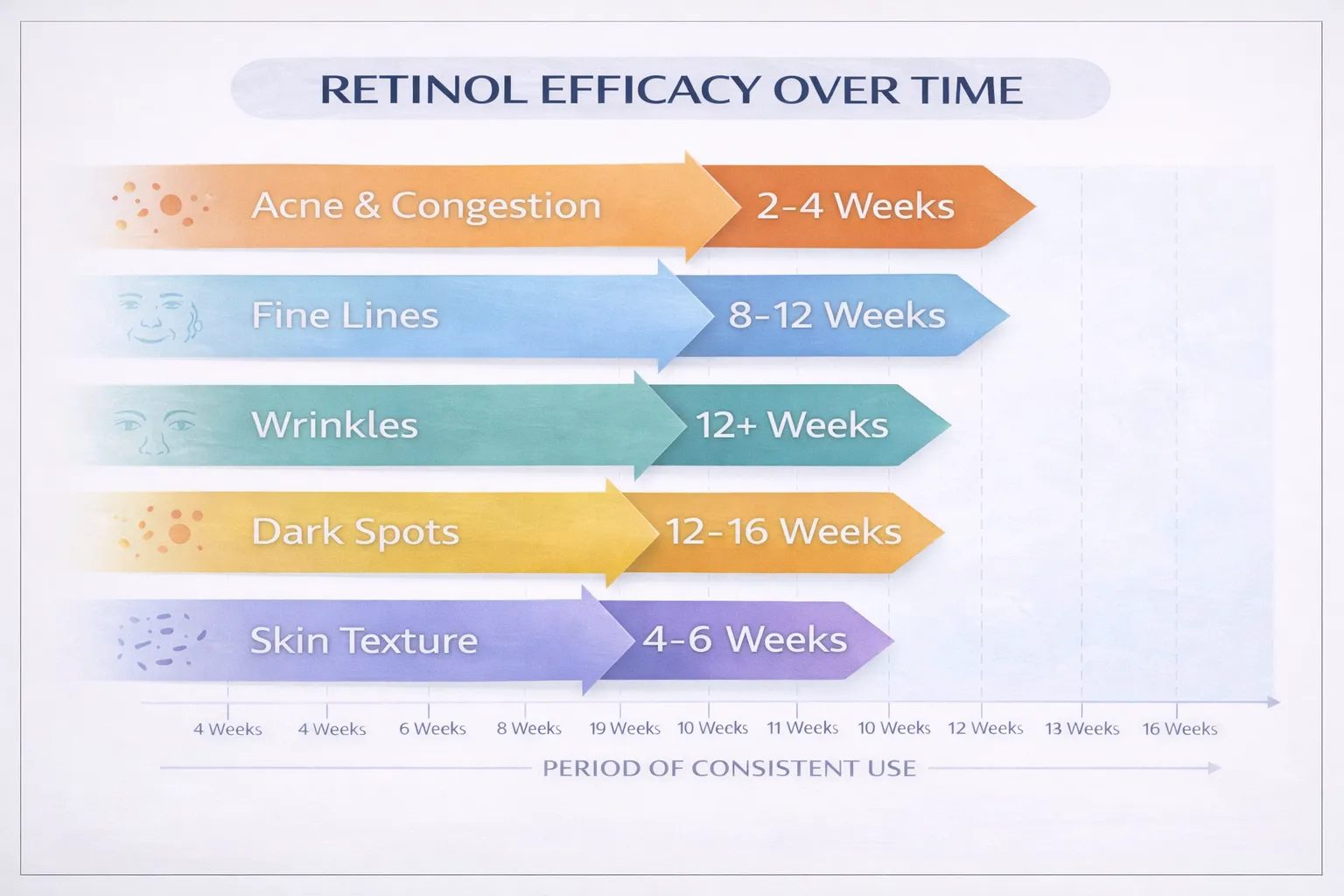
Timeline: When You’ll See Results
The retinol timeline varies based on the concern you’re addressing:
| Skin Concern | Timeline | What to Expect |
|---|---|---|
| Acne & congestion | 2–4 weeks | Initial purging may occur; pores appear cleaner by week 4 |
| Fine lines | 8–12 weeks | Noticeable smoothing and improved hydration; deeper wrinkles improve over 6+ months |
| Pigmentation & dark spots | 12–16 weeks | Gradual fading; maximum results at 6 months |
| Overall skin texture | 4–6 weeks | Smoother, more refined appearance |
| Firmness & elasticity | 12+ weeks | Cumulative collagen production effects |
Patience is essential. Retinol is not a quick fix, but the compounding benefits of consistent use make it worth the investment.
Types of Retinoids: Which Form Is Right for You?
The retinoid family encompasses multiple formulations, each with different potency levels, conversion requirements, and irritation profiles. Understanding these distinctions helps you select the appropriate product for your skin type and experience level.
Retinol (Over-the-Counter)
Retinol is the most accessible retinoid available without a prescription. It requires the two-step enzymatic conversion discussed above, making it gentler than prescription alternatives but slower-acting. Typical concentrations range from 0.25% to 1%.
Best for: Beginners, sensitive skin, prevention-focused users, and those seeking gradual improvement.
Retinaldehyde (Over-the-Counter)
Retinaldehyde is one step ahead of retinol in the conversion pathway. It converts directly to retinoic acid, making it approximately 10 times more potent than retinol while remaining gentler than prescription retinoids. Results appear faster, typically within 4–8 weeks.
Best for: Intermediate users who’ve developed tolerance to retinol and seek faster results without prescription irritation.
Retinyl Esters (Over-the-Counter)
Retinyl palmitate, retinyl acetate, and retinyl propionate are stabilized forms of retinol that require additional conversion steps. They’re significantly weaker than pure retinol-approximately 1/10th the potency.
Best for: Highly sensitive skin, first-time retinoid users, and sensitive skin conditions like rosacea or eczema.
Prescription Retinoids
Tretinoin (Retin-A): The gold standard prescription retinoid. It’s already in its active form (retinoic acid), bypassing conversion entirely. Tretinoin is typically prescribed in strengths of 0.025%, 0.05%, or 0.1%. Results appear rapidly, but so do potential irritation side effects.
Adapalene (Differin): A third-generation synthetic retinoid approved for acne. It’s more selective in binding to retinoic acid receptors and is generally considered less irritating than tretinoin while remaining highly effective.
Tazarotene: An extremely potent prescription retinoid reserved for severe acne or stubborn hyperpigmentation. It requires careful introduction and dermatologist monitoring.
For a comprehensive comparison of how over-the-counter retinol stacks up against tretinoin and other prescription alternatives, including efficacy, timeline, and cost considerations, see our detailed retinol vs tretinoin guide.
Benefits of Retinol: What the Research Shows
Retinol’s reputation as a skincare powerhouse is grounded in extensive clinical research. Here are the evidence-backed benefits dermatologists recommend retinol for:
Retinol for Wrinkles and Fine Lines
Fine lines and wrinkles form as collagen breaks down due to sun damage, aging, and repetitive facial expressions. Retinol addresses this through multiple mechanisms: accelerating cell turnover to improve surface texture, stimulating new collagen production, and enhancing skin hydration (plumper skin shows fewer fine lines).
Studies show that consistent retinol use for 12 weeks results in measurable improvements in fine lines. Users typically report increased skin firmness, improved texture, and a more refined appearance. Deeper wrinkles require 6+ months of consistent use for significant improvement.
For detailed before-and-after information and what realistic timelines look like, visit our retinol before and after guide.
Retinol for Acne
Retinol is one of the few skincare ingredients effective against multiple acne mechanisms:
- Increases cell turnover: Prevents dead skin cells from clogging pores
- Regulates sebum: Reduces excess oil production in acne-prone skin
- Anti-inflammatory: Calms existing inflammation and reduces redness
- Reduces bacteria: Retinol creates an environment where Cutibacterium acnes (formerly Propionibacterium acnes) cannot thrive
Studies demonstrate that 0.5–1% retinol significantly reduces inflammatory and non-inflammatory lesions within 8–12 weeks. Many dermatologists recommend retinol as a maintenance treatment after acne resolves or as a preventative for recurring breakouts.
Learn more about retinol’s specific benefits for acne-prone skin in our retinol for acne guide.
Retinol for Dark Spots and Hyperpigmentation
Retinol combats pigmentation through accelerated cell turnover (shedding pigment-laden cells faster) and by inhibiting tyrosinase, the enzyme responsible for melanin production. Studies show that consistent retinol application significantly fades sun spots, post-inflammatory hyperpigmentation, and melasma over 12–16 weeks.
For optimal results, combine retinol with dedicated anti-pigmentation ingredients like vitamin C or niacinamide. See our retinol for dark spots guide for comprehensive strategies.
Retinol for Enlarged Pores
Enlarged pores result from clogged follicles, reduced collagen, and increased sebum production. Retinol addresses all three: unclogging pores through accelerated turnover, strengthening skin structure through collagen stimulation, and regulating sebum. The result is visibly tighter, more refined pores.
Retinol for Skin Texture
Rough, uneven skin texture improves dramatically with retinol. By accelerating cell turnover and promoting even collagen deposition, retinol creates a smoother, more uniform appearance. Most users notice texture improvement within 4–6 weeks.
How to Use Retinol: The Complete Application Guide
Proper retinol application is critical for effectiveness and minimizing irritation. This section provides step-by-step protocols for every experience level.
The Beginner Protocol: Introduction Phase (Weeks 1–4)
If you’re new to retinol, introducing it gradually prevents excessive irritation and allows your skin barrier to adapt.
Frequency: 1–2 times per week
Concentration: 0.3–0.5% retinol
Application timing: Evening only
Step-by-step application:
- Cleanse your face thoroughly with a gentle cleanser, removing all traces of makeup, sunscreen, and oil
- Pat skin completely dry (retinol penetrates better on dry skin)
- Wait 10–15 minutes after cleansing before applying retinol (damp skin increases penetration and irritation risk)
- Dispense a pea-sized amount of retinol serum onto your fingertip
- Apply using gentle pressing motions across the face, avoiding the eye area, lips, and corners of the nose (most sensitive zones)
- Wait 10–15 minutes before applying moisturizer (this buffering technique reduces irritation while maintaining efficacy)
- Apply a nourishing moisturizer to seal in the retinol and protect your barrier
- In the morning, apply broad-spectrum SPF 30+ (non-negotiable-retinol increases photosensitivity)
Progression Protocol: Building Tolerance (Weeks 5–12)
Once your skin adapts without excessive irritation:
Increase to: 2–3 times per week, then gradually progress to every other night, then nightly as tolerated
Concentration: 0.5–1% retinol
If irritation increases when progressing frequency, return to the previous schedule for another 2 weeks before advancing.
Advanced Protocol: Maximum Efficacy (Week 13+)
Frequency: Every night or every other night
Concentration: 0.75–1% retinol or stronger retinoid alternatives
Option: Sandwich method (moisturizer → retinol → moisturizer) for added buffering while maintaining results
AM Routine (Morning)
A critical but often overlooked aspect of retinol use is daytime protection:
- Gentle cleanser
- Hydrating toner (optional)
- Lightweight serum (vitamin C, niacinamide, or hyaluronic acid)
- Moisturizer
- Broad-spectrum SPF 30+ (minimum SPF 50 recommended)
- Optional: occlusive lip balm if retinol application extended near mouth
PM Routine (Evening)
- Oil cleanser (removes makeup and excess sebum)
- Water-based cleanser (removes oil cleanser residue)
- Pat dry, wait 10–15 minutes
- Apply retinol (pea-sized amount)
- Wait 10–15 minutes (buffer time)
- Apply moisturizer
- Optional: Facial oil for extra barrier support
- Optional: Silk pillowcase (reduces friction and irritation)
Layering Rules: What Works With Retinol
Not all ingredients play nicely with retinol. Understanding compatibility prevents wasting products and minimizes irritation.
Safe to layer immediately after retinol:
- Hyaluronic acid (hydration buffer)
- Glycerin (humectant)
- Ceramides (barrier support)
- Niacinamide (soothing, supports barrier)
- Centella asiatica (calming)
Wait 15+ minutes before applying retinol:
- Vitamin C (can increase irritation if layered directly)
- AHA/BHA exfoliants (excessive exfoliation combined with retinol)
- Physical scrubs (mechanical exfoliation + chemical exfoliation = irritation)
Never combine on the same evening:
- Tretinoin and over-the-counter retinol (unnecessary; one retinoid per routine)
- Retinol and benzoyl peroxide in immediate succession (can oxidize retinol, reducing efficacy)
- Multiple active exfoliants (AHA, BHA, retinol together)
For detailed layering strategies and ingredient compatibility, see our how to use retinol guide.
Retinol for Different Skin Types
Retinol’s efficacy varies by skin type. Tailoring your approach ensures faster results and fewer side effects.
Oily & Acne-Prone Skin
Oily skin tolerates retinol exceptionally well. Retinol actually regulates sebum production, making oily skin a prime candidate for higher concentrations and faster progression.
Recommended approach:
- Start at 0.5% retinol (faster tolerance development than sensitive skin)
- Progress to every other night by week 6
- Consider lightweight, gel-based formulations that won’t add heaviness
- Skip heavy moisturizers; use a hydrating serum + lightweight gel moisturizer
- Retinol’s anti-inflammatory effects make it ideal for acne treatment
Dry Skin
Dry skin requires careful buffering, as retinol can exacerbate dryness and flaking. However, retinol’s collagen-stimulating effects benefit dry skin long-term.
Recommended approach:
- Start at 0.25–0.3% retinol (lower concentration)
- Use the sandwich method: moisturizer → retinol → moisturizer
- Begin at 1–2 times per week; progress more slowly than other skin types
- Apply a nourishing facial oil after moisturizer for barrier support
- Use a humidifier while sleeping to combat moisture loss
- Consider retinyl esters (gentler) rather than pure retinol initially
Combination Skin
Combination skin requires a balanced approach. Apply retinol to areas that need it most (typically the T-zone), avoiding overly drying the cheeks.
Recommended approach:
- Use 0.4–0.5% retinol
- Apply to forehead, nose, and chin first (typically oilier zones)
- After adaptation, extend to full face
- Use a lightweight moisturizer for oily areas and a richer cream for dry areas
- Avoid heavy occlusives if using the sandwich method; use medium-weight moisturizers instead
Sensitive Skin
Sensitive skin demands the most cautious retinol introduction. However, retinol’s benefits don’t require it to be avoided-just implemented strategically.
Recommended approach:
- Start with retinyl esters (gentlest option) or 0.3% retinol
- Begin at 1 time per week; stay here for 6–8 weeks before increasing
- Use the sandwich method consistently (even after sensitivity decreases, if desired)
- Pair with soothing ingredients: centella asiatica, panthenol, allantoin
- Consider a retinol-free week every 4 weeks to assess skin tolerance
- If redness or burning persists after 8 weeks at 1x/week, consult a dermatologist
For comprehensive guidance tailored to sensitive skin, see our retinol for sensitive skin guide.
Retinol Side Effects & How to Manage Them
Retinol’s efficacy comes with a temporary adjustment period. Understanding and managing side effects ensures you stick with the treatment long enough to see results.
Retinization: The Adjustment Phase
When you begin retinol, your skin undergoes an adjustment called “retinization” (or colloquially, “retinol uglies”). This typically lasts 2–4 weeks and involves temporary redness, peeling, and irritation as your skin acclimates. This is a normal, expected response-not an allergy.
Peeling and Flaking
What’s happening: Retinol accelerates cell turnover, causing the outer layer of dead skin to shed visibly. This often appears as dry, flaky patches, especially around the nose, mouth, and forehead.
Management strategies:
- Use a hydrating serum under moisturizer to plump skin
- Apply retinol less frequently if peeling is severe
- Use the sandwich method (moisturizer buffering)
- Avoid physical exfoliants; skip chemical exfoliants on retinol nights
- Apply a hydrating sheet mask on non-retinol nights
- Consider a heavier night cream temporarily
Redness and Irritation
What’s happening: Retinol increases skin sensitivity and can cause temporary inflammation as your skin adapts.
Management strategies:
- Reduce application frequency (return to 1x/week if using 2–3x/week)
- Ensure you’re using the correct concentration for your skin type
- Use the sandwich method for buffer
- Apply a soothing serum (niacinamide, centella) under moisturizer
- Avoid other potentially irritating ingredients (vitamin C, AHA/BHA, benzoyl peroxide)
- Consider a cooling facial roller post-application
Burning and Stinging
What’s happening: Retinol is a lipophilic (fat-soluble) compound that penetrates deeply, sometimes too quickly, causing a mild burning sensation.
Management strategies:
- Ensure your skin is completely dry before application (dampness increases penetration)
- Wait 15 minutes after cleansing before applying retinol
- Reduce concentration or frequency
- Apply to completely clean skin (product residue increases irritation)
- Use the sandwich method
Dryness and Tightness
What’s happening: Retinol accelerates cell turnover and can temporarily compromise the skin barrier.
Management strategies:
- Increase moisturizer weight and occlusive ingredients (oils, butters, ceramides)
- Use a humidifier at night
- Apply hydrating serum (hyaluronic acid, glycerin) to damp skin before moisturizer
- Consider a facial oil after moisturizer
- Temporarily reduce application frequency
Increased Sensitivity to Sun
What’s happening: Retinol increases UV photosensitivity, making sunburn and pigmentation more likely.
Management strategies:
- Apply SPF 50+ daily (not optional)
- Reapply sunscreen every 2 hours if outdoors
- Wear protective clothing in intense sun
- Consider applying retinol 5 nights per week instead of daily during summer
- Use a mineral sunscreen (zinc oxide, titanium dioxide) if chemical sunscreen irritates
When to Stop or Consult a Dermatologist
Stop retinol and consult a dermatologist if you experience:
- Severe allergic reaction (swelling, hives, difficulty breathing)
- Persistent irritation after 8 weeks despite proper buffering and dose reduction
- Signs of skin barrier damage (severe redness, raw patches, intense burning)
- Any reaction concerning you or affecting your quality of life
The Purge: Temporary Acne Worsening
Some users experience a temporary “purge”-increased acne for 2–4 weeks after starting retinol. This occurs because retinol accelerates the surfacing of clogged pores that would have erupted anyway, just over a shorter timeframe.
How to distinguish purge from adverse reaction:
- Purge = primarily comedonal or in areas where you typically break out
- Purge = improves substantially after 4 weeks
- Adverse reaction = widespread redness, burning, or persistent deterioration
Continue through a purge if possible; your skin will clear as retinization completes.
For detailed management strategies, see our retinol side effects guide.
Retinol vs Other Ingredients: Compatibility Chart
Combining retinol with other active ingredients requires strategy. Here’s what works, what to space out, and what to avoid:
| Ingredient | Compatibility | Recommendation | Why |
|---|---|---|---|
| Vitamin C | Use separately | Apply vitamin C AM, retinol PM | Both are potent; combining increases irritation risk |
| Niacinamide | Excellent | Layer after retinol | Reduces irritation; supports barrier |
| AHA/BHA | Avoid together | Use on alternate nights | Both exfoliate; combined = over-exfoliation |
| Hyaluronic Acid | Excellent | Apply before retinol | Humectant; hydrates and buffers |
| Ceramides | Excellent | Apply after retinol | Strengthen barrier; reduce irritation |
| Benzoyl Peroxide | Use cautiously | Apply AM only | Can oxidize retinol; space by 12+ hours |
| Salicylic Acid | Avoid together | Use on alternate nights | Chemical exfoliant; combined = irritation |
| Azelaic Acid | Moderate | Space by 1–2 hours | Both target pigmentation; may increase irritation |
| Peptides | Good | Layer with retinol | Support collagen; complementary benefits |
| SPF/Sunscreen | Essential | Always use AM (never with PM retinol) | Mandatory for UV protection |
What Percentage of Retinol Should You Use?
Retinol concentration significantly impacts efficacy and irritation potential. Matching concentration to experience level is crucial.
Beginners: 0.25–0.5% Retinol
Characteristics:
- Gentle concentration
- Low irritation incidence
- Results appear in 6–12 weeks
- Ideal for first-time users and sensitive skin
Application frequency: 1–2 times per week
Expected timeline: 3–4 months to see meaningful results
When to progress: After 8 weeks without significant irritation
Intermediate: 0.5–0.75% Retinol
Characteristics:
- Moderate potency
- Faster results than beginner concentrations
- Manageable irritation if introduced correctly
- Suitable for those with retinol experience
Application frequency: 2–4 times per week to every other night
Expected timeline: 6–10 weeks to see substantial results
When to progress: After 6 weeks at consistent application without troublesome irritation
Advanced: 0.75–1% Retinol or Higher
Characteristics:
- Highest over-the-counter potency
- Fastest results
- Requires careful management to minimize irritation
- Suitable for retinol-experienced users only
Application frequency: Every other night to nightly
Expected timeline: 4–8 weeks to see pronounced results
Prerequisites: At least 3 months experience with lower concentrations; comfortable managing retinization
Pro tip: Concentration alone doesn’t determine results. Consistent use of 0.5% retinol daily outperforms inconsistent 1% use. Prioritize consistency over concentration.
For a detailed analysis, see our retinol percentage guide.
How Long Does Retinol Take to Work?
Timeline expectations manage frustration and ensure you’re using retinol long enough to assess efficacy. Here’s what dermatological research shows:
| Concern | Timeline | Milestones |
|---|---|---|
| Acne & Congestion | 2–4 weeks | Reduced sebum; pores appear cleaner; new breakouts decrease |
| 4–8 weeks | Significant reduction in active lesions | |
| 8–12 weeks | Clear, acne-free skin (with continued use) | |
| Fine Lines | 8–12 weeks | Noticeable smoothing; improved hydration plumps fine lines |
| 12–16 weeks | Visible reduction in fine line depth | |
| 6+ months | Significant collagen rebuilding; reduced wrinkle depth | |
| Deep Wrinkles | 4–6 months | Initial improvement |
| 12+ months | Substantial reduction in wrinkle depth; skin firmness improves | |
| Dark Spots & Pigmentation | 8–12 weeks | Visible fading begins |
| 12–16 weeks | Significant pigmentation reduction | |
| 6 months | Maximum fading achieved; continued use maintains results | |
| Texture & Roughness | 4–6 weeks | Noticeably smoother; refined appearance |
| 8–12 weeks | Significant texture improvement | |
| Pore Size | 6–8 weeks | Pores appear tighter |
| 12+ weeks | Sustained pore refinement |
Key takeaway: Most users see preliminary results within 4 weeks, but transformative results require 8–12 weeks of consistent use. Patience is non-negotiable.
Best Retinol Products 2026
Selecting a high-quality retinol product ensures efficacy and minimizes the risk of irritation from poorly formulated products. Here are evidence-based recommendations across different categories:
Best Retinol for Beginners
Profile: Low concentration (0.25–0.5%), gentle formula, well-formulated delivery system, affordable.
Why this matters: Beginners need gentle entry into retinol. A poorly formulated beginner product may cause unnecessary irritation, discouraging continued use. Quality formulation matters more than concentration for beginners.
What to look for:
- Retinol concentration: 0.3–0.5%
- Stabilized formula (retinol oxidizes quickly; dark packaging is essential)
- Hydrating base (glycerin, hyaluronic acid)
- Additional soothing ingredients (centella, panthenol, allantoin)
- Clear dosing instructions
Best Retinol for Sensitive Skin
Profile: Extra-gentle formula, retinyl esters or very low retinol concentration (0.1–0.3%), emphasizes barrier support.
What to look for:
- Retinyl esters or <0.3% retinol
- Rich moisturizing base
- Soothing complex (centella asiatica, feverfew, zinc)
- Ceramides for barrier support
- Fragrance-free
Best Budget Retinol
Profile: Effective concentration (0.5%), reliable formulation, accessible price point (<$30).
Value criteria:
- 0.5% retinol concentration (effective without premium price)
- Stabilized formula (dark packaging)
- Functional but simple ingredients
- Sufficient quantity (30 ml minimum)
Best Luxury Retinol
Profile: Premium ingredients, advanced delivery technology, often combined with complementary actives (peptides, botanical extracts), higher price point ($80+).
Premium criteria:
- Advanced stabilization technology (encapsulation, air-free packaging)
- Synergistic ingredient combinations
- Enhanced texture and sensory experience
- Dermatologist-developed or clinically tested
Best Retinol for Acne
Profile: Higher concentration (0.5–1%), oil-control support, potential antibacterial ingredients, lightweight texture.
Acne-specific criteria:
- 0.5–1% retinol
- Lightweight, non-comedogenic base
- Optional: niacinamide (sebum regulation), salicylic acid (separate use)
- Quick-absorbing texture
- Clear skin benefits (not just wrinkle treatment)
Product selection note: Specific product recommendations require current pricing, availability, and user review data. Consult reviews on Reddit’s r/SkincareAddiction, Paula’s Choice (Beautypedia), or dermatologist databases for current top products. When selecting, prioritize:
- Retinol concentration appropriate for your experience level
- Stabilized, dark packaging (prevents oxidation)
- Suitable texture for your skin type
- Realistic price for your budget
- Clear usage instructions and safety information
Safety Considerations: Age, Pregnancy & Long-Term Use
Retinol safety is well-established when used appropriately. However, certain populations require special consideration.
When Should You Start Using Retinol?
General recommendation: Age 25–30 for preventative anti-aging use; any age for acne treatment.
Under 18: Retinol is not contraindicated for teenagers with acne, but other options (benzoyl peroxide, salicylic acid) are typically recommended first. Adolescent skin is still developing; consult a dermatologist before beginning retinol.
18–25: Preventative retinol use (very low concentration, 1–2x weekly) is appropriate for acne prevention or early anti-aging.
25+: All adults can use retinol. Prevention-focused users (no significant skin concerns) benefit from lower concentrations; treatment-focused users (acne, pigmentation, wrinkles) can progress to higher concentrations faster.
Retinol and Pregnancy
Current evidence: Topical retinol at typical skincare concentrations is considered safe during pregnancy by most dermatologists. The absorption rate is extremely low, and systemic exposure is negligible.
What the research shows: Studies examining birth outcomes in women using topical retinol during pregnancy have not found increased risk of birth defects. The American College of Obstetricians and Gynecologists (ACOG) does not list topical retinol as contraindicated.
Practical recommendation: Many dermatologists suggest pausing retinol during pregnancy as a precaution, even though topical safety is well-established. This is a personal decision to make with your obstetrician.
Do NOT use during pregnancy: Prescription retinoids (tretinoin, adapalene, tazarotene) carry systemic absorption risk and are explicitly contraindicated.
Retinol and Breastfeeding
Topical retinol is considered safe during breastfeeding. Systemic absorption is negligible, and breast milk transfer is not a concern at typical skincare concentrations. If desired, resume retinol immediately postpartum.
Long-Term Retinol Use: Safety Profile
Retinol has an excellent long-term safety profile when used as directed. Dermatologists routinely recommend retinol for indefinite use as part of a maintenance skincare routine.
What long-term use shows:
- No evidence of skin damage from chronic retinol use
- Continued collagen synthesis and skin improvement beyond 1 year
- No thinning of skin or barrier compromise with proper use
- Cumulative benefits that increase over years (not plateauing)
Important caveat: Consistency is key. Intermittent use (stopping for weeks, resuming) provides minimal benefit. Long-term retinol efficacy requires continuous, year-round application.
Seasonal adjustments: Some users reduce frequency during summer (increased sun exposure + retinol = higher photosensitivity). Maintain SPF 50+ if continuing retinol year-round.
Frequently Asked Questions About Retinol
Q1: How often should I apply retinol as a beginner?
A: Start with 1–2 times per week, applying only in the evening. This allows your skin to adjust to retinol without excessive irritation. After 4–6 weeks without significant irritation, gradually increase to 2–3 times per week, then every other night, and potentially nightly as your skin adapts.
Q2: Can I use retinol every night from day one?
A: Not recommended. Applying retinol nightly as a beginner typically causes excessive irritation (redness, peeling, burning), leading to treatment discontinuation. Gradual introduction ensures long-term compliance and better results.
Q3: What’s the difference between retinol and tretinoin?
A: Retinol requires enzymatic conversion in your skin to become active, while tretinoin (Retin-A) is already in its active form (retinoic acid). Tretinoin works faster but is significantly more irritating and requires a prescription. See our retinol vs tretinoin guide for a detailed comparison.
Q4: Does retinol cause birth defects?
A: Topical retinol at skincare concentrations is not associated with birth defects. Systemic absorption is negligible. Prescription retinoids (tretinoin, adapalene) carry theoretical risks and are contraindicated. Discuss with your obstetrician if you have concerns.
Q5: Why is my skin breaking out after starting retinol?
A: This is typically the “retinol purge,” where accelerated cell turnover brings clogged pores to the surface faster. This usually lasts 2–4 weeks and indicates retinol is working, not that you’re allergic. Continue if tolerable; consult a dermatologist if it worsens after 4 weeks.
Q6: Can I use retinol with vitamin C?
A: Yes, but apply separately: vitamin C in the AM, retinol in the PM. Layering both simultaneously increases irritation risk. Both are potent actives; spacing them out maximizes benefit while minimizing irritation.
Q7: Is retinol safe for sensitive skin?
A: Yes, but requires careful introduction. Start with retinyl esters or 0.25–0.3% retinol applied 1 time per week using the sandwich method (moisturizer → retinol → moisturizer). See our retinol for sensitive skin guide for comprehensive guidance.
Q8: How long until I see results from retinol?
A: Timelines vary by concern: acne improvements appear in 2–4 weeks, fine line smoothing in 8–12 weeks, and significant wrinkle reduction in 12+ weeks. Consistency is critical; sporadic use produces minimal results.
Q9: What concentration of retinol should I use?
A: Beginners: 0.25–0.5%. Intermediate users (3+ months experience): 0.5–0.75%. Advanced users: 0.75–1%. Higher concentration doesn’t always mean better results; consistency matters more than potency. See our retinol percentage guide for detailed recommendations.
Q10: Can I mix retinol with other skincare products?
A: Some combinations are excellent (retinol + niacinamide, hyaluronic acid, ceramides), while others should be avoided (retinol + AHA/BHA, benzoyl peroxide on the same night). See our compatibility chart above for specific guidance.
Q11: Why is my skin so dry when using retinol?
A: Retinol accelerates cell turnover, temporarily compromising the skin barrier. Manage by using the sandwich method, increasing moisturizer weight, applying a facial oil, using a humidifier, and reducing application frequency temporarily.
Q12: Does retinol make you more sensitive to the sun?
A: Yes. Retinol increases photosensitivity, making sunburn and hyperpigmentation more likely. Daily SPF 50+ is essential, non-negotiable, and should be reapplied every 2 hours if outdoors. Wear protective clothing in intense sun.
Q13: Can retinol be used with other actives like niacinamide?
A: Yes. Niacinamide actually reduces retinol irritation and supports skin barrier function. Apply retinol first (on clean, dry skin), wait 10–15 minutes, then layer niacinamide serum and moisturizer.
Q14: Is retinol effective for dark spots and pigmentation?
A: Yes. Retinol increases cell turnover (shedding pigmented cells) and inhibits tyrosinase (the enzyme producing melanin). Results appear in 8–12 weeks; maximum fading occurs around 6 months. See our retinol for dark spots guide for complementary strategies.
Q15: What should I do if retinol irritates my skin?
A: Reduce application frequency (return to 1x/week), use the sandwich method for buffering, ensure skin is completely dry before application (moisture increases penetration), apply a soothing serum after, and consider a lower concentration. If irritation persists after 6–8 weeks, consult a dermatologist.
Your Retinol Roadmap
Retinol represents one of the most scientifically proven, dermatologist-endorsed ingredients in modern skincare. Whether addressing acne, fine lines, dark spots, or pursuing preventative anti-aging care, retinol delivers measurable, lasting results when used consistently and correctly.
Your action plan:
- Assess your skin type and concerns (acne, sensitivity, wrinkles, pigmentation)
- Select an appropriate concentration (beginners: 0.3–0.5%; sensitive skin: retinyl esters or <0.3%)
- Start conservatively: 1–2 times weekly in the evening
- Use the sandwich method if dry, sensitive, or experiencing irritation
- Commit to consistency: Results require 8–12 weeks minimum
- Apply SPF 50+ daily (non-negotiable)
- Progress gradually as your skin adapts
Retinol isn’t a shortcut; it’s a long-term investment in your skin’s health and appearance. The compounding benefits of 6, 12, and 24 months of consistent use are transformative.
Next steps:
- Explore how to use retinol for detailed, personalized application protocols
- Read retinol for acne if breakouts are your primary concern
- Review retinol for sensitive skin if your skin is reactive or easily irritated
- Compare retinol vs tretinoin if considering prescription alternatives
- Check retinol for dark spots if hyperpigmentation is your focus
Your skin will thank you.