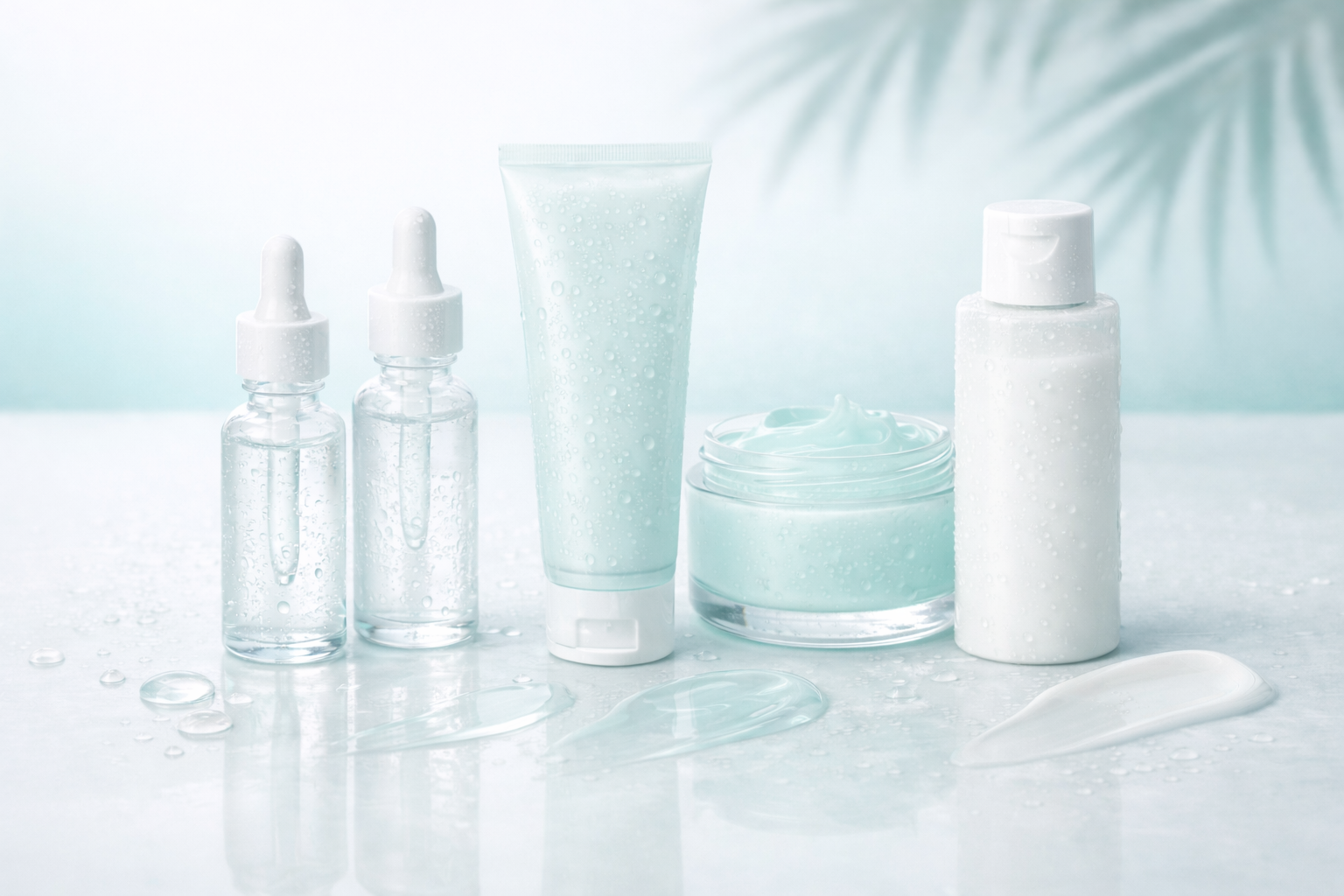
Thailand’s climate and beauty market create a very specific reality for brightening care: high UV exposure, persistent heat and sweat, and lightweight product formats designed for daily layering. This guide explains what actually improves uneven tone and post-inflammatory marks in tropical conditions — and how to choose products safely from typical Thailand retail environments (7-11, Boots, Watsons, beauty chains).
The emphasis is clinical: pigment biology, irritation control, and climate-appropriate textures. No hype, no miracle claims — just practical dermatology and formulation logic for real-world use.
Brightening vs Hyperpigmentation: what are you actually trying to fix?
Many people seek “brightening” when the underlying issue differs. The treatment path depends on the type of discoloration.
Glow / dullness vs uneven tone vs pigment patches
| Concern | Typical signs | Cause | What helps most |
|---|---|---|---|
| Dullness | Flat, tired skin, no distinct spots | Dehydration, dead-cell buildup | Hydration + gentle exfoliation |
| Uneven tone | Subtle shading differences | Mild pigment + texture | Antioxidants + niacinamide |
| PIH (post-acne marks) | Brown/red marks after acne | Inflammation-triggered melanin | Azelaic / tranexamic / niacinamide |
| Melasma | Symmetric patches (cheeks/forehead) | UV + heat + hormones | Strict SPF + pigment inhibitors |
| Sunspots/freckles | Discrete sun-exposed dots | UV damage | Sunscreen + retinoid/acid |
Quick self-check
- Spots appeared after pimples → likely PIH
- Patches symmetrical on both cheeks → possible melasma
- Marks darken with sun/heat → UV-driven pigment
- Skin looks grey or flat overall → dullness/dehydration
When to see a dermatologist (non-urgent):
- Pigment deepens despite strict sunscreen
- New irregular or changing patches
- Pigment during pregnancy or hormonal therapy
- Pigment with itching or scaling
Why Thailand climate changes the rules
1) UV intensity + year-round exposure
UV index remains high across seasons; incidental exposure accumulates pigment. Even short outdoor intervals matter.
2) Heat + sweat → inflammation → pigment persistence
Sweat, friction, and heat amplify inflammatory pathways. Inflammation prolongs melanin activity — especially in acne-prone skin.
3) Humidity dictates texture
Occlusive or heavy creams feel intolerable → poor adherence → inconsistent treatment. Gel-serums and fluid emulsions improve compliance.
4) Irritation worsens pigmentation
Over-exfoliation or strong retinoids in heat often trigger rebound PIH. Barrier-first strategy is essential in tropical dermatology.
The “Thailand brightening hierarchy” (the winning framework)
Ranked by impact under tropical conditions:
- Sunscreen consistency + humidity reapplication
- Barrier + inflammation control
- Targeted pigment actives
- Gentle exfoliation (if tolerated)
- Maintenance & prevention
Without steps 1–2, actives rarely succeed.
Product categories that actually matter (not a random list)
Functional taxonomy for Thailand climates
| Category | Why critical in Thailand | Ideal texture |
|---|---|---|
| High-UVA sunscreen | Pigment prevention | Fluid / gel-cream |
| Antioxidant brightener | UV + pollution defense | Watery serum |
| Tone-evening serum | Pigment regulation | Light emulsion |
| Spot-target gel | Localized pigment | Gel |
| Gentle exfoliant | Cell turnover | PHA/AHA toner |
| Barrier support | Irritation control | Gel-cream |
| Body brightening | Sun-exposed limbs | Lotion |
Face vs body brightening logic
- Body skin thicker → tolerates acids better
- Face pigment often inflammatory → gentler actives preferred
Ingredient playbook (mechanisms + pairing rules)
Vitamin C
- Mechanism: antioxidant + melanin inhibition
- Best for: dullness + early pigment
- Irritation risk: moderate (L-ascorbic acid), low (derivatives)
- Thailand format: water-light serum
- Pairings: sunscreen, niacinamide
- Avoid: strong acids same routine in sensitive skin
Heat stability: derivatives (MAP, SAP, AA-2G) tolerate humidity better.
Niacinamide
- Mechanism: melanosome transfer reduction + barrier support
- Best for: uneven tone + PIH
- Risk: low
- Texture: gel serum
- Pairings: most actives
- Avoid: none clinically significant
Tranexamic acid
- Mechanism: plasmin pathway pigment inhibition
- Best for: melasma + PIH
- Risk: low
- Texture: light serum
- Pairings: niacinamide, azelaic
- Avoid: irritation layering
Azelaic acid
- Mechanism: tyrosinase inhibition + anti-inflammatory
- Best for: acne + PIH
- Risk: moderate dryness
- Texture: gel-cream
- Pairings: niacinamide
- Avoid: strong exfoliation
Alpha-arbutin / licorice / kojic
- Mechanism: tyrosinase inhibition
- Best for: uneven tone
- Risk: low–moderate sensitivity
- Texture: serum
- Pairings: niacinamide
- Avoid: irritation stacking
In Southeast Asia, label language may reference “brightening” or whitening cream terminology historically linked to pigment-evening products rather than literal skin lightening; ingredient scrutiny remains essential.
Retinoids
- Mechanism: turnover + pigment dispersion
- Best for: sunspots + texture
- Risk: high irritation in heat
- Texture: light gel
- Pairings: barrier creams
- Avoid: acids same night
Beginner strategy: 2×/week nights, buffered with moisturizer.
AHA / PHA / BHA
- Mechanism: exfoliation + turnover
- Best for: dullness + superficial pigment
- Risk: climate-dependent irritation
- Thailand choice: PHA > AHA > BHA
- Frequency: 1–3×/week
Barrier helpers
Ceramides, glycerin, panthenol, centella, ectoin — reduce inflammation and pigment signaling.
Decision Trees (choose your path)
Decision Tree 1: Post-acne marks (PIH)
Acne active?
→ Yes → treat acne first + azelaic
→ No → niacinamide + tranexamic
Sensitive?
→ Yes → barrier + niacinamide only
→ No → add azelaic
Improving after 8–12 weeks?
→ Yes → maintain
→ No → dermatology consult
Decision Tree 2: Possible melasma
Symmetrical patches?
→ Yes → strict sunscreen + tranexamic
Heat-triggered?
→ Yes → avoid irritation + retinoids initially
Worsens with sun?
→ Yes → reapplication strategy
No improvement 12 weeks?
→ Dermatologist evaluation
Thailand-ready routines (AM/PM)
1) Oily/acne-prone + PIH
AM:
Cleanser → niacinamide serum → gel moisturizer → sunscreen
PM:
Cleanser → azelaic (alt nights) → barrier gel
If stinging: reduce azelaic frequency
2) Sensitive/reactive + uneven tone
AM:
Gentle cleanser → barrier serum → sunscreen
PM:
Cleanser → niacinamide → barrier cream
3) Dry/dehydrated + dullness
AM:
Hydrating toner → vitamin C derivative → gel-cream → sunscreen
PM:
Cleanser → PHA 2×/week → moisturizer
4) Combination + early sunspots
AM:
Antioxidant serum → niacinamide → sunscreen
PM:
Retinoid 2×/week → barrier
5) Minimalist travel (Bangkok + beach)
AM:
Water rinse → antioxidant → sunscreen
PM:
Cleanser → niacinamide
Patch testing: 3 nights behind ear before face.
“7-11 / Boots / Watsons” shopping reality
Thailand retail emphasizes:
- Sachets and minis
- Gel textures
- Multi-step layering
Quick label reading:
- Actives near top third
- Avoid heavy fragrance if reactive
- Check acid type
Pigment care products may be labeled brightening or tone-evening rather than whitening cream depending on brand positioning; focus on actives rather than claims.
Myths, risks, and safety
Myth: more actives = faster results
Reality: irritation delays pigment resolution.
Over-exfoliation
Common in humidity; barrier damage prolongs PIH.
Fragrance irritation
Sweat increases penetration → sensitivity risk.
Supplements / drinks / injections
Evidence inconsistent; topical SPF + actives remain first-line.
Pregnancy / lactation
Avoid retinoids; consult clinician.
FAQ (People Also Ask + community intent)
Best brightening product category in Thailand?
High-UVA sunscreen plus pigment serum.
Best ingredient for hyperpigmentation?
Tranexamic, azelaic, niacinamide depending on type.
What brightens safely in humidity?
Niacinamide and derivatives of vitamin C.
What to buy in Thailand for uneven tone?
Light pigment-regulating serum + fluid sunscreen.
Why “whitening” is common in Asia?
Historic terminology for tone-evening; modern dermatology focuses on pigment normalization, not bleaching.
Summary: the 30-second Thailand brightening protocol
Do
- Daily high-UVA sunscreen
- Barrier support
- Gentle pigment actives
- Consistent routine
Don’t
- Stack irritants
- Over-exfoliate
- Skip reapplication
- Expect rapid change
If you do only 3 things
- Sunscreen daily + reapply
- Niacinamide or tranexamic serum
- Barrier moisturizer
Realistic timelines
- Dullness: 2–4 weeks
- PIH: 8–12 weeks
- Melasma: 3–6 months
Pigment responds slowly; consistency beats intensity in tropical skincare.
Tables
Brightening goals vs signs vs best category
| Goal | Sign | Category |
|---|---|---|
| Glow | Flat tone | Antioxidant |
| PIH | Acne marks | Azelaic |
| Melasma | Patches | Tranexamic |
| Sunspots | Dots | Retinoid |
| Uneven | Shading | Niacinamide |
Pigmentation types vs first-line approach
| Type | First line |
|---|---|
| PIH | Azelaic |
| Melasma | TXA + SPF |
| Sunspots | Retinoid |
| Freckles | SPF |
| Dullness | Vitamin C |
Actives comparison
| Active | Strength | Irritation | Pregnancy caution | Pairing |
|---|---|---|---|---|
| Niacinamide | Moderate | Low | Safe | Most |
| TXA | Moderate | Low | Caution | Niacinamide |
| Azelaic | Strong | Moderate | Safe | Niacinamide |
| Vitamin C | Moderate | Low–Mod | Safe | SPF |
| Retinoid | Strong | High | Avoid | Barrier |
AM routine templates
| Skin | Steps |
|---|---|
| Oily | Cleanse → Niacinamide → SPF |
| Dry | Hydrate → Vit C → Cream → SPF |
| Sensitive | Barrier → SPF |
| Combo | Antioxidant → SPF |
| Acne | Niacinamide → SPF |
PM routine templates
| Skin | Steps |
|---|---|
| Oily | Cleanse → Azelaic |
| Dry | Cleanse → Cream |
| Sensitive | Cleanse → Barrier |
| Combo | Retinoid alt |
| Acne | Azelaic |
Reapplication methods in humidity
| Method | Pros | Cons |
|---|---|---|
| Stick | Portable | Thickness |
| Spray | Easy | Coverage |
| Powder | Matte | Low SPF |
| Gel | Light | Need mirror |
Pairing rules
| Do | Don’t |
|---|---|
| Niacinamide + TXA | Retinoid + AHA |
| Vit C + SPF | Multiple acids |
| Azelaic + Barrier | Over-layering |
Troubleshooting
| Issue | Cause | Fix |
|---|---|---|
| Stinging | Irritation | Reduce |
| Dryness | Overuse | Barrier |
| Breakouts | Occlusion | Gel |
| No change | Inconsistent | SPF |
| Darkening | Sun | Reapply |
Bottom line: In Thailand’s climate, pigment improvement depends less on product strength and more on sunscreen adherence, irritation control, and lightweight consistency. Brightening is achievable — gradually — with climate-adapted routines rather than aggressive treatment.