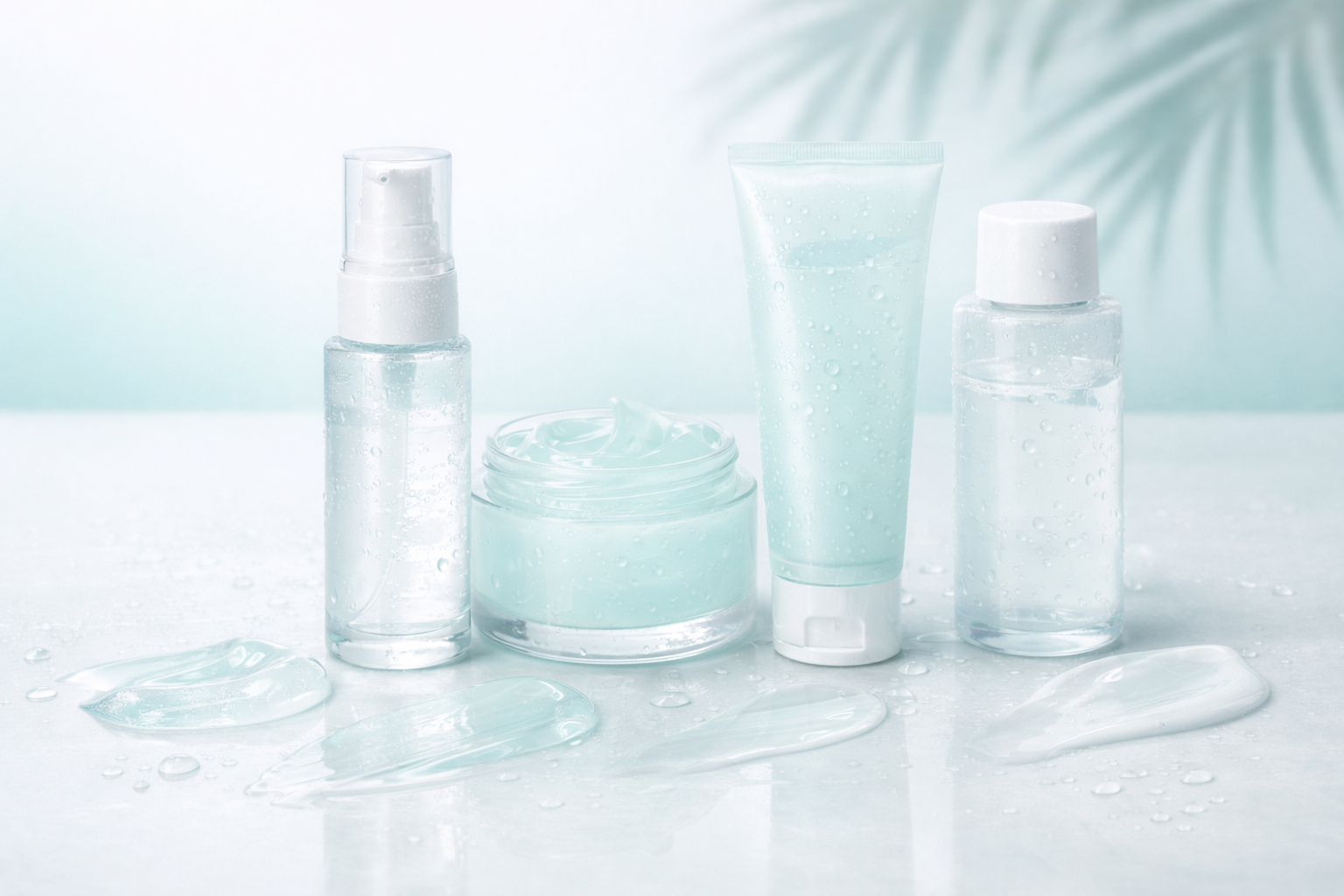
Oily skin in tropical Southeast Asia behaves differently than oily skin in temperate climates. Heat, humidity, and sweat dynamics fundamentally alter sebum behavior, pore optics, hydration balance, and acne ecology. As a result, Thai moisturizer oily skin formulations evolved toward lightweight gel hydration systems that prioritize oil compatibility, rapid absorption, and breathable moisture delivery.
This guide explains — from dermatology and formulation science perspectives — how Thai gel moisturizers manage hydration without amplifying shine or congestion in humid environments.
Why Oily Skin Becomes Worse in Hot & Humid Climates
Sebum Fluidity Increases in Heat
Sebum is a lipid mixture whose viscosity decreases as temperature rises. In tropical climates:
- Sebum becomes more fluid
- Surface spread increases
- Shine amplifies due to smoother lipid film
- Pore reflections intensify
This is why Bangkok oily skin skincare often appears shinier by midday, even when baseline sebum production is unchanged.
Sweat–Sebum Mixing Amplifies Shine
Humidity increases eccrine sweat output. Sweat mixes with sebum to form an emulsion-like surface film:
- Thinner lipid layer
- Higher reflectivity
- Faster spread across T-zone
- Greater pore visibility
This is a major driver behind the demand for humid climate oily skin moisturizer textures that absorb before sweat interaction occurs.
Pore Dilation in Heat
Thermal vasodilation and follicular relaxation cause pores to appear larger. Combined with fluid sebum:
- Follicle opening optics increase
- Shine concentrates around pores
- Sebum pooling occurs
The Oily Skin TEWL Paradox
Oily skin still experiences transepidermal water loss (TEWL), especially in:
- Air-conditioned environments
- Over-cleansed skin
- Acne treatments
- UV exposure
Thus, lightweight moisturizer oily skin types require hydration despite surface oiliness.
Humidity Shifts the Microbiome
Warm, moist environments favor lipophilic microbes such as Cutibacterium acnes and Malassezia. Excess occlusion or heavy creams can:
- Trap sweat
- Increase follicular humidity
- Promote acne or fungal breakouts
Hence Thailand’s preference for breathable oil-free moisturizer Thailand systems.
The Thai Approach to Moisturizing Oily Skin
Thai formulation philosophy differs from Western cream-based occlusion.
Core principles of Thai moisturizer acne-prone skin design:
- Gel dominance instead of cream
- Rapid absorption before sweat film forms
- Low occlusion thickness
- Matte or semi-matte finish
- Breathable hydration layers
- Acne-compatible emulsifiers
- Minimal lipid load
Western moisturizers often assume barrier impairment and low humidity → requiring occlusive creams.
Thai climate assumes high humidity + high sebum → requiring water-dominant gels.
This is why Thai gel moisturizer textures dominate humid Asia markets.
Types of Thai Moisturizers for Oily Skin
Gel Moisturizers
Water-rich polymer gel matrices.
Properties:
- Zero or near-zero oil phase
- Instant absorption
- Cooling effect
- No occlusive film
Best for:
- Very oily skin
- Sweat-prone climates
- Acne-prone skin
Typical classification: Thai oil control moisturizer gel systems
Gel-Cream Emulsions
Micro-emulsified oil phase within gel network.
Properties:
- Lightweight emolliency
- Slight barrier support
- Still breathable
Best for:
- Combination oily
- Dehydrated oily
- AC environments
Common in gel cream Thailand textures.
Oil-Free Lotions
Low-viscosity emulsions with minimal lipids.
Properties:
- Fluid spread
- Moderate hydration
- Low shine
Best for:
- Mild oily
- Sensitive oily
- Barrier-compromised oily
Acne Moisturizers
Gel or gel-cream with anti-acne actives.
Properties:
- Sebum regulation
- Anti-inflammatory
- Non-comedogenic
Used in Thai moisturizer acne-prone skin routines.
Barrier-Light Gels
Humectant + film former + trace emollient.
Properties:
- TEWL reduction without occlusion
- Hydration retention
- Matte finish
Useful for dehydrated oily skin in humid climate.
Texture vs Oily Skin Suitability
| Texture | Lipid load | Absorption speed | Shine risk | Acne risk | Humidity suitability |
|---|---|---|---|---|---|
| Gel | Minimal | Very fast | Very low | Very low | Excellent |
| Gel-cream | Low | Fast | Low | Low | Excellent |
| Oil-free lotion | Low | Moderate | Low | Low | Good |
| Cream | High | Slow | High | Moderate | Poor |
| Occlusive balm | Very high | Very slow | Very high | High | Very poor |
Ingredient Systems in Thai Oil-Control Moisturizers
Humectants for Oily Skin
Humectants provide hydration without lipid load.
Common in Thai skincare oily skin formulations:
- Glycerin (low %)
- Butylene glycol
- Sodium PCA
- Hyaluronic acid
- Betaine
Mechanism: bind water → increase stratum corneum hydration → reduce compensatory sebum secretion signals.
Sebum-Compatible Emollients
Ultra-light esters compatible with oily skin lipid profile.
Examples:
- Isoamyl laurate
- C12-15 alkyl benzoate
- Neopentyl glycol diheptanoate
These provide slip without shine.
Mattifying Powders
Sebum absorption + optical blur.
Common powders:
- Silica
- Polymethylsilsesquioxane
- Nylon-12
- Starch derivatives
Mechanism: absorb sebum → reduce surface reflectivity → matte appearance.
Film Formers for Oily Hydration
Create thin breathable hydration film.
Examples:
- Acrylates copolymer
- PVP
- Pullulan
- Hydroxyethylcellulose
These reduce TEWL without occlusion thickness — core to oil-free moisturizer Thailand design.
Soothing Acne Actives
Inflammation reduction in humid acne ecology.
Common:
- Centella asiatica
- Madecassoside
- Allantoin
- Panthenol
- Green tea
Lightweight Occlusives
Minimal TEWL reduction without congestion.
Examples:
- Dimethicone (low %)
- Hydrogenated polyisobutene (trace)
- Squalane (very low)
Ingredients vs Oil Control Function
| Ingredient system | Function in oily skin | Shine impact | Acne compatibility |
|---|---|---|---|
| Humectants | Hydrate without oil | Neutral | High |
| Light esters | Slip without grease | Low | High |
| Silica/powders | Sebum absorption | Matte | High |
| Film formers | TEWL reduction | Low | High |
| Heavy oils | Occlusion | High | Low |
How to Choose a Thai Moisturizer for Oily Skin (Decision Tree)
Very Oily Skin (Tropical Outdoor)
Choose:
- Pure gel
- Matte finish
- Zero oil
- Sebum powders
Avoid:
- Creams
- Rich gel-creams
Acne-Prone Oily
Choose:
- Gel moisturizer
- Soothing actives
- Non-comedogenic polymers
Avoid:
- Occlusive lipids
- Heavy silicones
Combination Oily
Choose:
- Gel-cream
- Low lipid
- Balanced humectant
Dehydrated Oily
Choose:
- Gel-cream
- Film former
- Humectant-rich
Sensitive Oily
Choose:
- Oil-free lotion
- Minimal actives
- Soothing agents
Thai Moisturizing Routines for Oily Skin
Bangkok Daytime Oily Routine
Climate: hot + humid + pollution
- Gentle gel cleanser
- Hydrating toner
- Thai gel moisturizer
- Matte sunscreen
Acne-Prone Humid Routine
- Low-pH cleanser
- Niacinamide serum
- Acne gel moisturizer
- Oil-control sunscreen
Dehydrated Oily Routine
- Mild cleanser
- Hydrating essence
- Gel-cream moisturizer
- Sunscreen
Oily in Air-Conditioning
AC increases TEWL despite oiliness.
- Gel-cream moisturizer
- Reapply mid-day
Why Heavy Creams Fail for Oily Skin in Humidity
Shine Trapping
Cream occlusion traps sebum + sweat beneath lipid film → reflective layer.
Pore Congestion
Follicular humidity rises → microcomedones.
Sweat Occlusion
Trapped sweat increases follicular swelling.
Acne Risk
Occlusion + microbes + heat → inflammatory acne.
Film Thickness
Thicker films scatter light unevenly → greasy appearance.
When Oily Skin Still Needs More Moisture in Thailand
Oily skin requires more hydration during:
- Retinoid use
- Over-cleansing
- Sunburn
- Barrier damage
- Dehydration
In these cases, gel-cream Thailand textures are preferred over pure gels.
Thai vs Western Moisturizers for Oily Skin
| Feature | Thai gel moisturizer | Western cream |
|---|---|---|
| Base | Water gel | Oil-emulsion |
| Occlusion | Low | High |
| Absorption | Fast | Slow |
| Finish | Matte/light | Dewy |
| Humidity compatibility | Excellent | Poor |
| Acne risk humid | Low | Higher |
Common Mistakes When Moisturizing Oily Skin in Humid Climate
“Oily skin should skip moisturizer”
False. Leads to dehydration → compensatory sebum.
“Gels are not hydrating”
Incorrect. Humectant gels hydrate effectively in humidity.
“Matte means dry”
Matte = low surface lipid, not low water.
“Oily skin has no barrier damage”
Oily skin can be dehydrated and inflamed.
“Acne skin should avoid moisturizer”
Proper Thai moisturizer acne-prone skin gels reduce irritation.
FAQ: Thai Moisturizers for Oily Skin
Best moisturizer for oily humid skin?
Lightweight gel with humectants and sebum-absorbing powders.
Gel vs cream for oily skin?
Gel in humid climates; cream in dry climates.
Do oily skins need moisturizer?
Yes — to maintain hydration balance and barrier function.
Why does moisturizer cause shine?
Excess lipids + slow absorption.
Thai moisturizer for pores?
Sebum-absorbing gel reduces pore reflectivity.
Dermatology Perspective: Managing Oily Skin Hydration in Tropical Climate
Oily skin in humid Southeast Asia is governed by three interacting factors:
- Heat-induced sebum fluidity
- Sweat–lipid surface films
- High microbial humidity ecology
Thai moisturizer technology evolved accordingly:
- Water-dominant gel systems
- Minimal occlusion thickness
- Fast absorption kinetics
- Sebum-compatible emollients
- Breathable hydration films
Thus, Thai oil control moisturizer design represents climate-specific dermatologic adaptation, not merely cosmetic preference.
For oily skin in tropical humidity, the optimal strategy is not oil suppression alone — but lightweight hydration that coexists with sebum physiology without amplifying shine or congestion.
Conclusion
The best Thai moisturizer for oily skin is defined less by brand and more by formulation logic:
- Gel or gel-cream base
- Low lipid load
- Fast absorption
- Humectant hydration
- Sebum-compatible slip
- Matte optical finish
- Acne-safe film
This architecture aligns with humid climate physiology and explains why Thai gel moisturizer systems outperform heavy creams for oily skin in tropical environments.