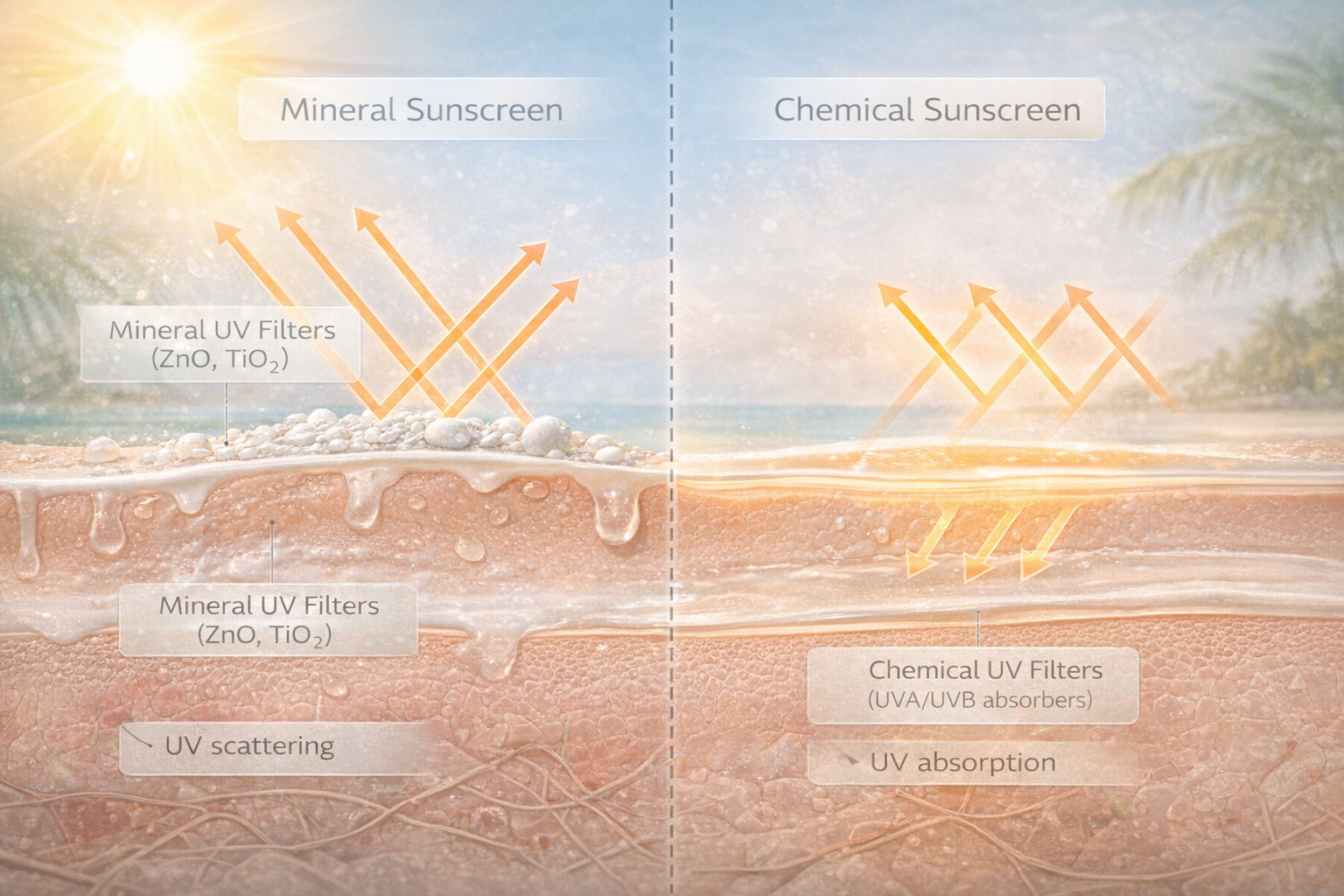
SECTION 1 — How Sunscreen Works: Mineral vs. Chemical Filters
To understand which sunscreen survives a Thai beach, we must first dismantle a persistent myth: Reflection vs. Absorption.
- The Myth: “Mineral sunscreens bounce UV rays away like a mirror, while chemical sunscreens absorb them.”
- The Science: Both Mineral (Inorganic) and Chemical (Organic) filters work primarily by absorption.
- Chemical Filters (e.g., Avobenzone, Tinosorb): Capture UV photons and convert their energy into harmless heat (thermal energy).
- Mineral Filters (e.g., Zinc Oxide): Also capture UV photons and convert them to heat. They only reflect/scatter about 5% of UV light (mostly visible light, which causes the white cast).
Why this matters in Thailand: Since both generate heat on the skin surface, the vehicle (the cream or gel base) determines whether that heat makes you sweat the sunscreen off.
SECTION 2 — How Tropical Climate Changes Sunscreen Performance
In temperate climates, sunscreen failure is usually due to rubbing. In Thailand, failure is due to thermodynamic breakdown.
- Viscosity Drop: At 35°C (Bangkok’s average), the oils and waxes in sunscreen melt. A thick mineral cream that is stable in London turns into a runny liquid in Phuket, leading to patchy coverage.
- Sweat Displacement: In 90% humidity, sweat acts as a “lifting agent.” It pushes the sunscreen film off the skin. Mineral particles are heavy; when the film lifts, they clump together (agglomerate), leaving microscopic gaps where UV rays penetrate.
- Chemical Instability: Older chemical filters (like Avobenzone) degrade when exposed to intense UV. In Thailand’s UV Index 11+, unstable filters can lose 50% of their potency in one hour if not stabilized by other ingredients.
SECTION 3 — Mineral Sunscreens in Thailand Climate (MizuMi, Smith)
What they are: Formulas relying solely on Zinc Oxide and Titanium Dioxide.
| Pros in Tropics | Cons in Tropics |
|---|---|
| Immediate Protection: No wait time needed. Essential when jumping off a boat. | Sweat Whitening: When you sweat, the white minerals separate from the clear base, creating milky white streaks. |
| Heat Stability: Zinc Oxide does not degrade in heat. It is rock-solid stable. | Occlusion: Thick mineral pastes can trap sweat, causing “Prickly Heat” (Miliaria) rash. |
| Less Stinging: Safer for eyes when sweat runs down your face. | Heavy Feel: Can feel like a “mask” in high humidity. |
Best For: Sensitive skin, children, and those with Melasma (heat-deflecting).
SECTION 4 — Chemical Sunscreens in Thailand Climate (Mistine, Srichand)
What they are: Formulas using carbon-based molecules like Octocrylene, Tinosorb, or Uvinul.
| Pros in Tropics | Cons in Tropics |
|---|---|
| Film Durability: Can be formulated into thin, breathable gels that adhere to oily skin. | Eye Sting: High-sweat environments cause the sunscreen to migrate into eyes, which stings badly. |
| Zero White Cast: Completely invisible, even on tan Thai skin tones. | Sensitization: Higher risk of allergic reaction on overheated, vasodilated skin. |
| Cooling: Often formulated with alcohol for a “fresh” feel in humidity. | Reef Bans: Many older chemical filters (Oxybenzone) are illegal in National Parks. |
Best For: Oily skin, daily city use, outdoor sports (if using modern no-sting filters).
SECTION 5 — Thai Mineral vs. Chemical Formulation Differences
Thai brands have innovated to solve the downsides of both types.
- The “Water-Encapsulated” Mineral: Brands like MizuMi use a process where Zinc particles are wrapped in water. This allows the sunscreen to apply like a serum but dry down to a powder finish, solving the “thick mineral” problem.
- The “Hybrid” Solution: Most modern Thai sunscreens (e.g., Her Hyness) are Hybrids. They use modern chemical filters (Tinosorb S/M) for protection and a small amount of Titanium Dioxide for oil control. This gives the durability of chemicals with the stability of minerals.
SECTION 6 — Mineral vs. Chemical for Skin Types in Tropics
| Skin Type | Recommended Filter | Why? |
|---|---|---|
| Oily / Acne | Hybrid or Chemical (Srichand Green) | Mineral particles can mix with sebum to clog pores. Chemical gels evaporate fast. |
| Sensitive / Rosacea | Mineral (MizuMi Blue) | Chemical filters generate heat reaction inside the skin; Minerals reflect heat, keeping face cooler. |
| Dry / Dehydrated | Hybrid (Her Hyness) | Pure mineral can be drying (astringent). Hybrids allow for moisturizing serum bases. |
| Sweaty / Sport | Chemical / Hybrid (MizuMi Orange) | Minerals streak when wet. Modern chemical polymers hold the film together underwater. |
SECTION 7 — SPF & PA++++: Mineral vs. Chemical
- UVA Protection (PA): Historically, Chemical filters (Avobenzone, Uvinul A Plus) offered better UVA protection than Minerals.
- The Zinc Revolution: New “Micronized” Zinc Oxide used in Thai brands offers excellent PA++++ protection without the whiteness.
- The Verdict: In Thailand, looking for PA++++ is more important than the filter type. Both modern minerals and chemicals can achieve this.
SECTION 8 — White Cast vs. Transparency in Humidity
- Dry vs. Wet: A mineral sunscreen might look invisible when dry (matte). However, once you sweat (wet), the refractive index changes, and the white cast often reappears.
- Thai Innovation: Thai brands use “Nano-Titanium” and “Coated Zinc” to prevent this “sweat-ghosting.” This is why a Thai mineral sunscreen (MizuMi) looks better than a US mineral sunscreen (CeraVe) in humidity.
SECTION 9 — Reef Safety: Mineral vs. Chemical Thailand
Legal Reality: Thailand’s Department of National Parks bans:
- Oxybenzone
- Octinoxate
- 4-Methylbenzylidene Camphor
- Butylparaben
- Mineral: Always Safe. Zinc Oxide and Titanium Dioxide are never banned.
- Chemical: Tricky. You must check the label. Mistine is safe (uses Octocrylene/Avobenzone). Banana Boat (old stock) might not be.
- Hybrid: Safe IF they use modern filters like Tinosorb S/M.
SECTION 10 — Which Sunscreen Is Better for Thailand?
Scenario 1: Island Hopping / Snorkeling
- Winner: Mineral (MizuMi)
- Reason: Guaranteed Reef Safe. No stinging eyes when mask floods. Immediate protection.
Scenario 2: Bangkok Shopping / Cafes
- Winner: Hybrid / Chemical (Her Hyness)
- Reason: Invisible under makeup. Light texture handles the transition from hot street to freezing AC malls without cracking.
Scenario 3: Jungle Trekking (Heavy Sweat)
- Winner: Modern Chemical (Biore/Mistine)
- Reason: The most durable film against friction and sweat. Minerals will wipe off on your towel.
SECTION 11 — Hybrid Thai Sunscreens: The Middle Ground
Why Hybrids Rule Thailand:
Hybrids use Tinosorb M (a particulate organic filter). It behaves like a mineral (scatters UV) and a chemical (absorbs UV).
- Pros: High PA++++, very stable, low irritation, no white cast.
- Examples: Ingu Super-Light, Her Hyness, Canmake (Thai version).
SECTION 12 — Common Myths
- Myth: “Chemical sunscreens are toxic.”
- Fact: The “hormone disruption” studies involved feeding rats massive doses. Topical application of modern filters (Tinosorb) is biologically inert and safe.
- Myth: “Mineral lasts longer.”
- Fact: Mineral particles physically slide off with sweat. Chemical filters bind to the skin. In Thailand, chemical sunscreens often last longer on the face.
FAQ
Q: Is mineral sunscreen better for Thailand?
A: For reef safety and sensitive skin, yes. For cosmetic elegance and sweat resistance, no.
Q: Do chemical sunscreens degrade in heat?
A: Old ones (Avobenzone) do. Modern Thai sunscreens use Photostable chemical filters (Tinosorb, Uvinul) that do not degrade in heat.
Q: Which one stops tanning better?
A: Hybrid Sunscreens. They combine the broad coverage of chemicals with the scattering power of minerals, offering the highest PPD (Pigment Protection).
Q: Can I mix them?
A: No. Mixing an un-encapsulated Octinoxate (Chemical) with Avobenzone can cause degradation. Stick to one formulated product.
Q: What is “Non-Chemical” in Thai marketing?
A: It means “100% Mineral” (Physical). It is the standard term used by brands like MizuMi.
Citations:
Scientific clarification of Mineral vs. Chemical absorption mechanisms (both absorb UV).
Thai National Parks ban on specific chemical filters (Oxybenzone, Octinoxate).
Ingredient analysis of MizuMi (Mineral) vs. Her Hyness (Hybrid/Chemical).
Photostability data comparing Zinc Oxide and Tinosorb S/M in UV exposure.
Explanation of Hybrid Filter technology (Tinosorb M) combining reflection and absorption.