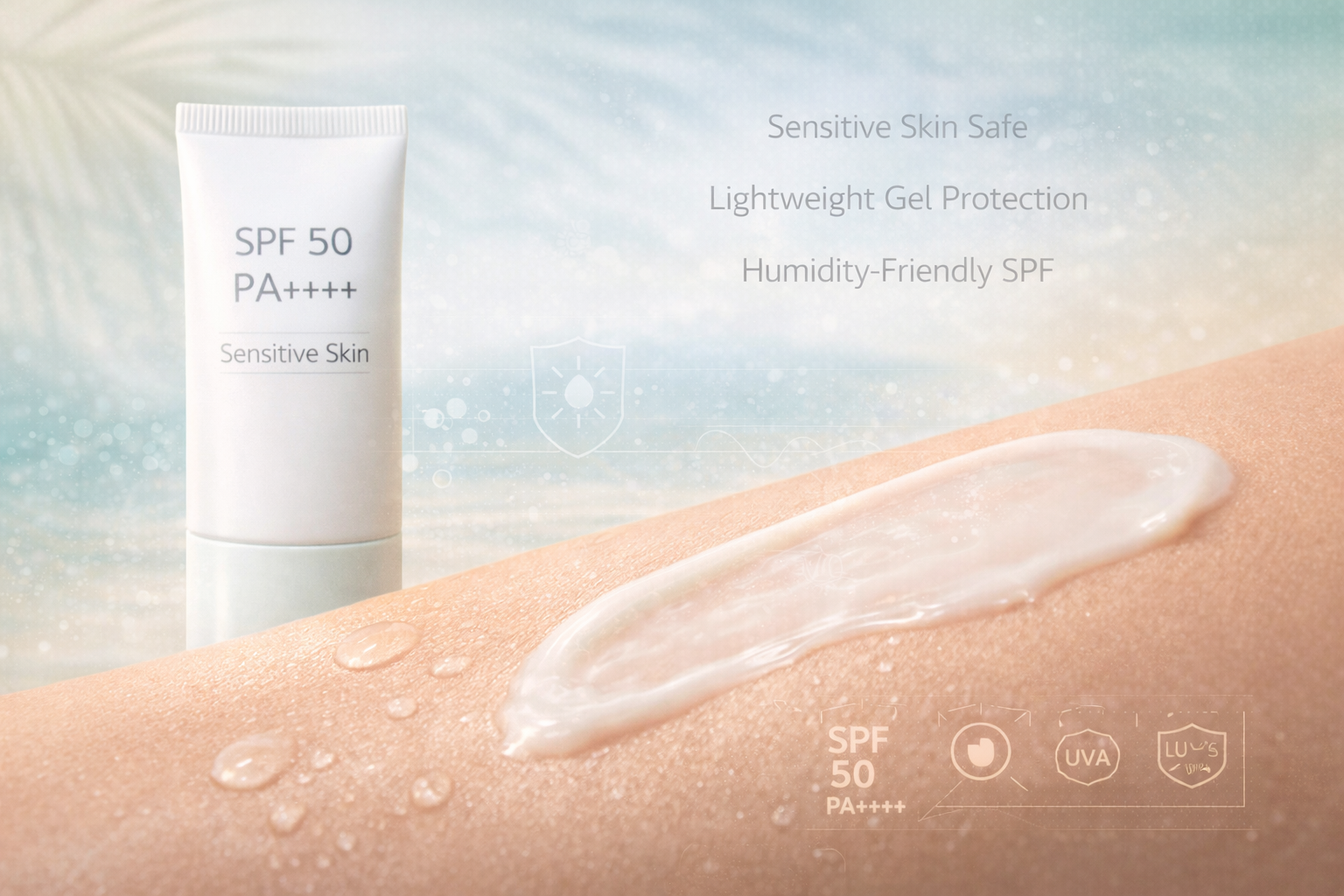
SECTION 1 — Why Sensitive Skin Reacts to Sunscreen in Heat & Humidity
Sensitive skin in a tropical climate like Thailand faces a “Triple Threat” that differs significantly from temperate zones. It is not just about the product; it is about how the product interacts with Heat, Sweat, and Vasodilation.
- Barrier Fragility in Heat: Research shows that when skin temperature exceeds 37°C, the lipid bilayer (your skin’s mortar) becomes more fluid and permeable. This allows potential irritants in sunscreens to penetrate deeper and faster than they would in a cool climate.
- The “Sting” of Vasodilation: Heat causes blood vessels to dilate (expand). This neurogenic inflammation lowers the threshold for sensory irritation. A sunscreen that feels fine in London might cause an immediate burning sensation in Bangkok simply because your nerve endings are hypersensitive due to heat.
- Sweat-Induced Dermatitis: In high humidity, sweat—which has a pH of 4.5–7.0 and contains salts/ammonia—can get trapped under occlusive sunscreens. This mixture macerates the stratum corneum, creating a pathway for allergens to enter.
The Clinical Reality: For sensitive skin in Thailand, breathability is as important as ingredients. An occlusive mineral sunscreen might be chemically safe but physically irritating due to heat trapping (Miliaria).
SECTION 2 — How Sunscreen Can Irritate Sensitive Skin
Understanding the mechanism of irritation helps you avoid it.
- Chemical Filter Reaction: Older UV filters like Oxybenzone and Avobenzone absorb UV energy and convert it to heat. On sensitive/rosacea skin, this exothermic reaction acts as a thermal trigger, causing flushing and stinging.
- The “Alcohol Shock”: Many lightweight Asian sunscreens use high concentrations of denatured alcohol to flash-dry the formula. While great for oily skin, on sensitive skin with a compromised barrier, this strips essential lipids and causes immediate stinging.
- Preservative Load: To survive the warm, humid shelf life in Thailand, formulas need robust preservatives. Ingredients like Methylisothiazolinone (MIT) are effective bactericides but common contact allergens.
- Fragrance Phototoxicity: Citrus and floral essential oils (Bergamot, Lime) can react with high-intensity tropical UV rays to cause Phytophotodermatitis—a blister-like burn that leaves hyperpigmentation.
SECTION 3 — What Makes Thai Sunscreens Suitable for Sensitive Skin
Thai formulators have developed a niche of “5-Free” or “7-Free” sunscreens specifically for the “Acne-Sensitive” demographic common in humid climates.
- Water-Encapsulation Technology: Instead of dissolving filters in oil or alcohol, brands like MizuMi and Her Hyness encapsulate them in a water-gel matrix. This minimizes direct contact between the filter and the skin barrier.
- Heat-Release Textures: Unlike heavy Western pastes, Thai sensitive sunscreens are designed to allow Transepidermal Water Loss (TEWL) to normalize, meaning sweat can evaporate rather than pooling under the film.
- Bio-Mimetic Soothing: They incorporate ingredients that mimic the skin’s natural anti-inflammatory processes, such as Centella Asiatica (Cica) and Ceramides, to buffer the impact of UV exposure.
SECTION 4 — Best Sunscreen Filters for Sensitive Skin
The filter is the engine of the sunscreen. For sensitive skin, we categorize them by “Irritation Potential.”
| Filter Category | Examples | Irritation Risk | Mechanism | Verdict for Sensitive Skin |
|---|---|---|---|---|
| Physical (Inorganic) | Zinc Oxide, Titanium Dioxide | Lowest | Reflects/Scatters UV. Biologically inert. | Gold Standard. Best for Rosacea/Eczema. |
| New-Gen Hybrid | Tinosorb S/M, Uvinul A Plus | Low | Large molecules (cannot penetrate skin). Photostable. | Excellent. Safe for most sensitive skins. |
| Old-Gen Chemical | Avobenzone, Octocrylene | High | Penetrates skin. Generates heat. Unstable. | Avoid. Common cause of stinging/allergy. |
| Solvent/Carrier | Alcohol Denat, Propylene Glycol | Medium | Disrupts barrier lipids to aid penetration. | Caution. Only acceptable in low % with buffers. |
SECTION 5 — SPF & PA for Sensitive Skin in Tropics
For sensitive skin, high UVA protection (PA++++) is non-negotiable.
- UVA = Inflammation: UVA rays penetrate the dermis and trigger the release of pro-inflammatory cytokines. This “silent inflammation” is what causes rosacea flare-ups and melasma darkening, even without a sunburn.
- Barrier Damage: UV exposure depletes the skin’s Ceramide levels. A PA++++ sunscreen preserves the barrier integrity, helping the skin defend itself against other irritants (pollution/sweat).
SECTION 6 — Soothing Ingredients in Thai Sunscreens
Thai formulations often double as “rescue serums.” Look for these on the INCI list:
- Centella Asiatica (Cica): A staple in Thai dermatology. It increases Type I collagen and significantly reduces UV-induced erythema (redness).
- Aloe Barbadensis Leaf Juice: Provides immediate evaporative cooling and hydration without occlusion.
- Mushroom Extracts (Fomes Officinalis): Used to tighten pores gently without the harshness of acids.
- Ceramides & Cholesterol: Found in brands like Ingu. These repair the mortar of the skin barrier while the SPF protects the bricks.
SECTION 7 — Best Thai Sunscreens for Sensitive Skin (By Need)
1. The Dermatologist’s Choice (Rosacea/Eczema)
Product: MizuMi UV Water Serum SPF50+ PA++++ (Blue)
- Why: It is the benchmark for “Non-Chemical” sunscreen in Thailand.
- Filters: 100% Physical (Micronized Zinc/Titanium).
- Safety: 5-Free (No Oil, Perfume, Alcohol, Paraben, Color).
- Feel: Breaks into water instantly. No heat-trapping.
2. The Barrier Builder (Damaged Skin)
Product: Ingu Super-Light Soothing Sunscreen
- Why: Formulated with Liposomal Ceramides and Niacinamide. It rebuilds the barrier while protecting it.
- Filters: Hybrid (Tinosorb) + Physical.
- Safety: Fragrance-free, reef-safe.
- Feel: Moisturizing but non-greasy.
3. The Anti-Aging Sensitive (Dry/Mature)
Product: Her Hyness Royal Hya Water Sunscreen
- Why: Uses Encapsulated UV Filters that do not touch the skin directly.
- Filters: Hybrid Encapsulated.
- Safety: Free from silicones that clog pores. Contains Royal Jelly for hydration.
- Feel: Like a luxury serum.
4. The Medical Matte (Acne + Sensitive)
Product: Smith Total Sunscreen SPF50+ PA+++
- Why: Created by a Thai dermatologist (Dr. Smith).
- Filters: Physical (Titanium Dioxide).
- Safety: Non-comedogenic, formulated for post-laser skin.
- Feel: Mousse-like, doubles as a primer.
SECTION 8 — Thai vs. Western Sensitive-Skin Sunscreens
| Feature | Thai (e.g., MizuMi) | Western (e.g., CeraVe Mineral) |
|---|---|---|
| Texture | Water-Gel / Milk | Thick Cream / Paste |
| White Cast | Minimal (Micronized) | High (Ghostly) |
| Heat Impact | Cooling (Evaporative) | Warming (Occlusive) |
| Wash Off | Easy (Soap/Micellar) | Difficult (Requires Scrubbing) |
| Irritation Risk | Low (New Gen Filters) | Low (Mineral) but high physical irritation |
Verdict: Thai formulations are superior for tropical sensitivity because they eliminate the heat-trapping occlusion of Western mineral pastes.
SECTION 9 — How to Apply Sunscreen on Sensitive Skin in Humidity
- The “Pat & Press” Technique: Do not rub. Rubbing generates friction heat and micro-exfoliation, triggering redness. Spread the fluid on your hands and press it gently into the face.
- Wait for the “Set”: Allow 5–10 minutes for the water phase to evaporate. This forms the protective film without trapping sweat.
- Cooling Prep: If your skin is flushed, splash with cool water or apply a cooled Aloe gel before sunscreen. Applying SPF to hot skin reduces efficacy and increases irritation.
- Double Cleanse Gently: You must remove the film at night. Use a Micellar Water (bioderma-style) followed by a gentle gel cleanser. Do not use scrubs.
SECTION 10 — Common Sunscreen Mistakes (Sensitive Skin in Thailand)
- Assuming “Baby” is Best: Baby sunscreens are often thick and sticky to ensure they stay on toddlers. On an adult face in humidity, this stickiness traps pollen and pollution, leading to “contact dermatitis.” Stick to adult sensitive formulas like MizuMi.
- Ignoring the Neck: The neck skin is thinner and more sensitive than the face. Always extend application down to the collarbone.
- Mixing Brands: Don’t layer a chemical sunscreen over a physical one. The ingredients can interact and destabilize, causing irritation. Stick to one good layer.
FAQ
Q: Is Thai sunscreen safe for sensitive skin?
A: Yes. Brands like MizuMi, Ingu, and Smith adhere to strict safety standards (5-Free/7-Free) and use advanced filters that are less irritating than traditional US filters.
Q: Does SPF irritate skin?
A: The SPF number doesn’t irritate, but the concentration of chemical filters needed to reach SPF 100 can. SPF 50 is the sweet spot for protection vs. irritation risk.
Q: What is the best mineral sunscreen in Thailand?
A: MizuMi UV Water Serum (Blue) is widely considered the best 100% physical sunscreen due to its innovative lightweight texture that doesn’t feel like chalk.
Q: Can I use sunscreen if I have Rosacea?
A: You must. UV is a primary trigger for Rosacea flares. Use a physical sunscreen (Zinc/Titanium) like Smith or MizuMi to reflect the heat and UV rays.
Q: Are “cooling” sunscreens safe?
A: No. Avoid sunscreens labeled “Cooling” or “Menthol” if you have sensitive skin. Menthol is a counter-irritant that tricks the nerves but actually causes inflammation and barrier disruption.
Q: Is fragrance-free better?
A: Absolutely. In the presence of UV light, fragrance molecules can become unstable and phototoxic. Always choose fragrance-free options like Ingu or Her Hyness.
Citations:
MizuMi UV Water Serum formulation analysis (Zinc Oxide, Water-Encapsulation, 5-Free safety).
Ingu Super-Light Soothing Sunscreen ingredient profile (Liposomal Ceramides, Hybrid Filters, Barrier Repair).
Her Hyness Royal Hya formulation (Encapsulated filters, removal of silicones/alcohol).
Smith Total Sunscreen medical-grade formulation (Physical filters, non-comedogenic).
Efficacy of botanical extracts (Lotus, Saussurea) in protecting skin barrier against UV radiation.