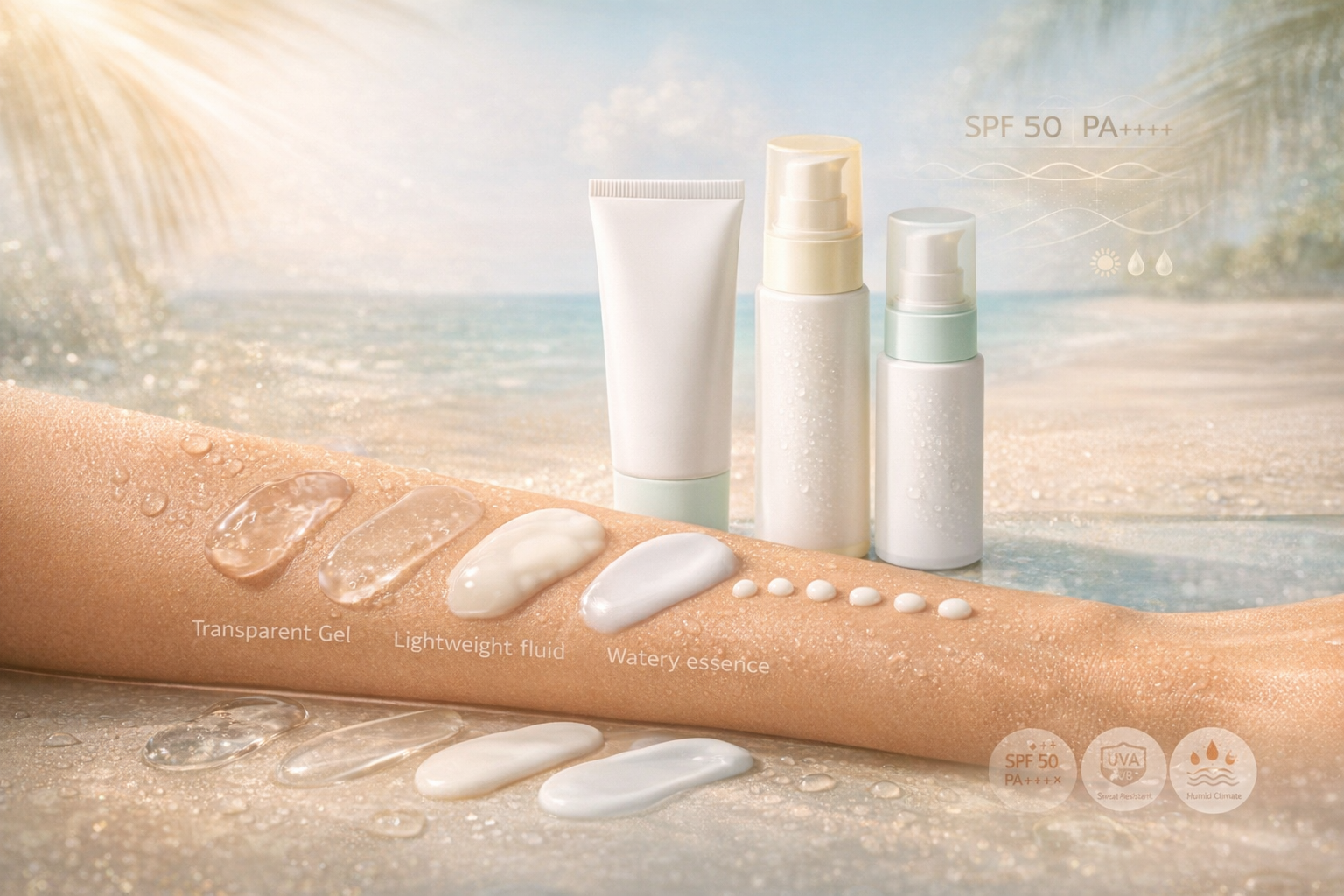
Quick Answer: The best Thai sunscreens are formulated specifically for high humidity and sweat resistance, unlike their Western or Korean counterparts. The top authorities are MizuMi (best for sensitive skin/physical UV filters), Her Hyness (best premium hybrid for anti-aging), Mistine (best budget/everyday wear), and Srichand (best for oily/acne-prone skin). For tropical travel, choose formulations labeled “Water Serum” for city use and strictly “Reef Safe” (Zinc Oxide/Titanium Dioxide) for island national parks to comply with the 2021 Thai regulatory ban on Oxybenzone.
SECTION 1 — Why Thai Sunscreens Are Different
The global obsession with Thai sunscreens isn’t just a trend; it is a solution to a meteorological problem. While Western sunscreens often focus on preventing burning (UVB) and Korean sunscreens prioritize winter hydration, Thai sunscreens are engineered for the “Tropical Crucible.”
Thailand’s average UV Index consistently hits 11+ (Extreme) year-round, combined with 75–90% relative humidity. This creates a unique challenge for formulation science: Film failure due to hyper-hidrosis (excessive sweating).
- The “Melt” Factor: In high humidity, traditional oil-based sunscreens trap heat, causing the skin to sweat the product off. Thai formulations prioritize hydrophilic-lipophilic balance (HLB) systems that allow sweat to evaporate through the sunscreen film without breaking its UV-protective matrix.
- Texture Innovation: The Thai market demands “Water Serum” textures—emulsions that break into water-like droplets upon contact, lowering skin surface temperature instantly.
- Whitening & Tone-Up: Culturally, there is a strong demand for “Tone-Up” effects. Unlike the “white cast” of Western mineral sunscreens, Thai tone-ups use micronized pigments (Iron Oxides and Titanium Dioxide) to color-correct yellow undertones and brighten dullness caused by sebum oxidation.
Expert Insight: “Formulating for Thailand is not about SPF numbers alone; it is about thermal comfort. If a sunscreen feels occlusive (suffocating) at 35°C, the consumer will apply less of it, rendering the SPF 50 label useless. Thai chemists master the ‘vanishing finish’—protection that feels like nothing.”
SECTION 2 — Thai Sunscreen Technology & Ingredients
Thai sunscreens represent a hybrid of Japanese technology (texture) and European safety standards (filters).
The Filter Spectrum
Unlike the US FDA, which has not approved a new UV filter in decades, Thailand follows the ASEAN Cosmetic Directive, which aligns closely with the EU. This allows Thai brands to use next-generation photostable filters.
| Filter Type | Common Names in Thai INCI | Function & Benefit |
|---|---|---|
| New Gen Chemical | Tinosorb S / M, Uvinul A Plus, Uvinul T 150 | High photostability, non-irritating, superior UVA1 protection (anti-aging). |
| Hybrid Encapsulated | Encapsulated Octocrylene / Avobenzone | Older filters wrapped in silica or polymer shells to prevent skin irritation and degradation. |
| Physical (Mineral) | Micronized Zinc Oxide, Titanium Dioxide | Reef-safe, reflects UV. Used heavily in “Sensitive Skin” lines (e.g., MizuMi). |
| Traditional | Octocrylene, Homosalate, Enzulisole | Common in budget brands (Mistine). Effective but older tech. |
PA++++ Explained
You will see PA++++ on every reputable Thai sunscreen. This is the PPD (Persistent Pigment Darkening) rating, originally from Japan.
- SPF 50 = Protection against UVB (Burning).
- PA++++ = Protection against UVA (Aging/Pigmentation).
- Why it matters: In the tropics, UVA intensity is constant. PA++++ indicates a PPD of 16+, meaning it takes 16 times longer to tan/age than unprotected skin. Do not buy anything less than PA++++ in Thailand.
SECTION 3 — Best Thai Sunscreen Brands (Authority Profiles)
1. MizuMi ( The Sensitive Skin Authority)
- Positioning: “5-Free” (No oil, perfume, alcohol, paraben, synthetic color).
- Signature Tech: 100% Non-Chemical (Physical) formulations that do not leave a ghost-white cast.
- Hero Product: UV Water Serum SPF50+ PA++++ (Blue Bottle).
- Best For: Sensitive skin, pregnancy, post-procedure skin.
2. Her Hyness (The Clean Beauty Royal)
- Positioning: Premium, “Clean Beauty,” Royal Jelly-infused skincare.
- Signature Tech: Encapsulated UV filters. They focus on hybrid sunscreens that act as skincare, often removing silicones to prevent clogging.
- Hero Product: Royal Hya Water Sunscreen SPF50+ PA++++.
- Best For: Anti-aging, dry skin, those who hate the feel of sunscreen.
3. Mistine (The National Icon)
- Positioning: Mass market, accessible, affordable, high durability.
- Signature Tech: “Aqua Base” technology. They excel at durable polymers that survive Bangkok commutes.
- Hero Product: Mistine Aqua Base Ultra Protection Matte & Light.
- Best For: Budget travelers, body application, daily city wear.
4. Srichand (The Oil Control Expert)
- Positioning: Legendary for loose powder, now translating that oil-control expertise to SPF.
- Signature Tech: “Sunlution” – sunscreens with active ingredients (Salicylic Acid for acne, Vit C for brightening).
- Hero Product: Sunlution Acne Care Sunscreen (Green Tube).
- Best For: Oily, acne-prone, and teenage skin.
SECTION 4 — Best Thai Sunscreens by Category
Best Lightweight (Invisible Finish)
Winner: Her Hyness Royal Hya Water Sunscreen
- Texture: Liquefies instantly. Zero silicone feel.
- Filters: Hybrid (Encapsulated).
- Why: It is arguably the most elegant texture on the market. It leaves a “glass skin” glow without greasiness.
Best for Sensitive / Post-Procedure Skin
Winner: MizuMi UV Water Serum (Blue)
- Texture: Milky white fluid, dries clear.
- Filters: 100% Physical (Zinc Oxide/Titanium Dioxide).
- Why: It has zero chemical absorbers, minimizing heat generation on the skin. Safe for rosacea and eczema.
Best for Acne-Prone / Oily Skin
Winner: Srichand Sunlution Acne Care (Green)
- Texture: Light cream-gel.
- Active Ingredients: Salicylic Acid (BHA) and Gluconolactone (PHA) to exfoliate while protecting.
- Why: It controls oil production for 8+ hours and prevents the “sunscreen breakout” cycle.
Best Waterproof / Beach Sport
Winner: MizuMi UV Water Active Sport (Orange)
- Texture: Velvety fluid.
- Durability: 80-minute water resistance.
- Why: Unlike the Blue version, this uses hybrid technology to adhere to wet skin. It is the go-to for diving and swimming.
Best “Medical Grade” (Use with Caution)
Winner: Yanhee Sun Block (White/Orange Tube)
- Context: Yanhee is a famous cosmetic hospital in Bangkok.
- Pros: High efficacy, treats melasma (often contains Arbutin/Glutathione).
- Warning: Some formulations still use Benzophenone-3 (Oxybenzone). While effective for humans, it is banned in National Parks. Use this only in the city.
SECTION 5 — Thai vs. Korean vs. Japanese Sunscreens
| Feature | Thai Sunscreens | Korean Sunscreens | Japanese Sunscreens |
|---|---|---|---|
| Primary Climate | Tropical (Hot/Humid) | Temperate (Cold Winters) | Varied (Humid Summers) |
| Texture Focus | “Water Serum” (Quick dry, sweat-thru) | Cream/Essence (Moisturizing) | Milk/Gel (Alcohol-based dry down) |
| Finish | Soft Matte / Satin (Oil Control) | Dewy / “Glass Skin” (Hydrating) | Natural / Matte |
| Alcohol Content | Moderate (needed for drying in humidity) | Low (to prevent dryness) | High (for elegance) |
| Best For… | Oily skin, sweating, humidity | Dry skin, winter, indoors | Daily commute, primers |
The Verdict: If you have oily skin or live in a humid climate (Florida, SE Asia, UK Summer), Thai sunscreens will outperform Korean ones, which may slide off or feel too heavy.
SECTION 7 — How to Choose a Thai Sunscreen (Decision Framework)
Use this logic flow to select your product:
- Where are you going?
- Marine Park / Island: MUST be MizuMi Blue or verified Reef Safe.
- Bangkok City / Shopping: Mistine or Her Hyness.
- What is your skin type?
- Oily/Acne: Srichand Green or Clear Nose.
- Dry/Dehydrated: Her Hyness.
- Sensitive: MizuMi.
- Makeup wearer?
- Yes: Look for “Serum” textures (MizuMi, Her Hyness) that act as a primer without pilling.
SECTION 8 — Should You Buy Sunscreen in Thailand?
Yes, absolutely.
- Price: A high-quality Anessa (Japanese) sunscreen costs ~$30 USD. A comparable Thai formulation (Mistine/MizuMi) costs $10–$15 USD (300–500 THB).
- Availability: Watsons, Boots, Eveandboy, and 7-Eleven are ubiquitous.
- Authenticity: Buy from major chains (Watsons/Boots) to avoid fakes found in street markets.
- Stocking Up: Thai sunscreens have a shelf life of 3 years unopened. They make excellent gifts/souvenirs due to their high quality-to-price ratio.
SECTION 9 — Reef Safety & Environmental Impact (CRITICAL)
The Law: Since August 2021, the Thai Department of National Parks has banned sunscreens containing:
- Oxybenzone (Benzophenone-3)
- Octinoxate (Ethylhexyl methoxycinnamate)
- 4-Methylbenzylid Camphor (4MBC)
- Butylparaben
The Fine: Up to 100,000 THB ($2,800 USD).
Advice: Do not trust the label “Reef Safe” blindly. Flip the bottle and check the INCI list.
- Safe Bet: MizuMi UV Water Serum (Blue) is the gold standard for compliance.
- Avoid: Older Yanhee formulations or generic “Coconut Oil Sunscreens” sold at beach stalls, which often lack broad-spectrum protection.
SECTION 10 — FAQ
Q: What does PA++++ mean?
A: It is the highest rating for UVA protection (aging rays). It means the product offers a PPD (Persistent Pigment Darkening) of 16 or higher.
Q: Can I use Thai sunscreen in winter/cold climates?
A: Yes, but you may need a moisturizer underneath. Thai sunscreens are not designed to protect against windburn or extreme dryness.
Q: Are Thai sunscreens safe?
A: Yes. Thailand FDA regulations are stricter than the US FDA regarding filter safety, aligning with EU and ASEAN standards.
Q: Do Thai sunscreens whiten skin?
A: “Tone-Up” versions do provide an instant (temporary) brightening effect. However, standard “Water Serums” (like Her Hyness) dry clear. Read the label: if it says “Tone Up” or “Base,” it has pigment.
Q: How often should I reapply in Thailand?
A: Due to sweating, reapply every 2 hours if outdoors, or immediately after swimming.
Q: Is SPF 50 enough in Thailand?
A: Yes, provided you apply the correct amount (2 fingers length for the face). SPF 50 blocks 98% of UVB. Higher numbers (SPF 100) offer negligible extra protection and often have worse textures.
Q: Can I find these brands in the USA/Europe?
A: Some are available via specialized importers (YesStyle, Stylevana) or Amazon, but the price will be double. It is best to buy them in Thailand.
Q: Is Mistine better than Biore (Japanese)?
A: Mistine is comparable to Biore in texture but often has better water resistance for the humid climate, and is significantly cheaper in Thailand.
Conclusion
Thai sunscreens are the undisputed champions of tropical photoprotection. By combining advanced European filters with textures designed for extreme humidity, brands like MizuMi and Her Hyness offer a wearing experience that is superior to Western counterparts for anyone with oily skin or those living in hot climates. When visiting Thailand, prioritizing PA++++ and Reef Safe ingredients is not just a skin health choice—it’s a legal and environmental responsibility.
Citations:
Formulation efficacy and regulatory alignment with ASEAN standards.
Her Hyness and MizuMi ingredient profiles and comparative analysis.
Thai Department of National Parks sunscreen ban regulations and fine structure.
Comparative analysis of Thai vs. Korean skincare philosophy based on climate.
Mistine and Srichand active ingredient analysis.