The Problem You’re Facing
Your skin isn’t cooperating. You’ve tried countless routines, purchased products that promised results, and scrolled through conflicting advice online-yet you’re no closer to the clear, healthy skin you want. The real issue? Most skincare guidance oversimplifies the science or recommends generic routines that ignore your unique skin type, concerns, and lifestyle.
What This Guide Delivers
This comprehensive skincare guide cuts through the noise with dermatology-backed routines, ingredient science, and product recommendations tailored to your specific needs. Whether you’re a skincare beginner or an enthusiast, you’ll discover the exact steps to build an effective routine, understand which ingredients actually work, and learn how to adapt your approach as your skin evolves.
What You’ll Learn in This Guide
This resource covers everything from foundational skincare science to advanced techniques. You’ll understand why product order matters, how to identify your true skin type, which ingredients deliver results, and how to troubleshoot common concerns like acne, dark spots, and aging. Most importantly, you’ll walk away with actionable routines you can implement today.
Why Trust This Guide
This guide is grounded in dermatological research, clinical studies, and evidence-based skincare formulation science. Every recommendation reflects how skin actually responds to active ingredients, hydration, and barrier support-not marketing claims or trends.
Section 1: Skincare Routine Order (The Correct Steps)
Why Order Matters: The Science Behind Sequencing
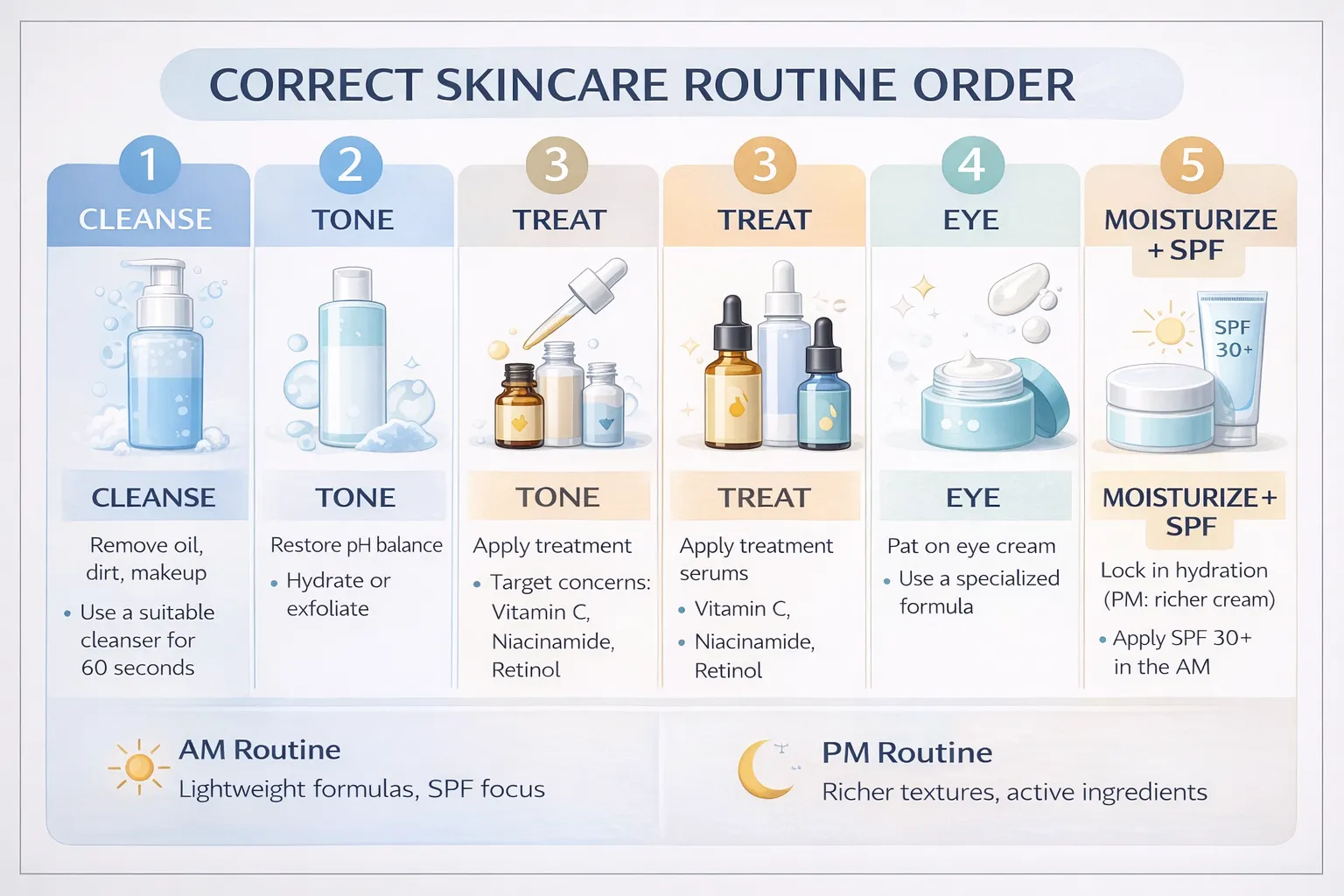
The sequence in which you apply skincare products isn’t arbitrary-it’s fundamental to efficacy. Your skin has a lipid barrier and multiple layers, each with different permeability and absorption rates. Applying products in the wrong order can cause:
- Reduced penetration: Heavier products applied first can block lighter actives from reaching deeper layers where they’re needed.
- Ingredient interference: Some ingredients compete for the same pathways; layering them incorrectly diminishes their effectiveness.
- Compromised barrier function: Disrupting the order can irritate sensitive skin or trigger transepidermal water loss (TEWL).
The correct sequence follows a simple principle: light to heavy, water to oil. Water-based treatments penetrate first, followed by oil-soluble ingredients, then occlusive moisturizers.
The 5-Step Routine Framework
A dermatology-informed skincare routine consists of five core steps, each serving a specific function:
1. Cleanse (Water-Soluble)
Purpose: Remove oil, bacteria, makeup, and environmental pollutants without disrupting the skin barrier.
Cleansing is the foundation. Without proper cleansing, subsequent products cannot penetrate effectively. Choose a cleanser that matches your skin type (see Skincare Routines by Skin Type for specific recommendations).
Duration: 60 seconds
Frequency: Twice daily (morning and evening)
2. Tone (Hydrating or Exfoliating)
Purpose: Restore pH balance and begin hydration (hydrating toners) or provide gentle chemical exfoliation (exfoliating toners).
Modern toners are not astringent-they’re treatment products. Hydrating toners containing glycerin or hyaluronic acid prepare the skin for serums. Exfoliating toners with AHAs/BHAs provide gentle daily exfoliation for those with resilient skin.
Duration: Allow 30–60 seconds to dry
Frequency: Daily (adjust based on skin sensitivity)
3. Treat (Actives & Serums)
Purpose: Address specific concerns using active ingredients like retinol, vitamin C, niacinamide, or AHAs/BHAs.
This step is where targeted treatment happens. Serums contain concentrated active ingredients in smaller molecular weights, allowing deeper penetration. Apply to clean, slightly damp skin for optimal absorption.
Duration: Allow 2–3 minutes between layers if using multiple serums
Frequency: Varies by product (see Advanced Skincare Topics)
4. Eye Care (Specialized)
Purpose: Address delicate periocular skin-thinner, more prone to dehydration and fine lines.
The eye area has minimal sebaceous glands and thinner dermis, making it vulnerable to dryness and premature aging. Use a dedicated eye product rather than applying facial serums to this zone.
Duration: Pat gently with ring finger
Frequency: Twice daily
5. Moisturize & Protect (Oil + Occlusives)
Purpose: Lock in hydration, reinforce the barrier, and in AM routine, provide UV protection.
Moisturizers contain humectants (water-attracting), emollients (softening), and occlusives (sealing). In the morning routine, sunscreen is non-negotiable-UV exposure causes 80% of visible skin aging.
Duration: Allow 2–3 minutes for absorption
Frequency: Twice daily (sunscreen AM only, unless using daily moisturizer with SPF)
Morning Routine vs. Evening Routine
AM Routine (3–5 minutes)
- Cleanser
- Toner (optional, hydrating)
- Vitamin C serum or brightening active (optional)
- Eye cream
- Lightweight moisturizer
- Sunscreen (SPF 30+)
PM Routine (5–10 minutes)
- Cleanser (double cleanse if wearing makeup)
- Toner
- Exfoliating active (AHA/BHA) OR retinol (alternate nights) OR hydrating serum
- Eye cream
- Richer moisturizer or night cream
Key Difference: The AM routine prioritizes sun protection and uses lighter, faster-absorbing products. The PM routine can accommodate richer textures and potent actives because there’s no photosensitivity concern.
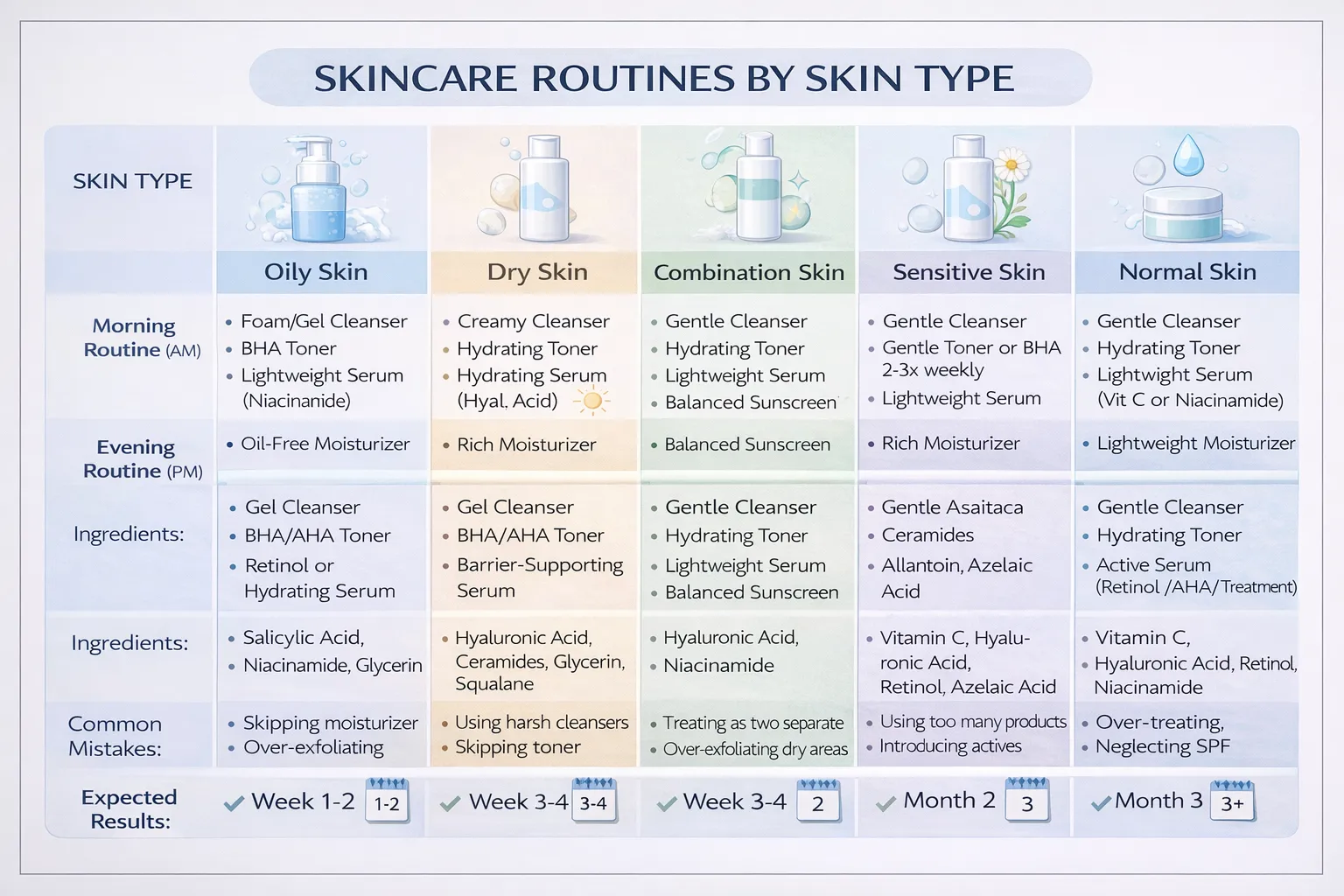
Section 2: Skincare Routines by Skin Type
Identifying your true skin type is essential before building a routine. Many people misidentify their skin type-oily skin might actually be dehydrated, and dry patches could indicate barrier damage rather than inherent dryness.
How to identify your skin type: Cleanse your face thoroughly, wait 30 minutes without applying any products, then observe. Do you feel tight? Do you see shine across your T-zone? Do you have visible flaking or redness?
Oily Skin Routine
Characteristics
Oily skin overproduces sebum due to enlarged pores and overactive sebaceous glands. This results in shine, congestion, and frequent breakouts. Contrary to popular belief, oily skin still needs hydration-depriving it of moisture triggers increased oil production.
Who This Is For
If your T-zone (forehead, nose, chin) appears shiny by midday, you experience frequent congestion or blackheads, and products feel heavy on your skin, this routine is designed for you.
AM Routine for Oily Skin
- Lightweight gel or foam cleanser
- Exfoliating toner with BHA (2–3x weekly) or hydrating toner (daily)
- Lightweight serum (niacinamide or hyaluronic acid)
- Oil-free moisturizer or mattifying gel
- Oil-control sunscreen
PM Routine for Oily Skin
- Gel cleanser
- Exfoliating toner with BHA or AHA
- Retinol serum (if not using actives in AM)
- Lightweight night moisturizer
- Optional: Clay or charcoal mask (2x weekly)
Best Ingredients for Oily Skin
- Niacinamide: Regulates sebum production and minimizes pores
- Salicylic acid (BHA): Penetrates pores to dissolve sebum and prevent congestion
- Glycerin: Provides hydration without heaviness
- Hyaluronic acid: Lightweight hydration that prevents oil overproduction
Common Mistakes to Avoid
- Skipping moisturizer: This dehydrates skin, triggering excess oil production as compensation
- Over-exfoliating: Using BHA/AHA daily combined with physical exfoliation irritates skin and increases oil production
- Using heavy occlusive moisturizers: Choose gel-based or lightweight formulas instead
- Layering too many actives: Stick to one active per routine (one exfoliating, one hydrating serum)
Expected Results Timeline
- Week 1–2: Reduced shine by midday
- Week 3–4: Visible improvement in pore appearance
- Month 2–3: Decreased breakouts and congestion
- Month 3+: Stable sebum production with consistent routine
Dry Skin Routine
Characteristics
Dry skin produces insufficient sebum and often exhibits compromised barrier function. This results in tightness, flaking, sensitivity, and accelerated visible aging. Dry skin requires consistent hydration and barrier support.
Who This Is For
If your skin feels tight after cleansing, you see visible flaking or rough patches, products absorb quickly but skin still feels uncomfortable, or you experience redness and sensitivity, this routine targets your needs.
AM Routine for Dry Skin
- Gentle, creamy cleanser or micellar water
- Hydrating toner with glycerin or ceramides
- Hydrating serum (hyaluronic acid, squalane, or peptides)
- Rich moisturizer with ceramides and humectants
- Sunscreen with hydrating ingredients
PM Routine for Dry Skin
- Gentle creamy cleanser
- Hydrating toner
- Hydrating or barrier-supporting serum
- Rich night cream or facial oil
- Optional: Sheet mask (3–4x weekly)
Best Ingredients for Dry Skin
- Hyaluronic acid: Holds up to 1000x its weight in water
- Ceramides: Repair and maintain barrier function
- Glycerin: Humectant that draws water into skin
- Squalane: Lightweight emollient that mimics skin’s natural oils
- Peptides: Support barrier strength and improve moisture retention
Common Mistakes to Avoid
- Using harsh cleansers: This strips the barrier further; choose sulfate-free, creamy formulas
- Skipping toner: Toners prepare skin for better serum absorption-especially important for dry skin
- Applying serums to completely dry skin: Slightly damp skin (just cleansed, not fully dry) absorbs hydrating serums more effectively
- Using actives too frequently: Dry skin is typically sensitive; introduce retinol gradually and use only 2–3x weekly
Expected Results Timeline
- Week 1–2: Reduced tightness and improved comfort
- Week 2–3: Flaking begins to diminish
- Week 3–4: Visible plumping as hydration increases
- Month 2+: Smoother texture and reduced sensitivity
Combination Skin Routine
Characteristics
Combination skin displays multiple characteristics-typically oily T-zone with normal-to-dry cheeks. This requires a balanced approach that doesn’t over-dry the T-zone or under-hydrate the cheeks.
Who This Is For
If you notice shine on your forehead and nose but dryness or tightness on your cheeks, experience congestion in some areas but sensitivity in others, this hybrid approach accommodates both zones.
AM Routine for Combination Skin
- Gentle-to-moderate cleanser (not too stripping, not too heavy)
- Hydrating toner
- Lightweight hydrating serum (hyaluronic acid)
- Lightweight moisturizer
- Oil-control or hydrating sunscreen
PM Routine for Combination Skin
- Gentle cleanser
- Hydrating or gentle exfoliating toner (BHA 2–3x weekly, hydrating toner other nights)
- Lightweight serum (can adapt based on concern)
- Lightweight to moderate moisturizer
- Optional: Apply heavier moisturizer to cheeks, lighter formulation to T-zone
Best Ingredients for Combination Skin
- Hyaluronic acid: Hydrates without heaviness
- Niacinamide: Balances oil and hydration
- Glycerin: Neutral humectant for all zones
- Lightweight ceramides: Provide barrier support without occlusion
Common Mistakes to Avoid
- Using a single heavy moisturizer: This overwhelms the T-zone; consider a lightweight formula or zone-specific application
- Treating combination skin as two separate types: Use a unified routine with products that work for both areas
- Over-exfoliating the dry areas: Limit exfoliation to oily zones if needed
Expected Results Timeline
- Week 1–2: Better balance across zones
- Week 2–4: Reduced shine in T-zone without increased dryness
- Month 2+: Stable combination with zone-specific maintenance
Sensitive Skin Routine
Characteristics
Sensitive skin is reactive, with a compromised barrier function. It experiences redness, burning, stinging, or inflammation in response to products or environmental triggers. Sensitive skin requires gentle, minimalist routines with barrier-supporting ingredients.
Who This Is For
If products frequently cause stinging or burning, you have visible redness or reactive patches, you break out easily from new products, or you have conditions like rosacea or eczema-prone skin, prioritize gentle formulations.
AM Routine for Sensitive Skin
- Gentle cream or micellar cleanser
- Hydrating toner (no actives or fragrance)
- Calming serum (centella asiatica, allantoin, or azelaic acid for rosacea)
- Rich moisturizer with ceramides
- Mineral sunscreen (physical blockers are typically less irritating)
PM Routine for Sensitive Skin
- Gentle cream cleanser
- Hydrating toner
- Calming serum (avoid actives; focus on soothing)
- Barrier-supporting night cream
- Optional: Apply facial oil over moisturizer for additional protection
Best Ingredients for Sensitive Skin
- Centella asiatica: Calming, anti-inflammatory, strengthens barrier
- Ceramides: Restore barrier integrity
- Niacinamide: Calming, supports barrier, reduces redness
- Allantoin: Soothing, wound-healing properties
- Azelaic acid: Anti-inflammatory, suitable for rosacea and reactive skin
Common Mistakes to Avoid
- Using too many products: Simplify your routine; each product increases irritation risk
- Introducing actives too quickly: If you must use retinol or exfoliants, start with lowest concentration, lowest frequency
- Using fragrance or essential oils: These are common irritants; avoid entirely
- Skipping sunscreen: Compromised barrier + UV exposure = accelerated irritation
Expected Results Timeline
- Week 1–2: Reduced stinging and redness
- Week 2–4: Barrier feels stronger; less reactive to products
- Month 2+: Ability to tolerate mild actives or specific treatments
Normal Skin Routine
Characteristics
Normal skin is well-balanced, with adequate sebum production, minimal sensitivity, and a healthy barrier. This skin type tolerates most products well and shows visible improvement with proper maintenance.
Who This Is For
If your skin feels comfortable after cleansing, you experience minimal breakouts or sensitivity, and your skin adapts well to products, this routine provides a solid foundation while allowing flexibility for concerns.
AM Routine for Normal Skin
- Gentle to moderate cleanser
- Hydrating toner (optional)
- Lightweight serum (vitamin C, hyaluronic acid, or niacinamide)
- Lightweight to moderate moisturizer
- Sunscreen
PM Routine for Normal Skin
- Gentle cleanser
- Hydrating toner
- Active serum (retinol, AHA, BHA, or treatment serum based on concern)
- Moderate moisturizer or night cream
- Optional: Mask or additional treatment (1–2x weekly)
Best Ingredients for Normal Skin
- Vitamin C: Brightening, antioxidant protection
- Hyaluronic acid: Hydration and plumping
- Retinol: Anti-aging, cell turnover
- AHA/BHA: Chemical exfoliation for texture
- Niacinamide: Multi-benefit-brightening, balancing, calming
Common Mistakes to Avoid
- Over-treating: Because normal skin tolerates actives, over-using them can damage the barrier
- Neglecting SPF: Sun damage is cumulative; never skip sunscreen
- Skipping maintenance: Normal skin requires consistent routine; skipping products leads to dehydration or barrier compromise
Expected Results Timeline
- Week 1–2: Skin appears brighter and more hydrated
- Month 1–2: Visible improvement in targeted concerns
- Month 3+: Sustained clarity and youthful appearance with consistent routine
Section 3: Skincare Ingredients Explained
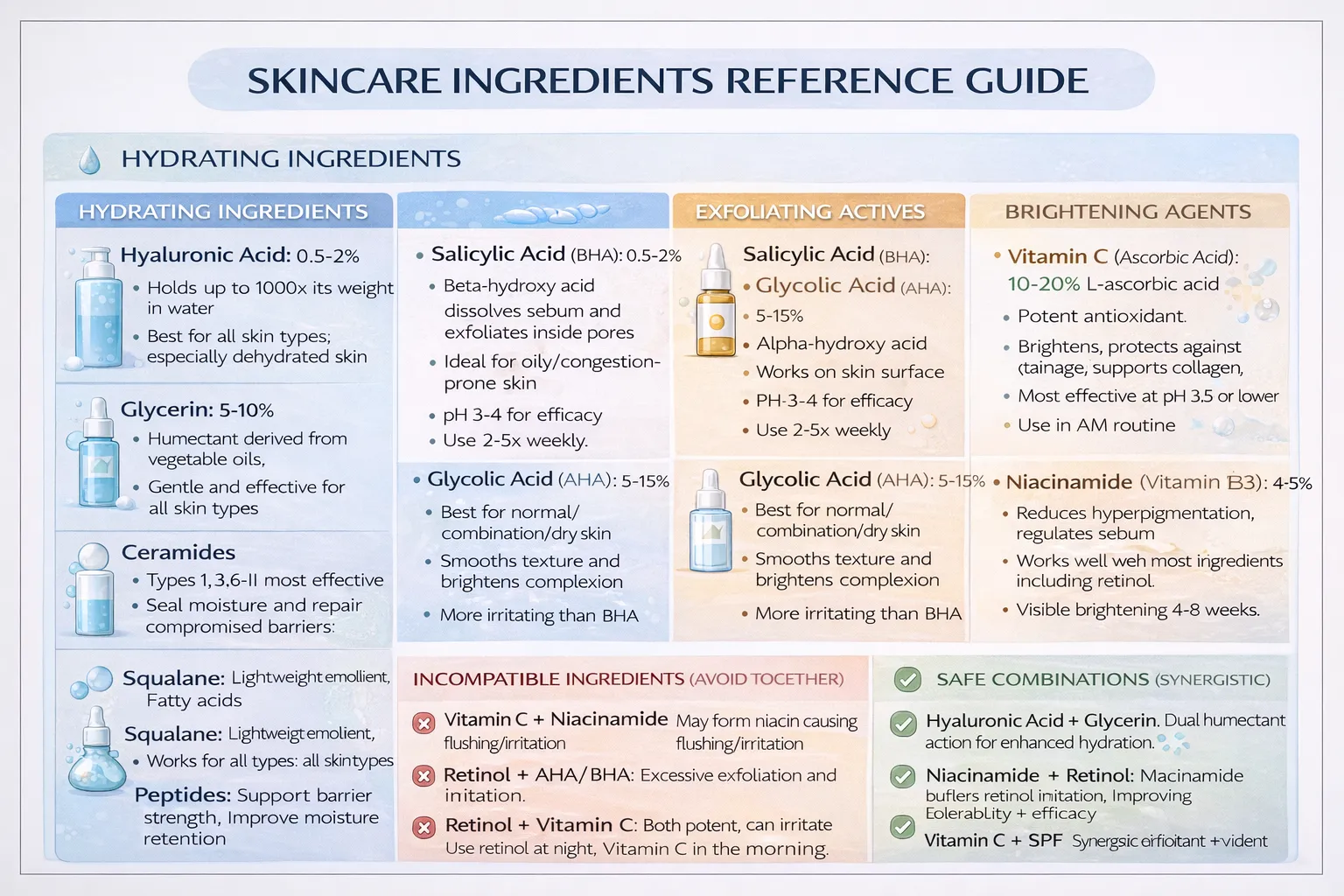
Understanding key ingredients empowers you to choose products strategically and recognize what’s truly effective versus marketing hype.
Hydration Ingredients
Hydrating ingredients work through three mechanisms: humectants (draw water), emollients (soften), and occlusives (seal).
Hyaluronic Acid
A naturally occurring humectant found in skin. Hyaluronic acid holds up to 1000x its molecular weight in water, making it extraordinarily hydrating.
- Molecular weight matters: Low-molecular-weight HA penetrates deeper; high-molecular-weight creates surface hydration
- Application tip: Apply to damp skin for optimal absorption
- Best for: All skin types, especially dehydrated or aging skin
- Concentration: 0.5–2% is effective
Glycerin
A humectant derived from vegetable oils. Glycerin is gentle, effective, and suitable for all skin types.
- Effective concentration: 5–10%
- Synergy: Works best combined with other hydrating ingredients
- Best for: All skin types
- Common in: Hydrating toners, serums, moisturizers
Ceramides
Lipids naturally present in the skin barrier. Ceramides seal moisture and repair compromised barriers.
- Types: Ceramides 1, 3, and 6-II are most studied for efficacy
- Concentration: Look for ceramides in top 5 ingredients for effectiveness
- Best for: Dry, sensitive, or barrier-damaged skin
- Works synergistically: Combine with cholesterol and fatty acids for optimal barrier repair
Active Ingredients: Exfoliants
Exfoliants remove dead skin cells and promote cell turnover, revealing smoother, brighter skin.
Salicylic Acid (BHA)
A beta-hydroxy acid that dissolves sebum and exfoliates inside pores.
- Ideal concentration: 0.5–2%
- Best for: Oily, congestion-prone, acne-prone skin
- Frequency: 2–5x weekly (adjust based on tolerance)
- pH matters: BHA is only effective at pH 3–4; higher pH reduces efficacy
- Purging: Expect 1–2 weeks of increased breakouts as skin exfoliates clogged pores
Glycolic Acid (AHA)
An alpha-hydroxy acid that works on skin surface, dissolving dead skin cells.
- Ideal concentration: 5–15%
- Best for: Normal, combination, and dry skin
- Frequency: 2–5x weekly
- Texture improvement: Glycolic acid smooths texture and brightens complexion
- Sensitivity: More irritating than BHA; start low-concentration
Active Ingredients: Anti-Aging & Cell Turnover
Retinol
A vitamin A derivative that increases cell turnover, stimulates collagen production, and reduces fine lines.
- Strengths: Most studied anti-aging ingredient; suitable for most skin types
- Starting strength: 0.25–0.5% for beginners
- Frequency: 2–3x weekly initially; can increase to daily with acclimation
- Photosensitivity: Use only at night; always wear sunscreen the next day
- Timeline: Visible results in 8–12 weeks
Brightening & Hyperpigmentation Ingredients
Vitamin C (Ascorbic Acid)
A potent antioxidant that brightens skin, protects against environmental damage, and supports collagen synthesis.
- Stabilized forms: L-ascorbic acid is most effective but unstable; stabilized forms (ascorbyl palmitate, sodium ascorbyl phosphate) are more stable but less potent
- Ideal concentration: 10–20% (L-ascorbic acid)
- pH: Effective at pH 3.5 or lower
- Application: Use in AM routine for daytime antioxidant protection
- Stability: Vitamin C oxidizes when exposed to air; use within 3 months of opening
Niacinamide (Vitamin B3)
A water-soluble vitamin with multiple benefits: reduces hyperpigmentation, regulates sebum, strengthens barrier.
- Effective concentration: 4–5%
- Best for: All skin types
- Synergy: Works well with most ingredients; notably compatible with retinol
- Timeline: Visible brightening in 4–8 weeks
Arbutin (Alpha & Beta)
A naturally derived ingredient that inhibits tyrosinase enzyme, reducing melanin production.
- Effectiveness: More gradual than hydroquinone but safer for prolonged use
- Concentration: 2% is standard
- Best for: Hyperpigmentation, dark spots, melasma
- Timeline: 8–12 weeks for visible results
Incompatible Ingredients & Safe Combinations
Avoid Together
| Ingredient A | Ingredient B | Why | Solution |
|---|---|---|---|
| Vitamin C | Niacinamide | May form niacin (flushing, irritation) | Use at different times (C in AM, niacinamide in PM) |
| Retinol | AHA/BHA | Excessive exfoliation, irritation | Alternate nights or use retinol alone |
| Retinol | Vitamin C | Both are potent; can irritate | Use retinol at night, vitamin C in morning |
| Benzoyl Peroxide | Retinol | Reduces retinol efficacy | Apply to separate areas or at different times |
Safe Combinations
| Ingredient A | Ingredient B | Why | Benefit |
|---|---|---|---|
| Hyaluronic acid | Glycerin | Dual humectant action | Enhanced hydration |
| Niacinamide | Retinol | Niacinamide buffers retinol irritation | Tolerability + efficacy |
| Ceramides | Hyaluronic acid | Seal + hydrate | Optimal barrier + moisture |
| Vitamin C | SPF | Synergistic antioxidant + UV protection | Comprehensive photoprotection |
Section 4: Best Skincare Products by Category
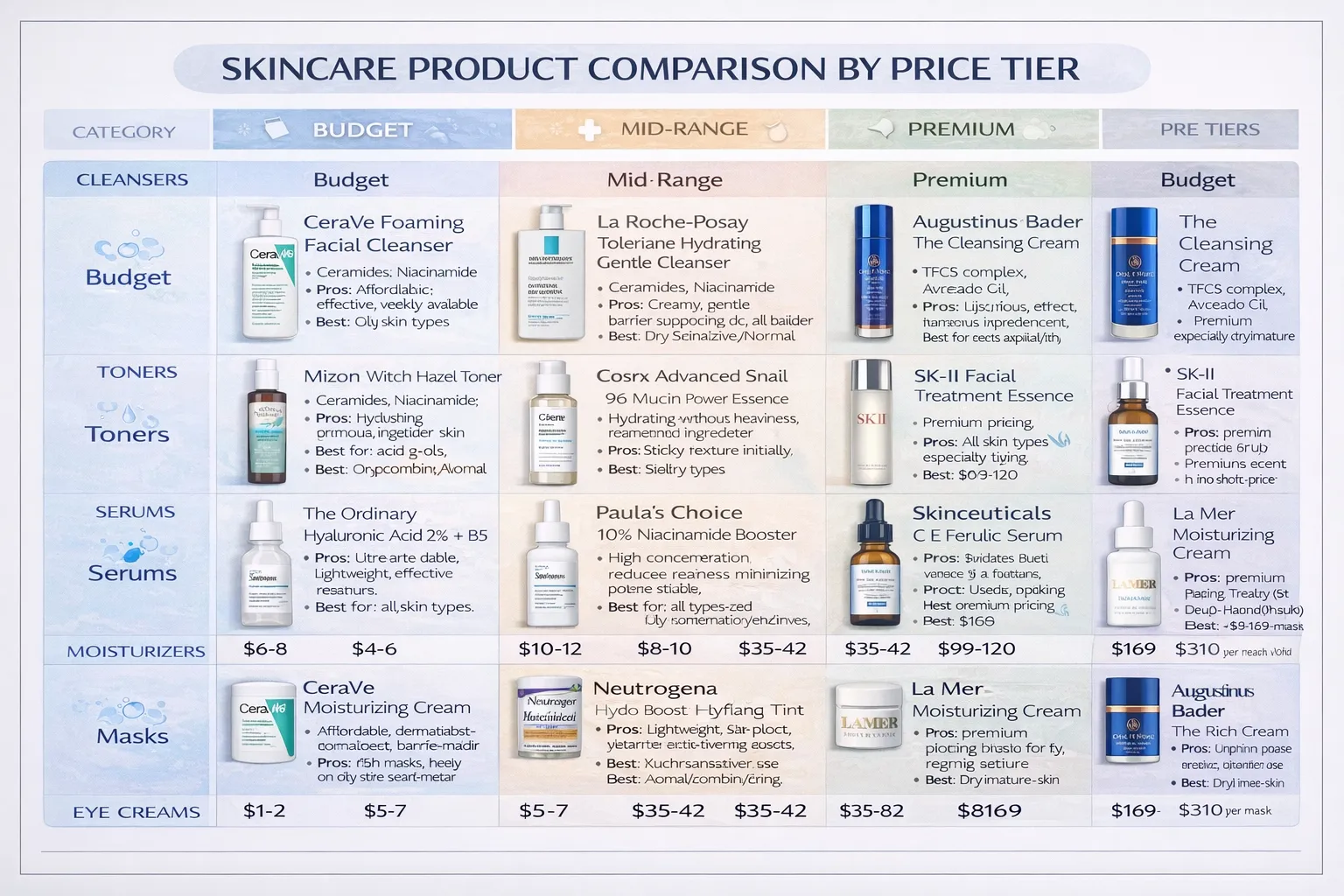
Product selection depends on your skin type, concern, and budget. This section breaks down categories with options across price points.
Cleansers
Cleansers remove makeup, sebum, and environmental pollutants without stripping the skin barrier.
Budget Option: CeraVe Foaming Facial Cleanser
- Best for: Oily, combination skin
- Key ingredients: Ceramides, hyaluronic acid, niacinamide
- Pros: Affordable, effective, widely available, fragrance-free
- Cons: Can feel slightly tight on very dry skin
- Price: $6–8
Mid-Range Option: La Roche-Posay Toleriane Hydrating Gentle Cleanser
- Best for: Dry, sensitive, normal skin
- Key ingredients: Ceramides, niacinamide, prebiotic thermal water
- Pros: Creamy, gentle, supports barrier, suitable for reactive skin
- Cons: Slightly heavier feel; may leave residue if not fully rinsed
- Price: $10–12
Premium Option: Augustinus Bader The Cleansing Cream
- Best for: All skin types (especially dry/mature)
- Key ingredients: Natural ingredients, amino acids, beeswax
- Pros: Luxurious texture, effective, minimal ingredients, supports barrier
- Cons: Premium pricing, jar packaging (requires fingers in jar)
- Price: $68
Toners
Modern toners are treatment products that hydrate, balance pH, and prepare skin for serums.
Budget Option: Mizon Witch Hazel Toner
- Best for: Oily, combination skin
- Key ingredients: Witch hazel, glycerin, aloe vera
- Pros: Affordable, suitable for sensitive skin despite witch hazel, hydrating
- Cons: Fragrance (may irritate extremely sensitive skin)
- Price: $4–6
Mid-Range Option: Cosrx Advanced Snail 96 Mucin Power Essence
- Best for: Dehydrated, sensitive, normal skin
- Key ingredients: Snail secretion filtrate, hyaluronic acid
- Pros: Hydrating without heaviness, fermented ingredient boosts efficacy, affordable
- Cons: Sticky texture initially; requires time to dry
- Price: $8–10
Premium Option: SK-II Facial Treatment Essence
- Best for: All skin types (especially aging)
- Key ingredients: PITERA (fermented yeast), hyaluronic acid
- Pros: Gold-standard hydrating essence, visible brightening, refined texture
- Cons: Premium pricing, fermented ingredient scent (polarizing)
- Price: $99–120
Serums
Serums deliver concentrated active ingredients in small molecular weights for deep penetration.
Budget Option: The Ordinary Hyaluronic Acid 2% + B5
- Best for: All skin types
- Key ingredients: Hyaluronic acid, panthenol (B5)
- Pros: Ultra-affordable, lightweight, effective hydration
- Cons: Can feel sticky; requires layering with moisturizer
- Price: $5–7
Mid-Range Option: Paula’s Choice 10% Niacinamide Booster
- Best for: All skin types (especially oily, combination, sensitive)
- Key ingredients: Niacinamide, aloe, hydrating humectants
- Pros: High niacinamide concentration, reduces redness, minimizes pores, stable formula
- Cons: May feel thick if layered with heavy moisturizer
- Price: $35–42
Premium Option: Skinceuticals C E Ferulic Serum
- Best for: Aging, sun-damaged, dull skin
- Key ingredients: 15% L-ascorbic acid, vitamin E, ferulic acid
- Pros: Most studied vitamin C serum, visible brightening, antioxidant protection, pH optimized
- Cons: Oxidizes quickly after opening, premium pricing, photosensitivity risk
- Price: $169
Moisturizers
Moisturizers lock in hydration and support barrier function. Texture varies from lightweight gels to rich creams.
Budget Option: CeraVe Moisturizing Cream
- Best for: Dry, sensitive, barrier-damaged skin
- Key ingredients: Ceramides, hyaluronic acid, niacinamide
- Pros: Affordable, formulated with dermatologists, effective barrier repair, fragrance-free
- Cons: Rich texture; can feel heavy on oily skin
- Price: $12–16 (tub)
Mid-Range Option: Neutrogena Hydro Boost Hydrating Tint SPF 30
- Best for: Normal, combination, oily skin
- Key ingredients: Hyaluronic acid, SPF 30
- Pros: Lightweight, provides sun protection, tinted to even skin tone, buildable coverage
- Cons: SPF concentration limits standalone use; requires higher SPF foundation
- Price: $8–10
Premium Option: La Mer Moisturizing Cream
- Best for: Dry, mature, sun-damaged skin
- Key ingredients: Miracle Broth (seaweed ferment), hyaluronic acid, glycerin
- Pros: Legendary formula, visible plumping, luxurious texture, transformative for dry skin
- Cons: Premium pricing, heavy for oily/combination skin, minimal actives
- Price: $310
Masks (Sheet & Clay)
Masks provide concentrated treatment and allow weekly boost to your routine.
Budget Option: Mediheal Tea Tree Calming Mask (Sheet)
- Best for: Oily, acne-prone skin
- Key ingredients: Tea tree oil, centella asiatica, hyaluronic acid
- Pros: Affordable, soothing, anti-inflammatory, hydrating
- Cons: Fragrance and essential oils (may irritate extremely sensitive skin)
- Price: $1–2 per sheet mask
Mid-Range Option: Aztec Indian Healing Clay
- Best for: Oily, congestion-prone skin
- Key ingredients: Bentonite clay, calcium montmorillonite
- Pros: Ultra-affordable, draws out impurities, visible pore improvement, DIY-friendly
- Cons: Drying; requires hydrating mask or moisturizer afterward
- Price: $4–6
Premium Option: SK-II Facial Treatment Mask
- Best for: All skin types (especially aging, dull)
- Key ingredients: PITERA, hyaluronic acid, panthenol
- Pros: Gold-standard sheet mask, immediate brightening, visible plumping, preserves hydration
- Cons: Premium pricing, should be used 2–3x weekly for results
- Price: $8–10 per mask ($150 for 10-pack)
Eye Creams
The eye area requires specialized treatment-thinner skin, minimal oil, high mobility. Eye creams are essential for anyone targeting fine lines, dark circles, or puffiness.
Budget Option: CeraVe Eye Repair Cream
- Best for: All skin types
- Key ingredients: Ceramides, hyaluronic acid, niacinamide
- Pros: Affordable, effective hydration, fragrance-free, supports barrier
- Cons: Minimal active ingredients; best for prevention rather than advanced aging
- Price: $14–17
Mid-Range Option: Cetaphil Rich Hydrating Eye Cream
- Best for: Dry, sensitive, aging skin
- Key ingredients: Shea butter, ceramides, panthenol
- Pros: Hydrating without irritation, rich texture, suitable for sensitive eyes
- Cons: Can feel heavy; may transfer to eye makeup
- Price: $16–19
Premium Option: Augustinus Bader The Rich Eye Cream
- Best for: Dry, mature skin with fine lines
- Key ingredients: Natural plant extracts, peptides, amino acids
- Pros: Luxurious texture, visible reduction in fine lines, minimal ingredients, dermatologist-developed
- Cons: Premium pricing, rich texture (not suitable for oily eyes)
- Price: $85
Section 5: Advanced Skincare Topics
How to Layer Serums Correctly
Layering multiple serums maximizes efficacy when done strategically. Improper layering wastes money and can reduce ingredient effectiveness.
Core Principle: Apply from lightest to heaviest viscosity (water-like → gel → creamy).
Layering Formula
- Lightest hydrating serum (hyaluronic acid, glycerin-based): 1–2 minutes
- Medium-weight treatment serum (vitamin C, niacinamide): 2–3 minutes
- Heavier active serum (retinol, thicker formulations): 2–3 minutes
- Emollient serum or facial oil (squalane, rosehip oil): Immediate
- Moisturizer: Immediate
Wait times matter: Allow 1–2 minutes between layers for partial absorption. This prevents pilling (product balling up on skin) and ensures each ingredient fully hydrates before the next layer.
Maximum serums: Limit to 2–3 serums per routine. Beyond this, diminishing returns occur, and irritation risk increases.
View full guide on serum layering →
How Many Products Do You Actually Need?
Skincare minimalism is increasingly valid. Dermatologists confirm that effective routines don’t require 10+ steps.
Minimal Routine (3 steps)
- Cleanser
- Moisturizer with SPF (AM) or night moisturizer (PM)
This works for healthy, non-reactive skin with no specific concerns.
Foundation Routine (5 steps)
- Cleanser
- Toner (hydrating or gentle exfoliating)
- One treatment serum (based on concern)
- Moisturizer
- Sunscreen (AM only)
This is optimal for most people-addresses hydration, barrier support, and one targeted concern.
Advanced Routine (7–9 steps)
- Cleanser
- Toner
- Exfoliating active (AHA/BHA)
- Hydrating serum
- Treatment serum (vitamin C, niacinamide, etc.)
- Eye cream
- Moisturizer
- Facial oil or emollient
- Sunscreen (AM only)
Use this if you’re targeting multiple concerns (acne + aging) or have very compromised skin requiring extensive barrier support.
Compare minimalist vs. comprehensive routines →
At What Age Should You Start Skincare?
Skincare is preventative and therapeutic. Starting early establishes healthy habits; starting later addresses existing damage.
Teens (13–19)
- Focus: Sun protection, gentle cleansing, acne management
- Routine: Cleanser, acne treatment (if needed), moisturizer, sunscreen
- Why SPF is critical: 80% of lifetime sun exposure occurs before age 18; UV damage is cumulative
20s (20–29)
- Focus: Prevention, barrier support, lifestyle adjustments
- Add: Hydrating serums, mild exfoliation (optional), antioxidants
- Why start retinol: Collagen production peaks at age 25 then declines; early retinol use prevents visible aging
30s (30–39)
- Focus: Early aging signs, skin resilience
- Add: Retinol (if not started), targeted actives, regular exfoliation
- Concern: Fine lines, loss of elasticity, hyperpigmentation
40s+ (40+)
- Focus: Advanced aging, barrier support, intense hydration
- Add: Higher retinol concentrations, multiple hydrating layers, peptides, growth factors
- Reality: Skin becomes more reactive; simplify to essentials
Can you start too early? SPF is appropriate at any age. Active ingredients like retinol are not suitable for pre-teens. For teens, focus on cleansing, hydration, and sun protection first.
Devices & Tools for Home Skincare
At-home devices supplement (never replace) a solid skincare routine. Tools with clinical evidence include:
LED Light Therapy
- Red light (630nm): Stimulates collagen, reduces inflammation, improves texture
- Blue light (415nm): Antibacterial, reduces sebum production, targets acne
- Efficacy: Requires consistent 3–5x weekly use; visible results in 4–12 weeks
- Cost: $50–$300
Microneedling Rollers (0.5–1.5mm)
- Mechanism: Creates micro-injuries, triggering collagen remodeling
- Efficacy: Clinical studies show improvement in fine lines, texture, and scarring
- Frequency: 1x weekly or every 2 weeks (1.0–1.5mm)
- Note: Do not use over active acne; avoid retinol for 48 hours post-treatment
- Cost: $20–$100
Facial Massage Rollers (jade, rose quartz)
- Mechanism: Increases blood flow, reduces puffiness, improves product absorption
- Efficacy: Limited clinical evidence, but anecdotally effective for lymphatic drainage and morning puffiness
- Frequency: Daily, 5–10 minutes
- Cost: $10–$50
Ultrasonic Cleansing Brushes
- Mechanism: Vibrations enhance cleanser effectiveness, remove dead skin
- Efficacy: Better mechanical cleansing than hands alone; may reduce breakouts with consistent use
- Frequency: 2–3x weekly (daily risks over-cleansing)
- Cost: $30–$200
Explore skincare tools and devices →
Section 6: Routines by Skin Concern
Regardless of skin type, you may experience specific concerns. These routines layer onto your base routine.
Acne-Prone Skin Routine
Root causes of acne: Excess sebum, bacterial colonization (Cutibacterium acnes), follicular hyperkeratinization, inflammation.
AM Routine
- Gentle cleanser
- Hydrating toner
- Niacinamide serum (regulates sebum, anti-inflammatory)
- Oil-free moisturizer
- Sunscreen with salicylic acid (optional, double acne-fighting benefit)
PM Routine
- Gentle cleanser
- Hydrating toner
- Salicylic acid (BHA) 2–5% serum (exfoliate inside pores)
- Lightweight moisturizer
- Optional: Benzoyl peroxide spot treatment (2.5% most effective)
Best ingredients: Salicylic acid, benzoyl peroxide, niacinamide, azelaic acid, sulfur
Expected results: Week 1–2: Reduced shine, some dryness. Week 3–4: Decreased breakouts, visible clearing. Month 2+: Sustained improvement with consistent use.
Dark Spots & Hyperpigmentation Routine
Root causes: UV exposure (melasma), post-inflammatory hyperpigmentation (PIH), age spots, genetic predisposition.
AM Routine
- Gentle cleanser
- Hydrating toner
- Vitamin C serum (15% L-ascorbic acid or stable derivative)
- Moisturizer
- Sunscreen SPF 50+ (absolutely non-negotiable-UV exposure worsens pigmentation)
PM Routine
- Gentle cleanser
- Hydrating toner
- Retinol (promotes cell turnover, fades pigmentation) or arbutin/kojic acid (inhibit melanin production)
- Rich moisturizer
- Optional: Hydroquinone 4% (prescription-only, most potent depigmenting agent)
Best ingredients: Vitamin C, retinol, kojic acid, arbutin, hydroquinone, azelaic acid, niacinamide
Expected results: Month 1–2: Slight lightening. Month 2–3: Visible reduction in spots. Month 4+: Significant fading (dark spots are stubborn; expect 4–6 months for visible improvement).
See complete dark spots routine →
Anti-Aging & Aging Skin Routine
Root causes of aging: Collagen decline, loss of elasticity, repeated sun exposure, oxidative stress, repetitive facial expressions.
AM Routine
- Gentle creamy cleanser
- Hydrating toner
- Vitamin C serum (antioxidant, collagen support)
- Rich moisturizer with peptides or growth factors
- Sunscreen SPF 30+
PM Routine
- Gentle cleanser
- Hydrating toner
- Retinol (gold-standard anti-aging; stimulates collagen)
- Rich night cream or facial oil
- Optional: Peptide serum or growth factor serum (support skin firmness)
Best ingredients: Retinol, peptides, vitamin C, hyaluronic acid, CoQ10, resveratrol, bakuchiol (retinol alternative), growth factors (EGF)
Expected results: Week 1–4: Skin appears more hydrated. Month 2–3: Fine lines soften, texture improves. Month 3–6: Visible reduction in wrinkles, improved elasticity.
See complete anti-aging routine →
Skin Barrier Damage & Repair Routine
Signs of barrier damage: Excessive dryness, stinging when products are applied, redness, flaking, sensitivity to previously tolerated products, increased breakouts or rashes.
AM Routine (Minimalist)
- Micellar water or gentle cream cleanser (no foam)
- Hydrating toner with ceramides or centella asiatica
- Barrier-repair serum with ceramides or peptides
- Rich moisturizer with ceramides + occlusives
- Mineral sunscreen
PM Routine (Minimalist)
- Gentle cream cleanser
- Hydrating toner
- Barrier-repair serum or facial oil (squalane, jojoba)
- Rich night cream
- Optional: Over-moisturizer approach (apply heavy occlusive over moisturizer)
Completely avoid: Actives (retinol, AHA, BHA), essential oils, fragrance, benzoyl peroxide, vitamin C (too acidic), dehydrating soaps
Best ingredients: Ceramides, hyaluronic acid, glycerin, centella asiatica, niacinamide, squalane, cholesterol, fatty acids
Expected results: Week 1–2: Reduced stinging, improved comfort. Week 2–3: Visible reduction in flaking and redness. Week 4+: Barrier feels stronger; ability to reintroduce mild actives.
See complete barrier repair routine →
Rosacea & Reactive Skin Routine
Root causes of rosacea: Genetic predisposition, vascular instability, blood vessel sensitivity, trigger factors (spicy foods, hot drinks, extreme temperatures, stress).
AM Routine
- Gentle lukewarm water rinse or micellar water
- Hydrating toner with centella asiatica
- Azelaic acid 15–20% (reduces redness, anti-inflammatory)
- Rich moisturizer with ceramides
- Mineral sunscreen (physical blockers less irritating than chemical)
PM Routine
- Gentle cream cleanser
- Hydrating toner
- Centella asiatica serum or azelaic acid
- Rich moisturizer with barrier-support ingredients
- Optional: Facial oil for additional protection
Completely avoid: Fragrance, essential oils (especially peppermint, eucalyptus), physical exfoliants, glycolic acid, salicylic acid, retinol, benzoyl peroxide, hot water
Best ingredients: Azelaic acid, centella asiatica, niacinamide, ceramides, sulfur
Expected results: Week 1–2: Reduced flushing, calmer appearance. Week 2–4: Visible reduction in redness and reactive flares. Month 2+: Improved tolerance and fewer triggers.
See complete rosacea routine →
FAQ Section
Q1: What is the best skincare routine for my skin type?
The best routine is one tailored to your specific skin type and concerns. Start by identifying your skin type using the method outlined in Skincare Routines by Skin Type-this determines whether you prioritize hydration (dry skin), oil control (oily skin), or balance (combination/normal). Then layer in targeted actives based on your concern (acne, aging, hyperpigmentation). The foundation routine (5 steps) works for most people: cleanser, toner, one treatment serum, moisturizer, and sunscreen. Add complexity only as needed for specific concerns.
Q2: How long before I see results from a skincare routine?
Visible results depend on the ingredient and concern. Hydration improvements appear within 1–2 weeks. Texture and brightness (from exfoliants or vitamin C) typically show in 3–4 weeks. Anti-aging results (fine line reduction from retinol) require 8–12 weeks. Hyperpigmentation (dark spots) is the most stubborn, requiring 4–6 months of consistent sun protection and depigmenting ingredients. Consistency is critical-skipping days resets the timeline.
Q3: Can I use retinol and vitamin C together?
Technically, no-not in the same routine. Both are potent actives that can irritate skin if layered. However, you can safely use retinol at night and vitamin C in the morning. Alternatively, if your skin is very resilient, apply vitamin C in the morning, wait 10+ minutes for it to fully absorb and oxidize, then use retinol at night. For most people, separating them is safer and allows higher concentrations of each.
Q4: Should I wear sunscreen every day, even on cloudy days?
Yes-absolutely. UVA rays (which cause aging) penetrate clouds and windows. UVB rays (which cause burning) are partially blocked by clouds but still reach skin on overcast days. Sun damage is cumulative; skipping sunscreen on cloudy days accelerates aging. Use SPF 30+ daily, rain or shine. This is the single most important anti-aging product you can use.
Q5: What’s the difference between retinization purging and irritation?
Retinization (purging) is a temporary increase in breakouts when starting retinol. It typically occurs in week 1–2 and indicates that retinol is working-it’s accelerating cell turnover and bringing congestion to the surface. Purging breakouts are usually small, temporary, and concentrated in your typical breakout zones.
Irritation manifests as burning, stinging, redness, or flaking that persists beyond week 2. This indicates your skin barrier is compromised or the retinol concentration/frequency is too high.
If experiencing irritation, reduce frequency (use retinol every 3 days instead of daily) or concentration (use 0.25% instead of 0.5%). True purging resolves within 4–6 weeks; irritation requires intervention.
Q6: Do I need a 10-step skincare routine to see results?
No. A 10-step routine is not more effective than a well-formulated 5-step routine. In fact, more products increase irritation risk and waste money. Dermatologists consistently recommend that a minimal but consistent routine (cleanser, treatment serum, moisturizer, sunscreen) outperforms a complex routine done inconsistently. Complexity is appropriate only if you’re targeting multiple concerns or have severely compromised skin. Start with 5 steps and add only as needed.
Q7: Can I use AHA and BHA on the same night?
Using both exfoliants on the same night risks over-exfoliation, barrier damage, and irritation. The safer approach is alternating nights: AHA on Monday/Wednesday/Friday, BHA on Tuesday/Thursday. This provides 5x weekly exfoliation while allowing barrier recovery. If your skin is very resilient and tolerates exfoliation well, you might use AHA in the AM and BHA in the PM, but start with alternating nights to assess tolerance.
Q8: What’s the difference between hyperpigmentation and a scar?
Hyperpigmentation is dark coloration caused by excess melanin production (post-inflammatory hyperpigmentation, melasma, age spots). It’s on the skin surface or just below. Depigmenting ingredients (vitamin C, arbutin, retinol, hydroquinone) effectively fade hyperpigmentation over 4–6 months.
Scars are structural damage where collagen has been lost or excessive collagen has formed. Topical treatments have limited efficacy; professional treatments (microneedling, chemical peels, laser) are more effective. If you’re unsure, a dermatologist can diagnose and recommend appropriate treatment.
Q9: How often should I use sheet masks?
Use sheet masks 1–3x weekly, depending on your skin’s hydration level. Oily, resilient skin can tolerate 1x weekly. Dry or sensitive skin benefits from 2–3x weekly use. Sheet masks are hydrating treatments; overuse doesn’t accelerate results and can cause dehydration if you’re not applying adequate moisturizer afterward. Apply your regular moisturizer immediately after removing the mask to lock in hydration.
Q10: Is it okay to use different brands for different steps?
Yes-there’s no requirement to use a single brand for your entire routine. In fact, mixing brands allows you to choose the best product for each step regardless of brand. For example, you might use Brand A’s cleanser (most gentle), Brand B’s vitamin C serum (most stable), and Brand C’s moisturizer (best texture). This “ingredient-first” approach maximizes efficacy. The only caveat: avoid unnecessary complexity; if a single brand offers excellent products for multiple steps, using them together simplifies your routine.
Q11: Can I use skincare products if I’m pregnant?
Most skincare ingredients are safe during pregnancy, but some require caution. Avoid: Retinoids (retinol, tretinoin, adapalene), salicylic acid in high concentrations, benzoyl peroxide, hydroquinone. Safe: Vitamin C, hyaluronic acid, glycerin, ceramides, azelaic acid (in moderation), sunscreen, most moisturizers. Consult your OB-GYN before starting new products, especially actives. Many pregnant women successfully use hydrating and barrier-support routines without actives.
Q12: What should I do if a product breaks me out?
If a new product causes breakouts, identify whether it’s true irritation or retinization purging. If it’s a treatment product (retinol, acid), purging is possible. If it’s a moisturizer or cleanser, the breakout is likely due to ingredient sensitivity.
Troubleshooting steps:
- Stop using the product for 3–5 days
- Identify the trigger (common culprits: silicones, heavy oils, fragrance)
- Do a patch test on your inner arm to assess sensitivity
- Reintroduce the product at lower frequency (every 2–3 days instead of daily)
- If breakouts persist, discontinue permanently
Keep a routine log to identify patterns-this helps pinpoint trigger ingredients for future purchases.
Summary & Next Steps
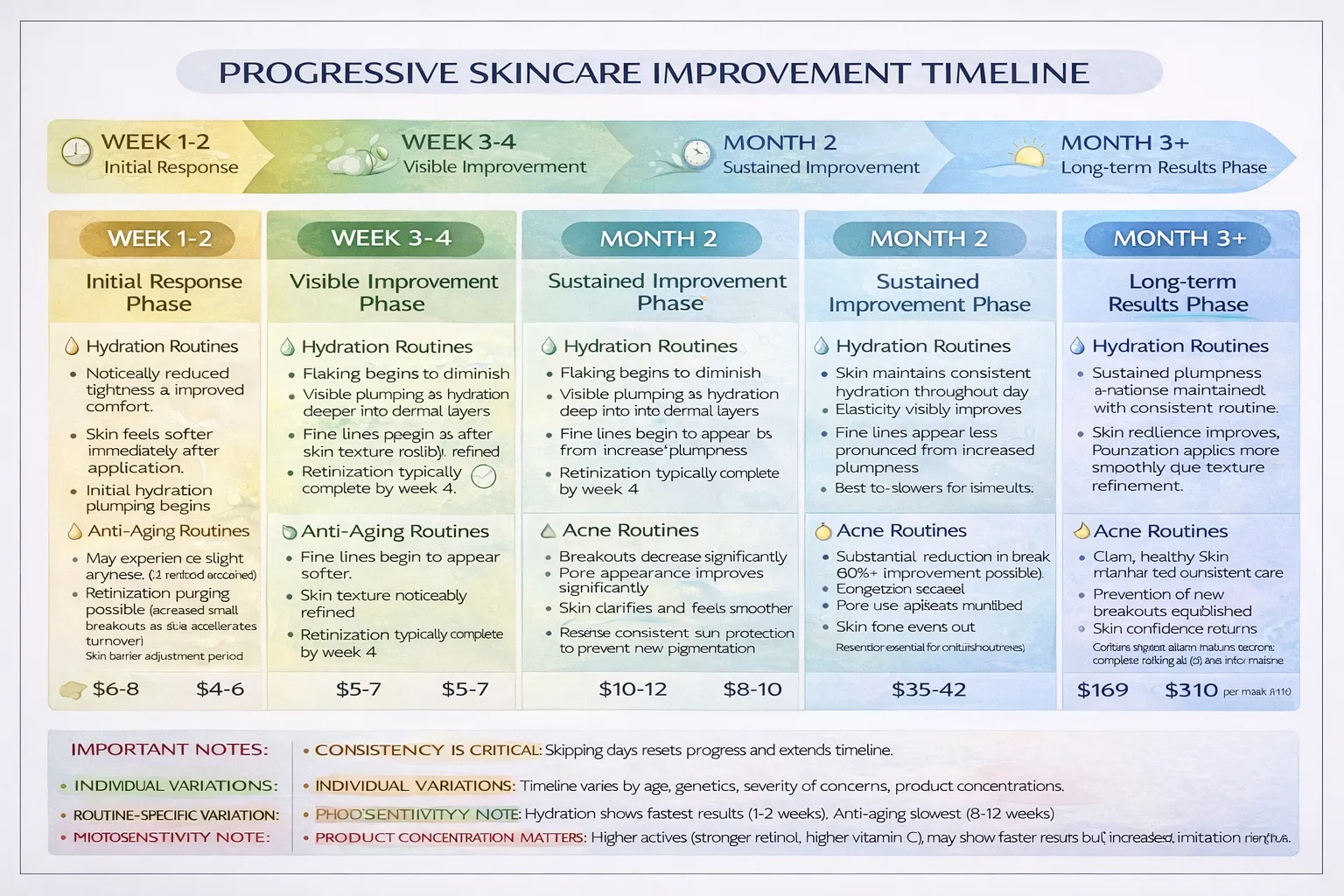
Skincare is a science-backed practice combining cleansing, hydration, targeted actives, and sun protection. The most effective routine is not the most complex-it’s the one you’ll use consistently that addresses your specific skin type and concerns.
Key Takeaways
- Identify your true skin type and build your foundation routine around it
- Hydration and barrier support are non-negotiable for all skin types
- Actives (retinol, exfoliants, vitamin C) deliver results when used correctly and consistently
- Sun protection is the single most important anti-aging step
- Consistency matters more than complexity-a simple routine done daily outperforms a complex routine done sporadically
- Allow 4–12 weeks for results, depending on the concern and ingredient
Your Next Steps
- Identify your skin type using the assessment method in Skincare Routines by Skin Type
- Choose your foundation routine (5 steps minimum) from the relevant skin type section
- Add one targeted active based on your primary concern (acne, aging, hyperpigmentation, etc.)
- Commit for 4–12 weeks without changing products-consistency is critical for visible results
- Track results with weekly photos to monitor progress and identify what works for your skin